Choosing the right metal fence post isn't some minor detail you can afford to overlook. It's the most critical decision you'll make for the strength, stability, and lifespan of your entire fence.
Think of them as the backbone. These posts are responsible for holding everything together, keeping wires taut, and standing firm against everything from leaning livestock to the harshest Aussie weather. Get this choice right, and your fence becomes a reliable asset for years. Get it wrong, and you're in for a future of constant repairs and headaches.
A fence is only ever as strong as its foundation. While the type of wire and the quality of the gates matter, it's the humble fence post that anchors the whole structure to the ground. It provides the stability needed to do its job, day in and day out. Making a smart choice from the very beginning will save you a world of time, money, and frustration down the track.
This guide is designed to give you practical, no-nonsense advice. We’ll cut through the jargon and break down everything you need to know, whether you're fencing a huge rural property, securing a commercial site, or just putting up a temporary barrier. The core principles of a solid foundation never change.
By the time you're done here, you’ll have a solid handle on:
This isn't just about buying posts; it's about making a smart investment. A poorly chosen post will lead to sagging wires, wobbly sections, and a fence that fails long before it should, forcing you to spend more on replacements and labour.
A quality metal fence post is a one-time investment in long-term security and peace of mind. It’s the difference between a fence that stands firm for decades and one that becomes a constant maintenance chore.
At Super Rack, we believe in supplying solutions that actually deliver value. With our commitment to superior quality materials, competitive AUD pricing, and fast delivery across Australia, you’re getting the best possible foundation for your project. And with our expert advice just a phone call away, you can be confident you’re making the right choice. Let’s get started.
Not all metal posts are made the same, and picking the right one is the key to building a fence that actually lasts. Think of the post as the backbone of your entire fence line—the right choice means decades of stability, while the wrong one can lead to sagging, rust, and costly headaches down the track.
Let's break down the common types you’ll find across Australia. We’ll look at what they’re good for and where they shine, without getting lost in technical jargon. Each one is built for a specific job, whether that’s keeping livestock in on a massive rural property or securing a busy construction site.
If you picture a classic Aussie farm fence, you’re thinking of galvanised steel posts. They are, without a doubt, the champions of rural and agricultural fencing, and for good reason. The galvanising process coats the steel in a layer of zinc, which acts as a tough, sacrificial barrier against rust.
This is what gives these posts their legendary durability, letting them stand up to decades of rain, sun, and humidity. For anyone with property in harsh Australian climates—from salty coastal air to the damp tropics—heavily galvanised steel is a smart, set-and-forget investment.
Powder-coated steel posts give you two benefits in one package: an extra layer of rock-solid protection and a much cleaner, more professional look. The process involves electrostatically applying a dry powder which is then baked on, forming a finish that’s much tougher than standard paint.
This hard-wearing coating offers fantastic resistance to chipping, scratching, and fading. It makes these posts a go-to choice for commercial properties, public parks, and event fencing where you need something that performs well and looks good.
You'll often see purpose-built posts for temporary jobs, like the metal posts used in Heras fence systems, which are designed to support heavy mesh banners for site security. It’s a great example of how different finishes are matched to specific, practical needs.
This concept map shows how the right fence post is central to achieving strength, a long lifespan, and overall value for your project.
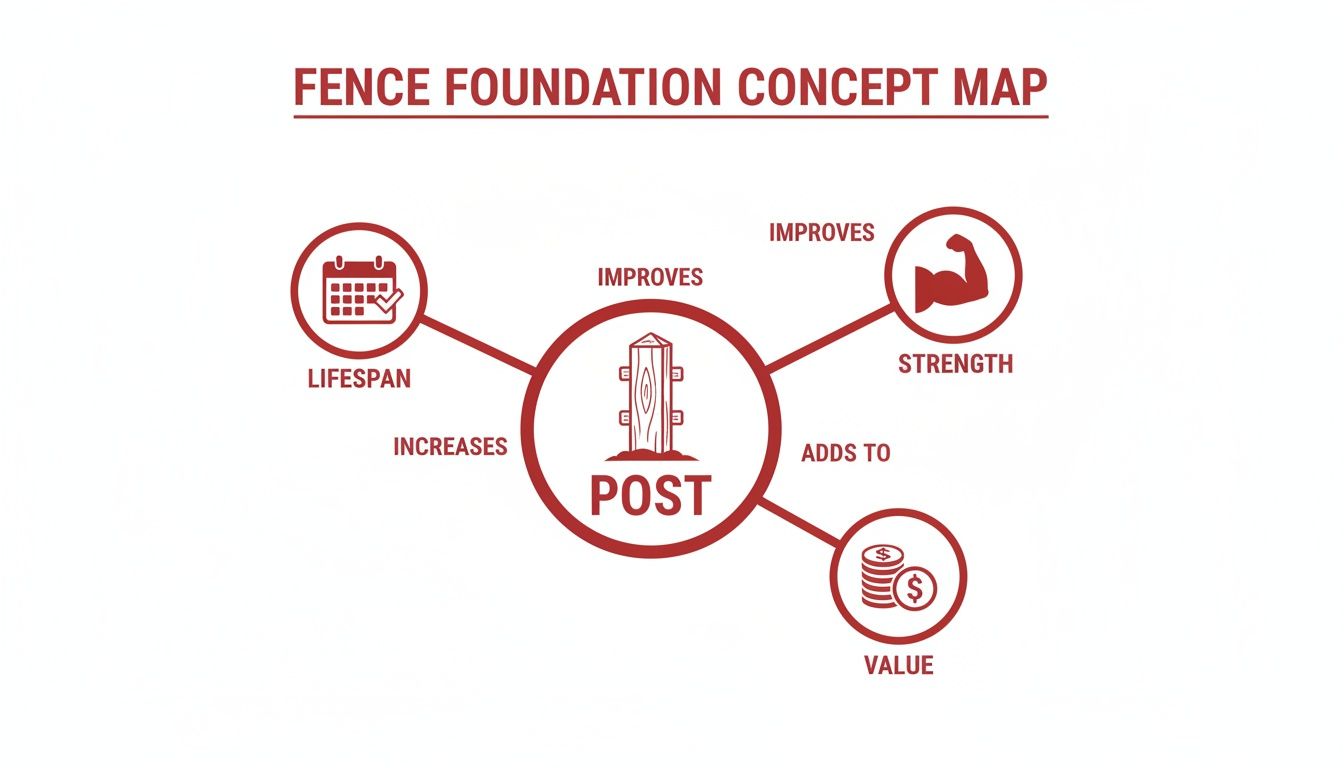
The main takeaway here is that these three benefits are all connected. A stronger post lasts longer, which directly boosts its long-term value.
Beyond the material and coating, the actual shape—or profile—of a metal fence post dictates how it works and where it should be used. Each profile has clear advantages.
T-Posts (Star Pickets): These are the absolute classic for intermediate posts in rural Australia. Their T-shape provides plenty of strength while using less steel, which makes them a super cost-effective option for long runs of fencing.
Round Posts: Generally heavier and stronger than star pickets, galvanised round posts are what you’ll use for strainer assemblies. Think corners, gates, and ends—anywhere the fence wires are pulled under high tension. Their smooth surface also means less risk of injury to livestock.
Square Posts (SHS/RHS): Square Hollow Section (SHS) or Rectangular Hollow Section (RHS) posts offer excellent structural strength and a clean, modern finish. They’re often the top pick for security fencing and are perfect for systems like Super Rack’s modular mesh panels, creating seriously strong and rigid barriers for construction sites and commercial yards.
By matching the post type—galvanised for durability, powder-coated for looks—and the right profile to your specific needs, you ensure your fence isn't just built, but built to last.
Making the right call starts with understanding these basic differences. At Super Rack, our team is always ready to give you expert advice to help you select the ideal post for your job, ensuring you get a solution that delivers on performance and value, all backed by our fast, nationwide delivery.
The lifespan of any metal fence post really boils down to two things: the quality of the steel it’s made from and, just as important, the protective finish shielding it from the elements. A great fence isn’t just about being strong on day one; it's about holding that strength for decades. That’s where the right materials and coatings make all the difference.
Think about it: an uncoated steel post left out in the rain is just asking for rust. Australia’s climate is incredibly tough on metal, with everything from scorching UV rays to salty coastal air and heavy downpours trying to break it down. Without a solid defence, corrosion is inevitable, and a rusty post is a weak post.
This is why investing in top-notch protection from the start isn’t an expense—it’s a massive saving in future repair bills and headaches.
When we talk about protecting steel, galvanising is the undisputed champ, especially for Aussie conditions. It’s a process where the steel post is dipped in molten zinc. This isn't just a lick of paint; it creates a metallurgical bond that provides rugged, long-lasting protection.
The magic of zinc is that it acts as a sacrificial layer. If the post gets scratched or scuffed, the zinc around the exposed area corrodes first, protecting the steel underneath. This "self-healing" property is what makes galvanised posts so incredibly tough and the go-to choice for rural fencing that needs to last generations.
A heavily galvanised post can handle constant exposure to moisture and harsh weather, making it a rock-solid foundation for your fence line. It's the reason you see old farm fences still standing strong after decades in the paddock.
While galvanising offers incredible corrosion resistance, powder coating adds another powerful layer of defence and a clean, professional finish. Think of it as tough, baked-on armour for your fence posts.
The process involves spraying a dry powder electrostatically onto the post, which is then cured under heat. This forms a hard finish that's much tougher than conventional paint, creating a solid barrier that seals the metal against moisture, chemicals, and UV damage that causes fading and chipping.
A powder-coated finish on a galvanised steel post gives you a dual-layer defence system. It combines the sacrificial protection of zinc with the tough, sealed barrier of the powder coat, creating the ultimate shield against the elements.
This combination is perfect for situations where both performance and appearance matter, like on commercial properties, construction sites, or public-facing security fences.
The right coating often comes down to your specific environment. The needs of a fence in a humid, coastal town are vastly different from one in a dry, inland region.
Coastal and High-Rainfall Areas: For properties near the coast, salty air is extremely corrosive. Here, a heavily galvanised finish is non-negotiable. A powder-coated galvanised post provides the best possible protection, stopping rust dead in its tracks.
Dry, Inland Farms: In drier parts of the country, a standard high-quality galvanised post is often more than enough to provide decades of reliable service for livestock fencing.
When looking at advanced protection, options like durable and flexible elastomer coatings show how specialised finishes can be tailored for extreme environments. Investing in a superior coating from a trusted supplier like Super Rack is a smart move. It ensures your fence remains a strong, reliable asset for years, saving you from the recurring costs and labour of replacing failed posts. Our expert team can provide practical advice to help you choose the perfect metal fence post for your project, backed by our competitive AUD pricing and fast, nationwide delivery.
A fence is constantly fighting a battle. It’s up against wire tension, strong winds, and sometimes, the sheer weight of livestock leaning against it. Choosing the correct metal fence post size and strength is what ensures your fence wins that battle, year after year.
Get this part wrong, and you're looking at a fence that sags, bends, or completely gives up the ghost when you need it most. It's not about over-engineering; it's about matching the right post to the right job. A lightweight post meant for a temporary barrier just won’t cut it when you're trying to contain a herd of cattle.
In any fence line, not all posts are created equal. Think of them as a team, with two key players doing very different jobs: strainer posts and intermediate posts. Understanding their roles is the first step to getting your fence right.
Strainer Posts: These are the heavy-hitters, the absolute anchors of your fence. You'll find them at corners, ends, and gates where they take on the immense tension from strained wires. They need to be incredibly strong and dug in deep, which is why they're always larger in diameter with thicker steel walls.
Intermediate Posts: These are the supporting cast, filling the gaps between the strainers. Their main job is to keep the wire at the right height and stop it from sagging. While they don't handle the same pulling forces as strainers, they still need enough backbone to handle pressure from animals and rough weather. Star pickets are a classic, cost-effective choice for intermediates in many rural jobs.
Think of it like this: strainer posts are the foundation pillars of a building, and intermediate posts are the supporting walls. The pillars do the heavy lifting to keep the whole structure standing, while the walls maintain its shape and integrity. Both are essential, but they serve very different purposes.
One of the most common mistakes we see is people choosing posts that are too short. A post's strength isn't just in its steel; it's in how securely it's anchored in the ground.
A good rule of thumb is to bury at least one-third of the post's total length.
Here's how that works in the real world:
Always figure out your desired above-ground height, then add at least half of that measurement for the part that goes underground. This simple bit of maths is what separates a long-lasting fence from a failed one.
The final piece of the puzzle is matching the post's strength to what you're asking it to do. The demands on a fence can vary wildly, and the posts have to be up to the task.
For instance, a fence designed to contain cattle has to be exceptionally tough. You'd be looking at heavy-duty, large-diameter galvanised strainer posts and strong intermediate posts to handle the serious pressure. For robust stockyards, you would use components from our heavy-duty cattle panels and gates to make sure the entire system is rock-solid.
On the other hand, a lightweight temporary barrier for crowd control at an event doesn't need anywhere near that level of strength. Lighter, more economical posts from our temporary fencing solutions will do the job perfectly.
By carefully considering the different roles of your posts, calculating the right height for a deep anchor, and matching strength to the application, you'll build a fence that is both cost-effective and built to last. At Super Rack, we stock a huge range of post sizes and strengths, and our experts are always here to give you practical advice to make sure you get the right metal fence post for your project.
A top-quality metal fence post is only as good as its installation. You can buy the best steel on the market, but putting it in the ground correctly is what turns a pile of posts into a strong, reliable fence that’ll last for years.
Get the technique right, and your posts will stay upright and your wires will stay tight. This guide will walk you through the essentials, from how deep to bury your posts to how far apart to space them, so you can plan a layout that delivers a professional result.
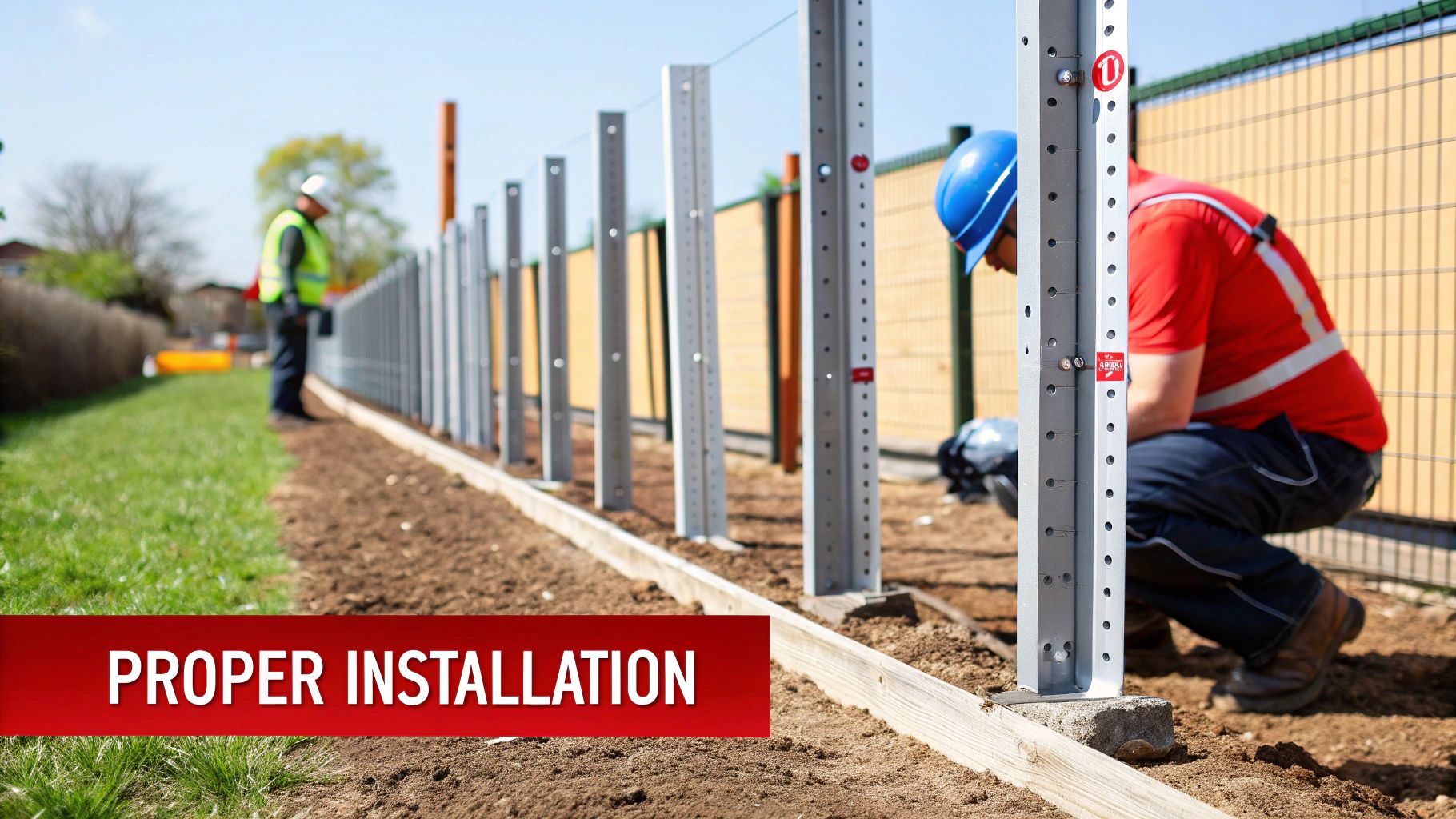
When it comes to getting your posts in the ground, you’ve got two main options. Each has its place in the fenceline.
Driving Posts: This is the quickest way to install your intermediate posts—the ones that make up the long runs of your fence. Using a manual or pneumatic post driver, you simply hammer the post straight into the ground. The soil’s natural compaction grips the post, holding it firm. It’s perfect for rural fencing where you've got a lot of ground to cover.
Concreting Posts: For strainer posts, concreting is non-negotiable. These are the critical anchor points at corners, ends, and gates that take all the strain. They need a solid concrete footing to stop them from pulling out of the ground or leaning under tension. A good concrete foundation is what keeps the entire fence tight and secure.
How deep you bury your posts is probably the single most important factor for a stable fence. A shallow post will just wobble and fail over time.
As a rule of thumb, always bury at least one-third of the post's total length in the ground. This gives it enough leverage below ground to resist forces like wind, wire tension, and livestock pushing against it.
So, if you want a finished fence that’s 1.2 metres high, you’ll need a post that's at least 1.8 metres long. That way, you can sink a solid 60 cm into the ground for a really secure anchor.
Correct spacing is all about balancing strength with cost. Closer posts mean a stronger fence, but it also means buying more posts. The ideal distance really comes down to a couple of key things.
Terrain: On flat, even ground, you can get away with wider spacing. But if you’re fencing hilly or undulating country, you’ll need to place your posts closer together to follow the contours of the land and keep the wire at a consistent height.
Fence Purpose: For a high-pressure livestock fence for cattle, spacing your intermediate posts 4 to 5 metres apart is a good standard. For lower-pressure jobs, like a sheep fence or a temporary barrier, you can often stretch that out to 6 metres or more.
In Australia, steel fence posts play a huge role in both commercial and industrial projects. The commercial fencing market here was valued at over $320 million AUD in the mid-2020s and is tipped to grow. Metal fences are a big slice of that pie, prized for their durability. You can read the full research on Australia's commercial and industrial fencing market for more insights.
With the right installation methods and a bit of planning, your fence will be a strong, dependable asset for years to come. If you need expert advice on your specific project, don’t hesitate to contact the team at Super Rack. We’re here to help.
When you're budgeting for a new fence, it’s easy to focus on the price of a single metal fence post. But grabbing the cheapest option off the shelf rarely pays off. To make a smart investment, you need to look at what's really driving the cost.
The price tag on a post comes down to a few key things: the grade of steel used, its size (height, diameter, and wall thickness), and the quality of the protective coating. A thick, heavy-duty post made from high-grade steel with a generous galvanised finish will always cost more upfront than a shorter, thinner post with a light coating. And for good reason.
The real trick to smart budgeting is to think about the 'whole-of-life' cost. This isn’t just what you pay today in AUD; it’s the total cost over the entire life of your fence.
That cheaper, thinly coated post might save you a few bucks right now, but it's far more likely to rust and fail within a few years, especially out in the harsh Aussie weather. Before you know it, you're paying for replacement posts all over again, not to mention the time and hassle of ripping out the old ones to put new ones in. Suddenly, that initial "saving" doesn't look so smart.
Investing a little more in a high-quality, durable post from a trusted supplier like Super Rack is the most cost-effective decision you can make. It provides better long-term value, turning your fence into a reliable asset, not a recurring expense.
It's no surprise that the demand for quality metal fencing is on the rise. In fact, the Australian fencing market is growing steadily, with metal prized for its long-term value and durability. This shows that more people are recognising the benefits of investing in a fence that's built to last.
When you choose a high-quality metal fence post, you're really buying peace of mind. A strong, well-coated post ensures your fence stays standing for years, saving you from the headache and expense of early replacements.
At Super Rack, our focus is on providing superior quality products that deliver genuine value. Our posts are built to last, with competitive AUD pricing and fast, nationwide delivery to get your project moving. Our expert team is always here to offer practical advice, helping you choose the right post to protect your investment for the long haul.
Got questions about picking and installing metal fence posts? You're not alone. Here are some clear, no-nonsense answers to the questions we get asked all the time.
For a standard rural fence using high-tensile wire, a good rule of thumb is to space your intermediate posts 4 to 6 metres apart. This is a solid starting point, but you might need to adjust it depending on the lay of the land and what kind of animals you're keeping in.
Just remember, your strainer posts—the ones at the corners and ends—are the real anchors of the whole fence line. Their placement is dictated by your fence's layout, not a set spacing. While stretching the distance between posts can save a few dollars upfront, putting them closer together always results in a stronger, longer-lasting fence.
That really depends on what job the post is doing. For your main strainer posts (the ones at corners, ends, and gates), the answer is always yes. These posts take all the strain from the tightened wires, and concreting them in is non-negotiable if you want to stop them from leaning or pulling out of the ground.
For the intermediate "line" posts in between, driving them straight into firm soil is usually more than enough. It's a lot faster and more budget-friendly. The exception is if you're dealing with really soft, sandy, or loose ground—in that case, you might need to concrete a few more posts to give the fence line some extra stability.
Here’s a simple guideline that has never failed: bury at least one-third of the post's total length. Following this rule ensures your post is properly anchored, giving it the stability it needs to hold your fence straight and true for years to come.
So, if you want your finished fence to stand 1.2 metres tall, you’ll need a post that's at least 1.8 metres long. That gives you a solid 60 cm buried firmly in the ground where it counts.
For most Aussie farms, you can't go past heavily galvanised steel posts. They deliver the brute strength needed for rural applications and have the best defence against corrosion from our tough, unpredictable weather.
When it comes to intermediate posts, star pickets are a popular, cost-effective workhorse. But for the all-important strainer assemblies that have to withstand serious tension, you absolutely need to step up to heavier galvanised round or square steel posts. They’re the backbone of a reliable fence.
A fence is only as strong as its foundation. To make sure yours stands the test of time, trust Super Rack. We supply superior quality, durable metal fence posts built specifically for Australian conditions.
Explore our full range of fencing solutions and get expert advice for your project today!
