Choosing the right farm gate size is a crucial decision for any Aussie property. It’s one of those things that directly impacts your daily workflow, security, and how you manage livestock. This is about more than just filling a gap in a fence line; getting it right ensures you have smooth access for machinery and reliable containment for animals, saving you from costly mistakes and daily headaches.
Picking a farm gate can feel like a pretty straightforward job, but the real-world consequences of getting the size wrong can create some serious logistical nightmares. It’s a choice that affects how efficiently your property runs, every single day.
Just picture the frustration of trying to squeeze a brand-new header or air seeder through a main gate that’s only a few centimetres too narrow. It’s not just a minor inconvenience; this is how you end up with damaged equipment, busted gate posts, and big delays right in the middle of your busiest season.
On the other hand, a gate that’s way too wide for its job can become a real liability. It’s more likely to sag over time, scrape along the ground, and become a back-breaker to open and close.
On any working Aussie farm, a single gate size is never going to cut it. Your property has all sorts of different access points, each with its own job to do, and that calls for a variety of gate sizes to match.
Getting the farm gate size right from the start is a direct investment in efficiency and safety. A well-planned system of gates saves time, cuts down on stress for both people and animals, and protects your valuable machinery.
At the end of the day, picking the right dimensions is about future-proofing your operation. Here at Super Rack, we know that a high-quality, properly sized gate is non-negotiable. Our galvanised steel gates are built tough to handle the Australian climate, offering superior quality at a competitive price. With fast, nationwide delivery and expert advice from our team, we’ll help make sure your investment boosts efficiency and adds to the safety of your property.
Picking the right farm gate isn't a one-size-fits-all job. A well-run property needs a mix of sizes, each chosen for a specific task—from a simple walkway you use every day to a main entrance that has to handle the biggest machinery you own.
Thinking about these common sizes in real-world terms helps you picture exactly where each one fits on your own place. Let's break down the most popular options you'll find on Aussie farms.
For nipping through on foot or moving small gear, you don't need a huge, heavy gate.
1.2m Gates (4ft): Often called 'man gates', these are perfect for high-traffic walkways. Think about the path to your homestead garden, a side gate on a shed, or the entry to your chook pens. They're lightweight, easy to swing open with one hand, and just make life easier in spots you're in and out of all day.
1.8m to 2.4m Gates (6ft to 8ft): A bit wider, these gates are spot-on for getting the ride-on mower, quad bike, or a loaded wheelbarrow through. They give you more room to move without the bulk of a full vehicle gate, making them a smart choice for laneways between paddocks or smaller utility yards.
This is the sweet spot for most farm gates. They need to be wide enough for daily workhorses like your ute and tractor without being ridiculously oversized for the job.
The 3.6m gate (12ft) is the undisputed champion of Australian farm gates. It’s versatile and gives you plenty of room for most standard tractors, utes, and trailers. This is the go-to size for most paddock entrances and internal roadways where you're constantly moving stock or equipment.
If you want a little extra breathing room, stepping up to a 4.2m gate (14ft) is a brilliant move. It provides that extra bit of comfort for wider implements or for those less confident backing a trailer through a tight spot.
Modern farming runs on bigger, more efficient gear. Your main access points have to be able to handle these machines without creating a bottleneck or, even worse, causing some very expensive damage.
4.8m Gates (16ft): This width is quickly becoming the new standard on properties running larger, modern equipment. It’ll comfortably fit most headers, air seeders, and sprayers, making it a wise investment for main paddock entries off your central laneway.
6.0m Gates (20ft): Reserved for your widest access points, a 6.0m gate is a must-have for combine harvesters, large tillage equipment, and B-double truck access. Putting one of these at your main property entrance and along major internal transport routes is a smart way to future-proof your operation.
A critical factor for any gate, no matter the size, is the material. Australia's climate is brutal on steel, so choosing a heavy-duty, hot-dip galvanised gate is non-negotiable. This process gives it a thick, protective zinc coating that fights off rust for decades, making sure your investment stands up to the elements.
At Super Rack, we know that what you're really buying is durability. Our gates are engineered to last, offering superior quality at a price that makes sense. When you're planning out your fencing, remember that the right combination of gates, posts, and panels is what creates a truly reliable system. For instance, pairing well-sized gates with tough, purpose-built fencing like our sheep panels ensures you have a secure and efficient setup for managing your stock.
Getting the measurement right is the single most important step for a hassle-free gate installation. A few minutes with a tape measure now will save you from a world of headaches later, guaranteeing your new gate fits and swings perfectly from day one.
One of the biggest mix-ups we see is what "farm gate size" actually refers to. When you buy a gate advertised as 3.6 metres, that's the length of the physical gate leaf itself. It's not the total opening it’s designed to fit. Getting this straight is key to ordering the right product.
First things first, you need to measure the clear distance between the inside faces of your two gate posts.
Grab a good tape measure and run it straight across the gap, from the inside surface of one post to the inside surface of the other. It's a good idea to take this measurement at both the top and bottom of the posts. If the numbers are a bit different, it just means your posts aren’t perfectly plumb (straight). No stress—just use the smaller of the two measurements as your working number.
A gate can't be an exact fit; it needs a bit of wiggle room to swing without grinding against the posts. This gap is called clearance, and it allows space for the hinge gudgeons and the latch to operate smoothly.
For most standard farm gate hardware, allowing for 50mm to 100mm of total clearance is a safe bet. This gives you plenty of space for the hardware to function correctly without binding up.
Here’s a practical example: Say the clear opening between your posts measures 3700mm. To find the right gate size, you just subtract your planned clearance. If we allow for a generous 100mm of clearance (3700mm – 100mm), we’re left with 3600mm. That means a standard 3.6m (or 12ft) farm gate is the perfect fit.
This quick visual guide shows how different gate sizes line up with the equipment they need to let through, from a simple pedestrian gate to one wide enough for the biggest machinery.
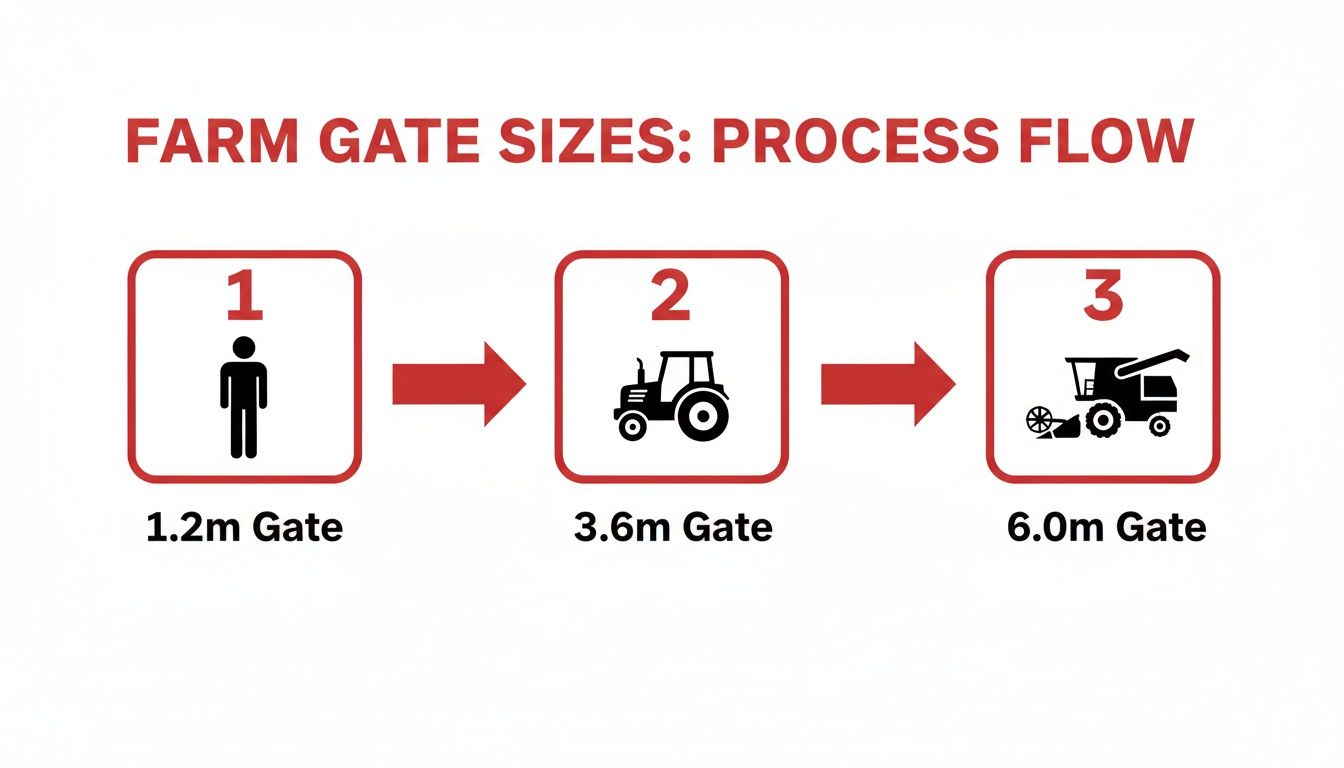
As you can see, matching the gate to its job is common sense, ensuring everything from a person to a combine harvester can pass through without a fuss.
While width gets all the attention, gate height is just as critical, especially when you're trying to keep livestock in.
The standard Aussie farm gate height is around 1.17 metres. This is generally spot-on for most cattle and all-purpose boundary fences.
However, if you're dealing with animals known for their high-jumping antics, like certain sheep breeds or goats, you'll want to look for a taller gate. The same goes for high-pressure situations, like handling bulls or flighty horses in yards—a taller, more imposing gate is a must for keeping everyone safely contained. The best approach is to simply match the gate height to your existing fence line to maintain a secure perimeter.
One of the biggest mistakes we see Aussie farmers make is choosing a gate size for the tractor they have today, not the one they’ll need tomorrow. It's a classic case of short-term thinking. Machinery only seems to get wider, so future-proofing your property’s main access points is absolutely critical.
Planning for your largest equipment goes far beyond just the width of the machine itself. You have to account for essential clearance on either side. Think about the extended side mirrors on a new tractor, the full span of spray booms, or the extra room needed for a front-end loader. A gate that’s a tight squeeze today could become a complete roadblock after your next equipment upgrade, forcing a costly and frustrating replacement.
You also need to think about the other vehicles that need to get onto your property. What about a B-double truck delivering feed or fertiliser? Those rigs need a massive turning circle to get in and out safely without tearing up your fences or the gate itself. A narrow entrance can turn a simple delivery into a logistical nightmare.
The same goes for modern harvesters. Their sheer size requires a generous opening, not just for straight-line access but for navigating the turn off the main road. The golden rule is to always plan your farm gate size with the absolute largest possible vehicle in mind.
The rule of thumb is this: measure your widest piece of equipment and add at least 1.5 to 2 metres of clearance. This buffer zone accounts for turning angles, attachments, and mirrors, ensuring you never have to hold your breath while squeezing through.
For those really wide entry points, a double-gate system is almost always a smarter solution than one enormous single gate. A single 6-metre gate is incredibly heavy. All that weight puts immense strain on its hinges and post over time, which inevitably leads to sagging.
A double-gate configuration—using two 3-metre gates, for example—is far more practical.
This approach gives you the best of both worlds: everyday convenience and maximum clearance when it really counts. Planning for large vehicle access isn't just a farm problem, either. You see the same logic in commercial settings, like the carefully designed sliding gate at Unilever’s main entry for trucks and service vehicles, which shows just how crucial this kind of forward-thinking is for operational efficiency.
When you're working with livestock, the right gate is more than just a barrier—it’s a critical tool for low-stress stock handling. A well-chosen gate keeps animals calm and moving smoothly, which is a game-changer for safety, both for them and for you.
Of course, the "right" gate depends entirely on what you're running. Getting the size and style spot-on can be the difference between a frustrating day in the yards and an efficient, productive one.
Containment is your number one priority with smaller animals like sheep, goats, or even calves. This is where mesh-infilled gates are an absolute non-negotiable. Their smaller apertures stop lambs or kids from squeezing through, a classic headache with standard 5-bar gates.
Think about drafting ewes and lambs. A solid mesh gate in the laneway prevents lambs from getting separated from the mob, which cuts down on stress and saves you chasing strays. The standard 1.17m height is plenty for most sheep breeds.
Cattle are a whole different ball game. They put far more pressure on fences and gates, especially in high-traffic zones like cattle yards, forcing pens, and laneways.
For these spots, you need gates that are not just taller but significantly stronger. Here’s what to look for:
A well-placed, heavy-duty gate in a laneway can transform your stock flow. Animals move forward with more confidence when they see a clear, secure path ahead, rather than baulking at something that looks flimsy.
Remember, a gate is only as good as the fence it’s attached to. Pairing strong gates with equally durable fencing, like quality cattle panels, is how you create a handling facility that's truly reliable.
Finally, don’t forget about usability. A tough, easy-to-use latch you can work quickly from horseback or the ute isn’t a luxury—it’s essential. At Super Rack, we get these practical needs. We supply top-quality farm gates built for Australian conditions, ensuring they make your job easier, safer, and more efficient.
Even the best-made, perfectly sized farm gate is set to fail if it’s not installed properly. A rock-solid installation is what turns a good gate into a great one—something that’ll give you decades of hassle-free, sag-free use. And getting it right really boils down to one thing: the posts.
Think about it—the entire weight of your gate, especially a wider one, puts constant strain on the post it hangs from. If that post isn’t up to the job, the gate will inevitably start to drop, scrape the ground, and become an absolute nightmare to open and close.
Your gate posts are the foundation of the whole setup. The hinge post, in particular, takes the full load, so it needs to be chosen and set with real care.
A bit of extra effort spent on your posts pays dividends for years to come. Setting them in concrete is non-negotiable for a long-lasting job. It locks the post in place and provides a rigid anchor that won’t budge under the gate’s weight.
Once your posts are in and the concrete has cured, it's time to hang the gate.
Grab a spirit level to make sure the gate is perfectly horizontal. You can then adjust the threaded gudgeons on your hinges to get the ground clearance just right—high enough to clear any lumps and bumps in the driveway but not so high that small stock can sneak underneath.
The latch post is just as important. It has to be positioned so the gate closes securely without you having to lift it or force it shut. When a latch lines up perfectly, it takes the strain off the hinges and the hinge post when the gate is closed, which all contributes to its longevity. A well-installed gate is part of a complete fencing system, and for creating versatile enclosures or yards, you might find that combining gates with other solutions like modular mesh panels can greatly improve your property's functionality.
Ready to find the perfect gate for your property? Browse our full range of durable, galvanised farm gates at Super Rack or contact our expert team for personalised advice on sizing and installation. We deliver nationwide.
