Picking the right trolleys for warehouse work is one of those decisions that quietly makes or breaks your daily efficiency. It’s about more than just moving things from A to B. A good trolley saves backs, speeds up workflows, and protects your valuable stock from damage.
In Australia’s booming logistics and e-commerce scene, every second counts. The right trolley isn’t just a piece of gear; it’s a critical tool for keeping your operation humming. Using the wrong one is like trying to hammer a nail with a screwdriver – you’ll get there eventually, but it’ll be slow, frustrating, and maybe even dangerous.
The impact ripples through your entire day, from unloading trucks to picking orders for dispatch. And with the Australian warehouse market valued at around AUD 44.45 billion and growing fast, getting material handling right is more important than ever. You can discover more insights from the Australia Warehouse Market Report to see just how big the demand is.
Investing in quality, task-specific trolleys pays off in ways you’ll see across the whole operation. It’s all about creating a smarter, safer, and more productive environment for your team.
Here’s what a good trolley brings to the floor:
At Super Rack, we see a quality trolley as a fundamental building block of an efficient warehouse. It’s an investment that pays for itself through improved performance and safety, all backed by our expert advice and fast, nationwide delivery.
Once you get these basics, it’s clear that choosing the right trolleys for warehouse use is a strategic move. This guide will walk you through the different types, key features, and safety tips to help you pick the perfect trolley to drive your success.
Using the right trolley for the right job is the fastest way to get things done efficiently in your warehouse. It's common sense, really. You wouldn't use a fork for soup, and you definitely shouldn't grab a hand truck to move a full pallet. Every type of warehouse trolley is engineered for a specific job, and knowing which is which is fundamental to a smooth operation.
This decision-making flowchart breaks it down, guiding you based on what you’re actually moving.
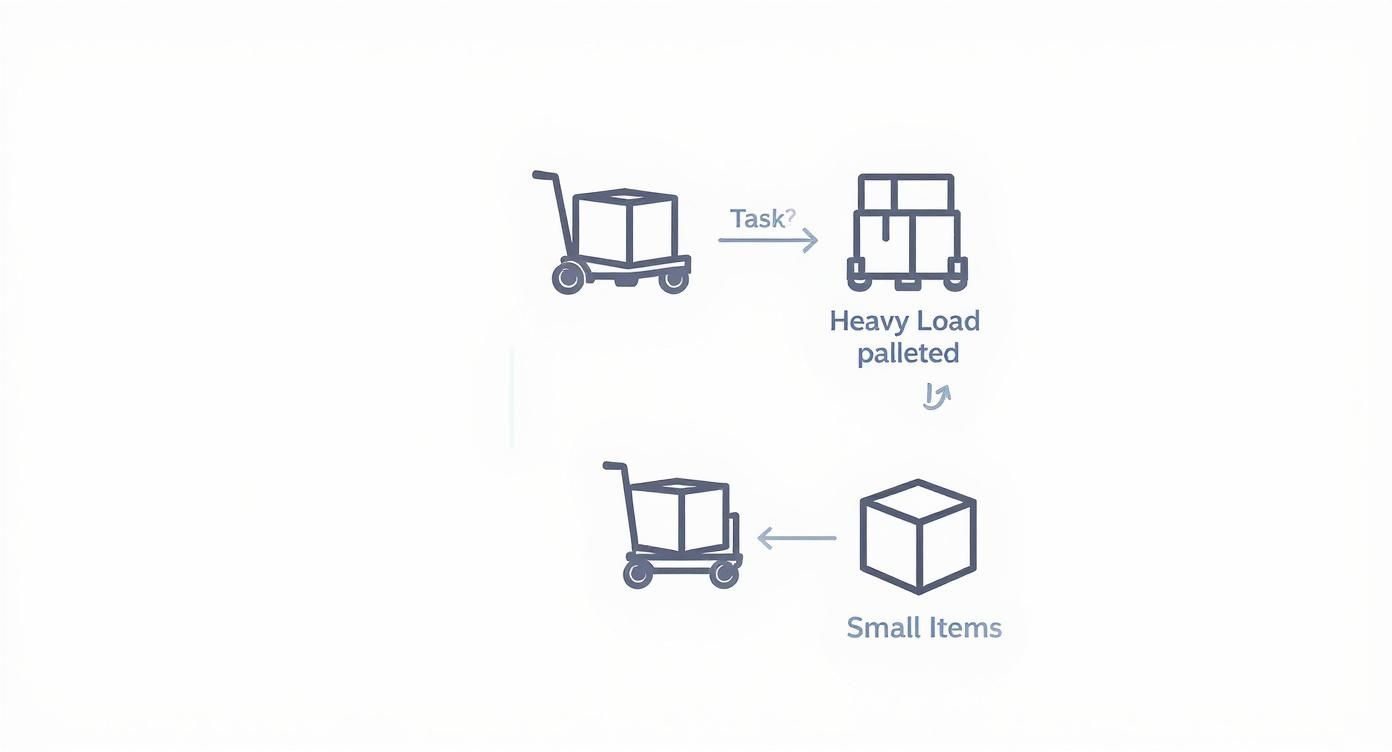
The first question is always about the task at hand: are you shifting big, palletised goods, or are you moving smaller, individual items? Just answering that simple question will cut your options down in a big way.
Platform trolleys are the real workhorses in most Aussie warehouses. With their simple flat deck on wheels, they are incredibly versatile for moving just about anything—from incoming stock in boxes to outbound orders ready for dispatch. Their biggest strength is their simplicity and their ability to handle bulky or awkwardly shaped items that just won't sit right on other gear.
For example, a furniture warehouse could use a large, heavy-duty platform trolley to shift flat-pack chairs from the receiving dock to the storage racks. On the other hand, a small parts supplier might use a multi-tiered platform trolley to ferry several organised tubs in one go, saving a heap of time.
When you need to get through tight spots, a hand truck (often called a sack truck) is your best mate. Its upright design and tiny footprint make it perfect for weaving through narrow aisles, getting into the back of a delivery van, or moving stacked cartons in a cramped stockroom.
They're a must-have for last-mile delivery drivers or any warehouse staff who need to move things vertically, like stacking boxes onto a shelf or loading them onto a truck.
Pro Tip: If you're regularly moving goods up and down steps, look for hand trucks with stair-climber wheels. This simple feature makes a massive difference to operator safety and gets the job done much faster.
For anything and everything that arrives on a pallet, a pallet jack is non-negotiable. These are essential trolleys for warehouse operations that handle bulk goods. They let a single person lift and move loads weighing up to a couple of tonnes with hardly any physical strain, which is a game-changer for productivity and injury prevention.
Just picture your team trying to unload a truck packed with palletised goods without one. It would be an incredibly slow and dangerous job. A pallet jack turns that nightmare into a quick, straightforward task.
Lifting heavy items from the floor to a workbench or shelf is a classic recipe for a bad back. A scissor lift trolley solves this problem by combining transport with a height-adjustable platform. An operator can load a heavy motor or a bulky box onto the trolley at ground level, wheel it over, and then raise it to the exact height needed.
This completely gets rid of awkward bending and lifting, turning a two-person struggle into a safe and quick one-person job. If you want to see how they can improve workplace safety, Super Rack has a fantastic range of durable and easy-to-use hydraulic lifting trolleys.
Beyond the usual suspects, there are plenty of specialised trolleys out there designed to solve very specific problems:
Once you’ve settled on the right type of trolleys for warehouse work, it’s time to zoom in on the details. These are the features that separate a trolley that simply gets the job done from one that becomes a reliable workhorse for years to come. Think of it as a long-term investment in equipment that’s safe, tough, and easy for your team to handle day in, day out.
Let's break down the three core elements that truly make a quality trolley: its load capacity, what it's made of, and the wheels it rolls on. Get these right, and you've got an asset, not a future headache.
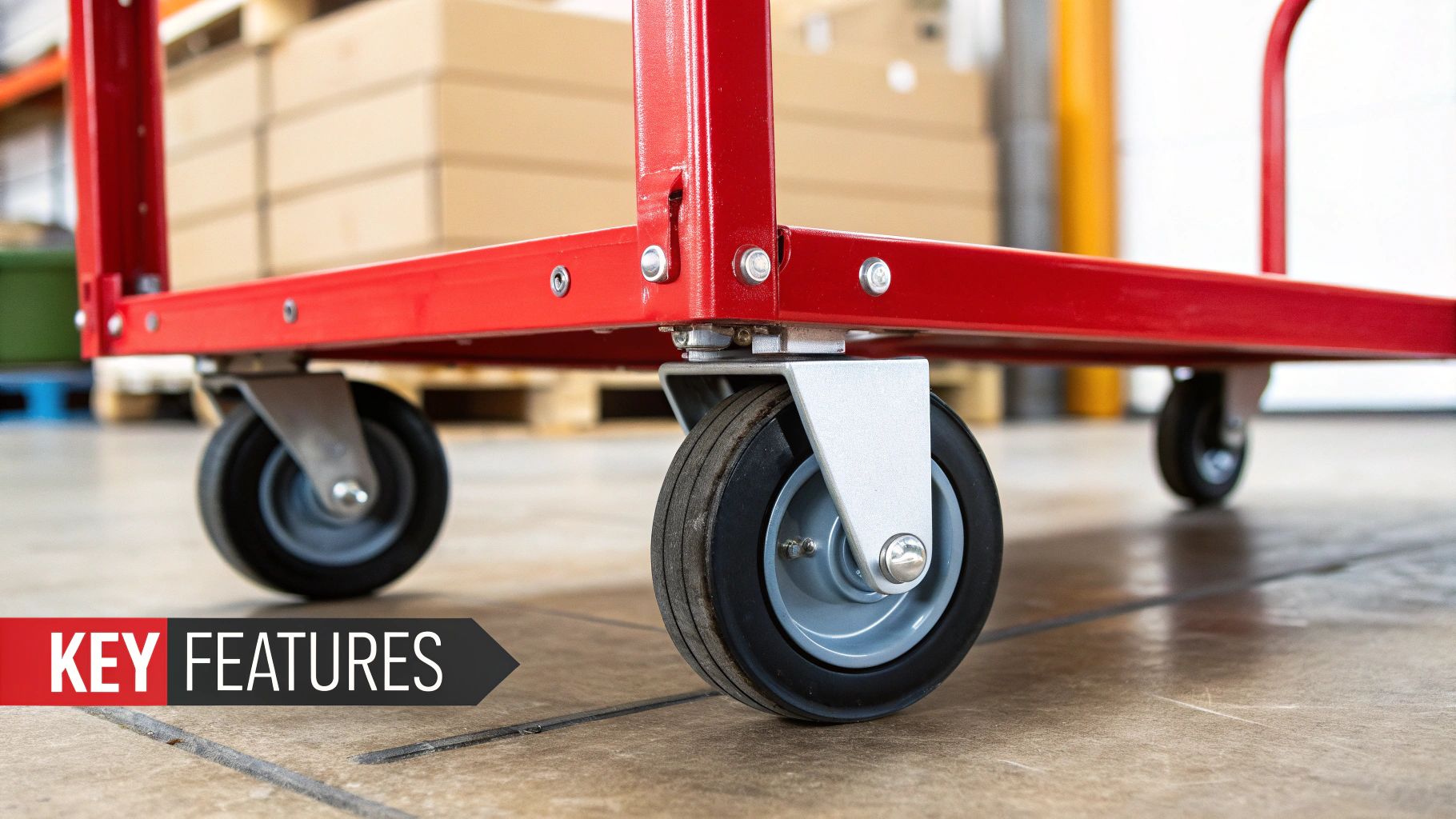
If there's one spec you can't afford to ignore, it’s the load capacity, often called the Safe Working Load (SWL). This isn't just a friendly suggestion; it's a hard safety limit. Pushing a trolley beyond its SWL is the fastest way to cause a catastrophic failure, which could mean damaged stock and, far worse, serious injuries.
Always pick a trolley with a capacity that comfortably handles your heaviest typical loads. A solid rule of thumb is to calculate your maximum load and then add a 25% safety buffer. So, if you're regularly moving crates weighing up to 300 kg, you need a trolley rated for at least 375 kg. It's a simple calculation that ensures safety and longevity.
What a trolley is made from directly impacts its strength, weight, and how long it'll last. For the rough-and-tumble reality of most warehouses, industrial-grade steel is the undisputed champion. It offers brute strength and incredible impact resistance, making it ideal for demanding environments. That’s why Super Rack trolleys are built with superior quality steel—to withstand the daily grind.
But steel can be heavy. In situations where you need something more portable or are working in a corrosive environment, aluminium or high-density plastic are fantastic alternatives. Aluminium offers a great strength-to-weight ratio, while plastic is brilliant for resisting rust and chemicals.
A trolley is only as good as its wheels. Seriously. The right wheels make all the difference, ensuring smooth rolling, protecting your floors from scuffs, and making the trolley feel effortless to push.
Here’s what you need to look at:
Selecting the right combination of features has become a major focus in Australia. The local market is seeing a clear shift towards more durable and ergonomic designs that prioritise worker safety and productivity. You can read more about these Australian market trends to understand the move towards higher-quality equipment.
Nailing these key features—capacity, materials, and wheels—ensures you end up with a trolley that’s not just fit for purpose but is also a safe, dependable tool for your crew. This attention to detail is what Super Rack is all about, offering competitively priced, superior quality equipment with fast, nationwide delivery.
Having the best equipment is only one piece of the puzzle. An efficient warehouse is always a safe one. This is where we move beyond the hardware and focus on the human element—the safety protocols and daily habits that protect both your team and your bottom line.
Creating a culture of safety isn't just about ticking boxes; it turns using trolleys for warehouse operations from a routine chore into a professional skill. It's a key part of any comprehensive guide to employee safety in the workplace, and at Super Rack, we know that top-tier equipment and safe practices go hand-in-hand.
When you're choosing trolleys, it's the small design details that make a massive difference to an operator's comfort and safety over a long shift. Look for features that are designed to reduce physical strain and improve control.
Here are the key ergonomic features to watch for:
These features aren't just "nice-to-haves"—they're essential investments in your team's wellbeing and overall productivity.
Proper training is critical. Simple, consistent rules drilled into daily habits can dramatically slash the risk of accidents and injuries on the floor.
Start by enforcing these practical, commonsense techniques:
A proactive safety culture goes beyond just the equipment in motion. It includes how you maintain your entire storage system. Just as you check your trolleys, regular, professional inspections of your racking are vital for preventing major structural failures. To ensure your whole setup is secure, it's worth learning more about the importance of professional pallet racking inspections.
At the end of the day, safety is a mindset, not just a checklist. Encourage your team to speak up and report any equipment faults immediately, whether it’s a wobbly wheel or a brake that feels a bit soft.
Make safety a shared responsibility where everyone is actively looking out for each other. By combining ergonomically designed equipment from Super Rack with consistent training and a vigilant team, you build a warehouse environment that's not only productive but fundamentally safe. It's an investment that protects your most valuable asset: your people.
Buying a quality trolley for warehouse use is one thing, but how long it lasts comes down to how well you look after it. A trolley that’s properly maintained isn't just a reliable tool; it’s a smart investment that saves you serious money by avoiding costly breakdowns and early replacements.
The best way to keep your fleet in top shape is with a simple, regular maintenance routine. It doesn't have to be complicated. A proactive schedule that your team can actually follow is all it takes to catch small issues before they snowball into big, expensive headaches. This hands-on approach is the perfect partner to the durability we build into Super Rack equipment, which is designed to work hard for years with the right care.
A consistent maintenance plan keeps your trolleys ready for action, shores up safety standards, and cuts down on frustrating downtime. The easiest way to manage this is to split your checks into daily and weekly tasks.
Daily Visual Checks (Before Each Use):
Weekly Function Checks:
Turning these simple checks into a daily habit builds a culture of care and responsibility. This proactive mindset doesn't just make your trolleys last longer—it reinforces your commitment to keeping everyone on your team safe.
Looking down the road, technology is starting to change how we handle equipment upkeep. We’re seeing more smart trolleys with sensors that help cut down on manual work and sharpen up inventory counts. While these systems are still evolving, they point towards a future of predictive maintenance, where a trolley might just tell you it has a problem before it actually breaks. If you want to get a clearer picture of this trend, you can learn more about the evolution of the storage trolley market and see where the technology is heading.
But for now, a hands-on approach is still your best bet. Don't forget proper storage, either—keep your trolleys in a designated, dry spot away from forklift paths to prevent accidental bumps and dings. Combine this straightforward maintenance plan with quality Super Rack gear, and you’ll ensure your investment pays off for years to come.
Your storage systems and your material handling gear should work together in perfect harmony, not fight for space. To get a truly productive warehouse humming, you need to choose trolleys for warehouse operations that fit seamlessly with your racking. This creates a single, unified ecosystem where goods flow smoothly from A to B, slashing wasted time and effort.
At Super Rack, we design our storage solutions with this exact principle in mind. By planning for compatibility from the get-go, you can build a workflow that makes the most of your space, cuts down handling time, and seriously boosts productivity.
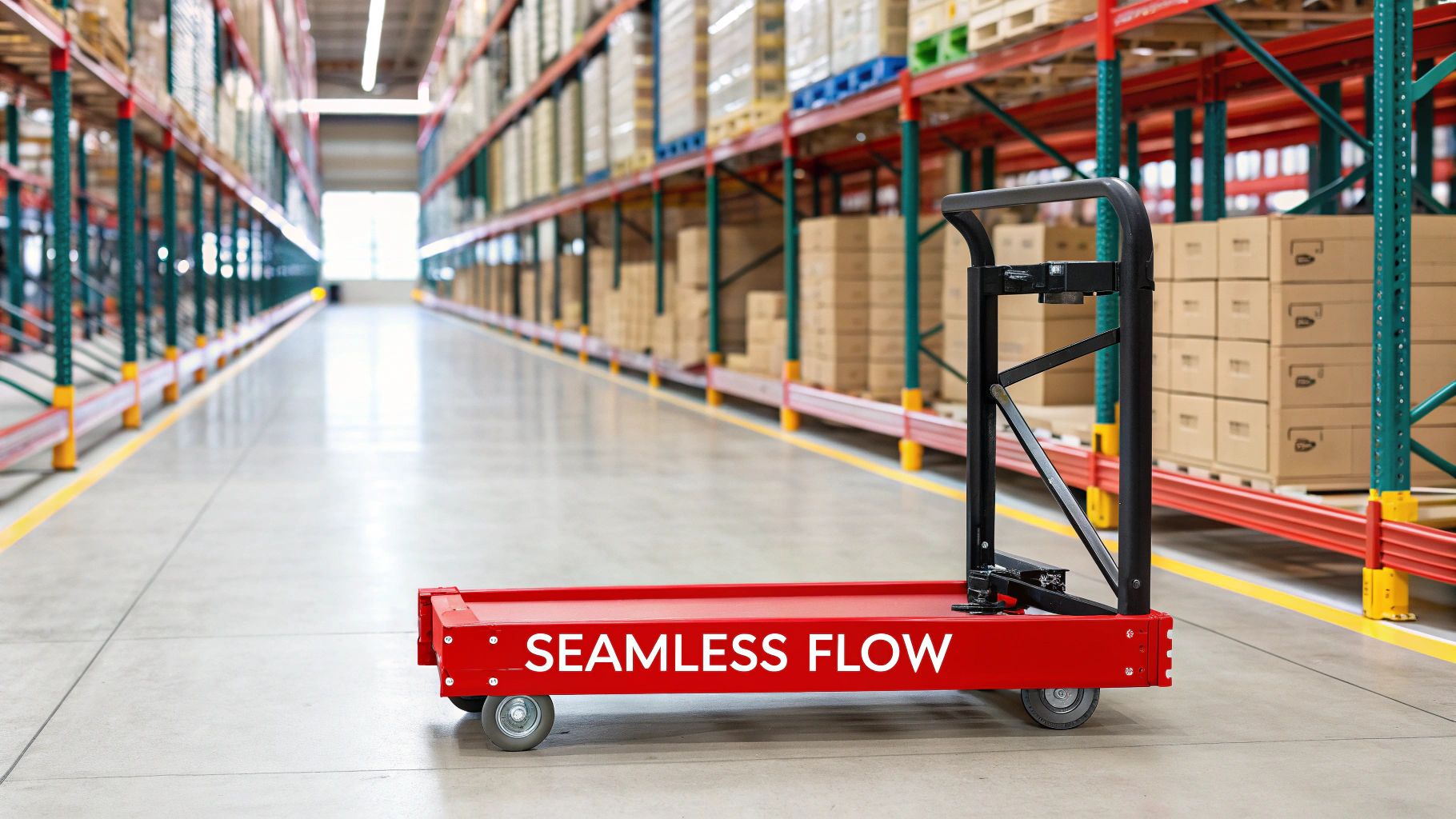
Let’s start with the basics: the physical size of your trolleys. An oversized trolley crammed into a narrow aisle is a recipe for bottlenecks, damaged stock, and seriously frustrated staff. It just doesn't work.
Before you even think about buying, get out the measuring tape and check your aisle widths. Make sure any platform or pallet trolleys you’re considering can easily navigate corners without scraping up against your racking. A good rule of thumb is to leave at least 50 cm of clearance on either side of the trolley for safe, easy movement.
Don’t forget about height, either. If you’re using order-picking trolleys, their shelf heights should line up nicely with your shelving levels. This simple check makes it faster and safer for staff to transfer items without awkward reaching or bending, which directly improves picking speed and accuracy.
Picture this: a pallet trolley zips over to a delivery truck, picks up a pallet, and glides it directly into a Super Rack pallet racking bay. No double-handling, no hold-ups. That’s the kind of slick efficiency you get when your equipment is designed to work in tandem.
By matching the right trolley to your storage system, you can optimise the entire flow for every single process:
To truly get the most from your warehouse, optimising storage isn't just about racks and trolleys; it also involves smart data-driven insights. Exploring advanced supply chain intelligence solutions can provide a competitive edge in managing material flow.
When you thoughtfully pair your trolleys with your Super Rack storage, you’re not just buying equipment. You’re designing a complete material handling strategy that actively supports your business goals. With Super Rack’s superior quality, competitive pricing, and fast nationwide delivery, you get a system that’s built for peak performance from day one.
When you're sorting out trolleys for a warehouse, the same few questions tend to come up again and again. Getting straight, practical answers is the key to making a smart choice for your team and your bottom line. Here are some of the most common queries we hear from warehouse managers.
In a tight space, it's all about manoeuvrability. A compact platform trolley with four swivel castors is a brilliant all-rounder because it can turn on a dime and handle tricky corners without a fuss. This makes it perfect for warehouses with narrow aisles or packed floor space.
If you’re mostly shifting stacked boxes or cartons, you can't beat a classic hand truck. It has the smallest footprint of them all, making it ideal for zipping through tight doorways or loading up the back of a delivery van. The main thing is to steer clear of oversized, heavy-duty trolleys that will just get in the way and cause frustration in a smaller setup.
Picking the right load capacity isn't a rough guess—it's a critical safety decision. Start by figuring out the absolute heaviest load your team will need to move on a regular basis. Got that number? Now, add a safety buffer of at least 25% to it.
For example, if your heaviest typical load is 200 kg, you should be looking for a trolley rated for at least 250 kg. This simple bit of maths prevents overloading, which is a major cause of equipment damage and a serious workplace hazard. Always base your choice on your heaviest tasks, not the average ones.
For the smooth, hard surfaces you find in most warehouses, like concrete, you’ll want solid wheels. Materials like polyurethane (PU) or nylon are your best bet. They are incredibly tough, can't be punctured, and roll with very little effort, which makes a big difference for your team over a long shift.
PU wheels have the added bonus of being non-marking, so they won't scuff up your floors, and they run a lot quieter than hard nylon wheels. You’d really only need pneumatic (air-filled) wheels if you're working on rough, uneven ground or taking trolleys outdoors.
Good, regular training is non-negotiable for trolley safety. Run practical sessions that cover correct manual handling techniques. Hammer home the important stuff: always push a trolley instead of pulling it, keep the load’s centre of gravity as low as possible, and take extra care around blind corners.
It also helps to put up visual safety reminders in key spots like loading docks and at the end of aisles to keep best practices top of mind. Finally, make sure your supervisors are leading by example and that your team sticks to a consistent maintenance schedule. Safe gear and safe habits have to work together to create a properly secure workplace.
Ready to equip your warehouse with trolleys that are built to last? Super Rack offers a wide range of superior quality, durable solutions designed for Australian businesses. With competitive pricing, fast nationwide delivery, and expert advice, we make it easy to find the perfect equipment for your needs.
Explore our full range of material handling solutions and find the right fit for your operation today at https://www.superrack.com.au.
