A quality hay feeder for horses is one of the smartest investments you can make for your property. It saves you a surprising amount of money on wasted feed while giving your horse’s health a massive boost. Think of it as moving from a messy, inefficient chore to a clean, controlled part of your daily routine.
Investing in a proper hay feeder isn't just another purchase; it's a fundamental upgrade to how you manage your horses. For anyone running a property in Australia, the benefits are immediate and tangible, starting with a huge drop in wasted hay. That translates directly into real cost savings.
Picture a stable owner in rural NSW saving hundreds of dollars every month, just by stopping their valuable hay from being trampled into the mud, soiled, and left to rot. This isn't a fantasy—it’s the reality for countless horse owners across the country who’ve made the switch.
When you feed hay on the ground, a huge chunk of it is inevitably lost. Horses will walk all over it, urinate on it, and mix it with dirt until it’s completely unpalatable. A well-designed hay feeder contains the hay, making sure almost every single strand gets eaten.
That efficiency adds up fast. In Australia, purpose-built hay feeders can slash hay waste from round bales by more than 75 percentage points compared to just leaving bales unprotected in the paddock. Studies show that a good feeder can cut waste from roughly one-third of a bale right down to less than one-twentieth.
With hay prices in Australia often hitting AUD $300–$400 per tonne, saving even 30% of a single tonne-bale means you’re preventing AUD $90–$140 from being thrown away. For a small yard using ten bales a month, that’s a potential saving of over AUD $1,000 monthly. You can discover more insights about feeder efficiency on stablemanagement.com.
Beyond the numbers, the health advantages are even more compelling. Ground feeding forces horses to breathe in dust and eat sand and other nasties along with their hay, which can lead to serious health issues down the track.
A hay feeder provides a much cleaner, safer way for them to eat. This helps to:
By lifting the hay off the ground and encouraging a more natural head position, a feeder creates a healthier environment that mimics how horses were built to eat. It makes a durable, well-designed feeder from a trusted supplier like Super Rack a smart move for both your horse's long-term health and your wallet.
Trying to figure out which hay feeder for horses is best can feel like a bit of a maze, but it all gets a lot simpler when you start with your own setup. Instead of just running through a list, let's look at each type in a way that makes sense for a real Aussie property. This will help you match the right feeder to your herd size, paddock layout, and even your daily routine.
The first step is usually figuring out your main goal. Are you looking to slash your feed bill by cutting down on waste, or is your top priority improving your horse's health and digestion?
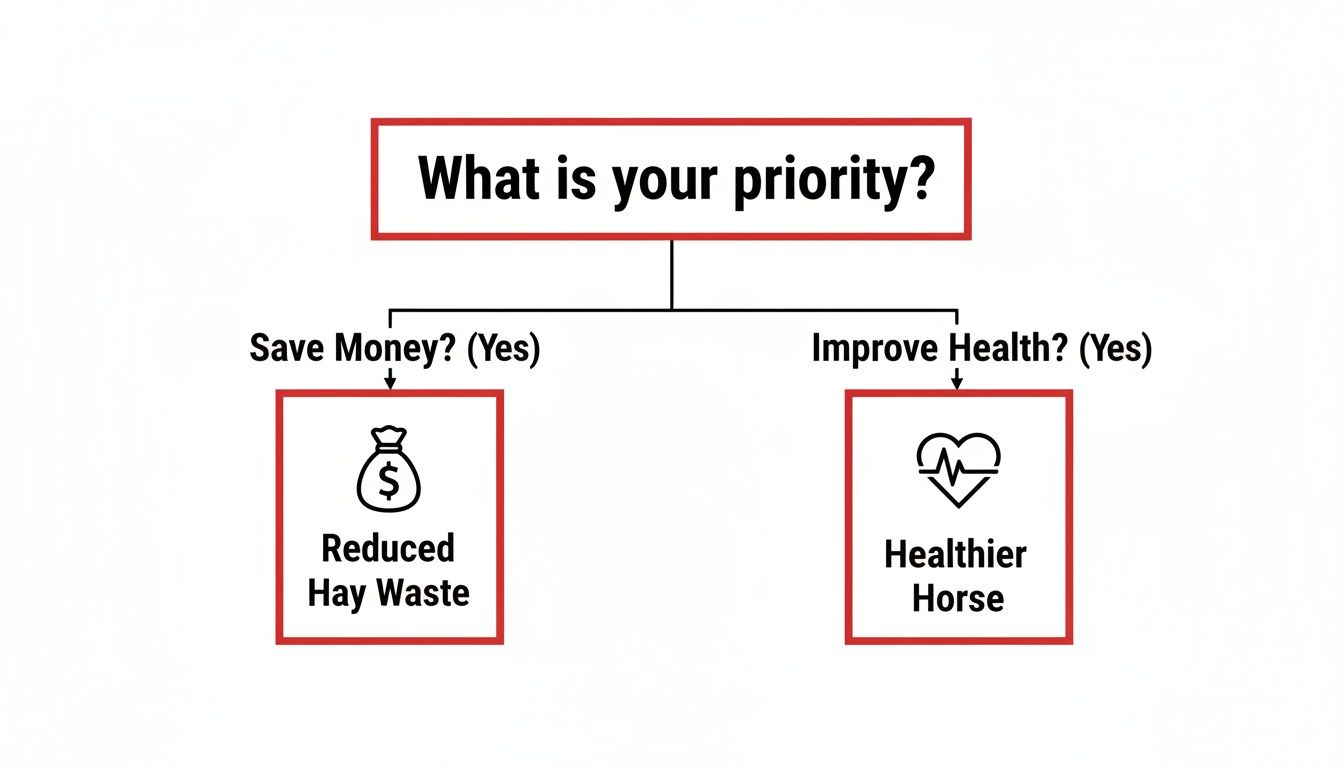
As you can see, both paths lead to great outcomes. A good feeder isn't just an expense; it's a smart investment in both your horse's wellbeing and your back pocket.
Picture this: you've got a small mob of three or four horses out in a decent-sized paddock. This is where a round bale feeder really shines. These feeders are built to house a whole round bale, letting multiple horses eat at the same time without any bickering over a small pile of hay on the ground.
By giving them 360-degree access, these feeders cut right down on competition and bullying, so even the more timid horses in the group can get their fill. Plus, the design keeps that expensive hay up off the dirt, which drastically reduces the amount that gets trampled into the mud and wasted. They’re a tough, set-and-forget solution for feeding groups.
Now, think about a different horse. Maybe you've got a classic 'good-doer' who seems to live on air, or a horse on a strict diet for a health issue like laminitis. For this job, a slow-feed hay net is the perfect tool. These nets have very small holes that make the horse work for each mouthful, nibbling away slowly just like they would when grazing naturally.
It's a simple idea, but the benefits are huge. It keeps them busy for hours, which is great for their mental health and helps stop boredom-related habits from developing. More importantly, it supports a healthy gut by keeping a small, steady trickle of forage moving through their system, which is a key factor in preventing issues like ulcers and colic.
Using a slow feeder isn't about restricting how much hay your horse gets, but rather controlling how fast they eat it. This simple shift supports a healthier digestive system and a more contented horse.
For horses kept in individual stalls or smaller yards, hay racks and troughs are the standard for a good reason. They mount securely to a wall or fence, giving each horse a clean, dedicated spot for their hay and keeping it contained and off the floor. This makes them ideal for managing individual portions and keeping a close eye on how much each horse is actually eating.
A well-designed hay rack encourages a natural head-down eating posture, which is much better for their respiratory system and jaw alignment. It’s a clean, efficient way to feed stabled horses, ensuring their tucker stays hygienic and is always easy for them to get to. The solid construction of these systems, much like the quality you'd find in robust cattle panels, ensures they can stand up to the daily grind of stable life.
At Super Rack, we get that every horse, owner, and property is different. That’s why our team is here to offer practical advice and help you find the right feeding solution for your needs. With superior quality, competitive pricing, and fast, nationwide delivery, we help you make a choice you can be confident in—for your horse’s health and your bottom line.
Picking the right size hay feeder for horses is about more than just convenience—it’s crucial for keeping your herd safe, well-fed, and calm. Nail this from the start, and you’ll cut down on waste, save money, and make sure every horse gets a fair go without any bickering.
The first step is a bit of simple maths: working out how much hay your horses actually need. A solid rule of thumb used right across Australia is that a horse should eat between 1.5% and 2.5% of its body weight in forage each day.
This basic formula is your best friend for a good feeding plan. Let's make it real with a quick example.
Say you’ve got a 500kg Stock Horse doing moderate work. Here’s how you’d figure out its daily hay needs:
So, your horse needs somewhere between 7.5kg and 12.5kg of hay daily to stay in top nick. You can use this number to figure out how big your feeder needs to be to last a day, two days, or even longer, depending on your routine.
This is where slow-feeding systems really shine. They’re designed to make a day's worth of hay last much longer, mimicking how a horse would naturally graze. In fact, Australian guidelines and suppliers advise that a 500kg horse requires about 10–12kg of forage dry matter daily. Slow feeders help manage this intake, stretching feeding time to better match their natural 18–20 hour-a-day grazing pattern, which helps reduce risks like colic and gastric ulcers. You can discover more insights about slow feeding rules on gutzbusta.com.au.
The right feeder size isn’t just about how much hay it holds—it’s also about giving every horse enough elbow room to eat peacefully.
For a single performance horse in a stable: A smaller wall-mounted hay rack or a tough slow-feed hay net is ideal. It just needs to be big enough to hold a single day's portion so you’re not constantly refilling it.
For a small herd of three paddock mates: Here, space is everything. A single small feeder is a recipe for trouble, as the boss horse will likely hog it all, leaving the others hungry and stressed. A larger ring feeder or a long trough-style feeder with multiple access points lets all three eat at once without any drama.
A key sign of a well-sized feeder is a calm feeding environment. If you see horses being pushed away or waiting nervously for their turn, it’s a clear signal you need more feeding space.
Ultimately, the goal is simple: make sure every horse can get to the hay comfortably. At Super Rack, our range of livestock equipment is built to cater for everyone, from a single beloved horse to a large professional agistment centre. With our expert advice and nationwide delivery, we can help you find the perfect, high-quality feeder to keep your entire herd happy and well-fed.
Deciding where to put your hay feeder for horses is every bit as important as picking the right one in the first place. The perfect spot can make a huge difference to your horse’s health, protect your paddock from turning into a mud pit, and honestly, just make your daily feeding routine a whole lot easier. Getting it right from the get-go saves a lot of headaches down the track.
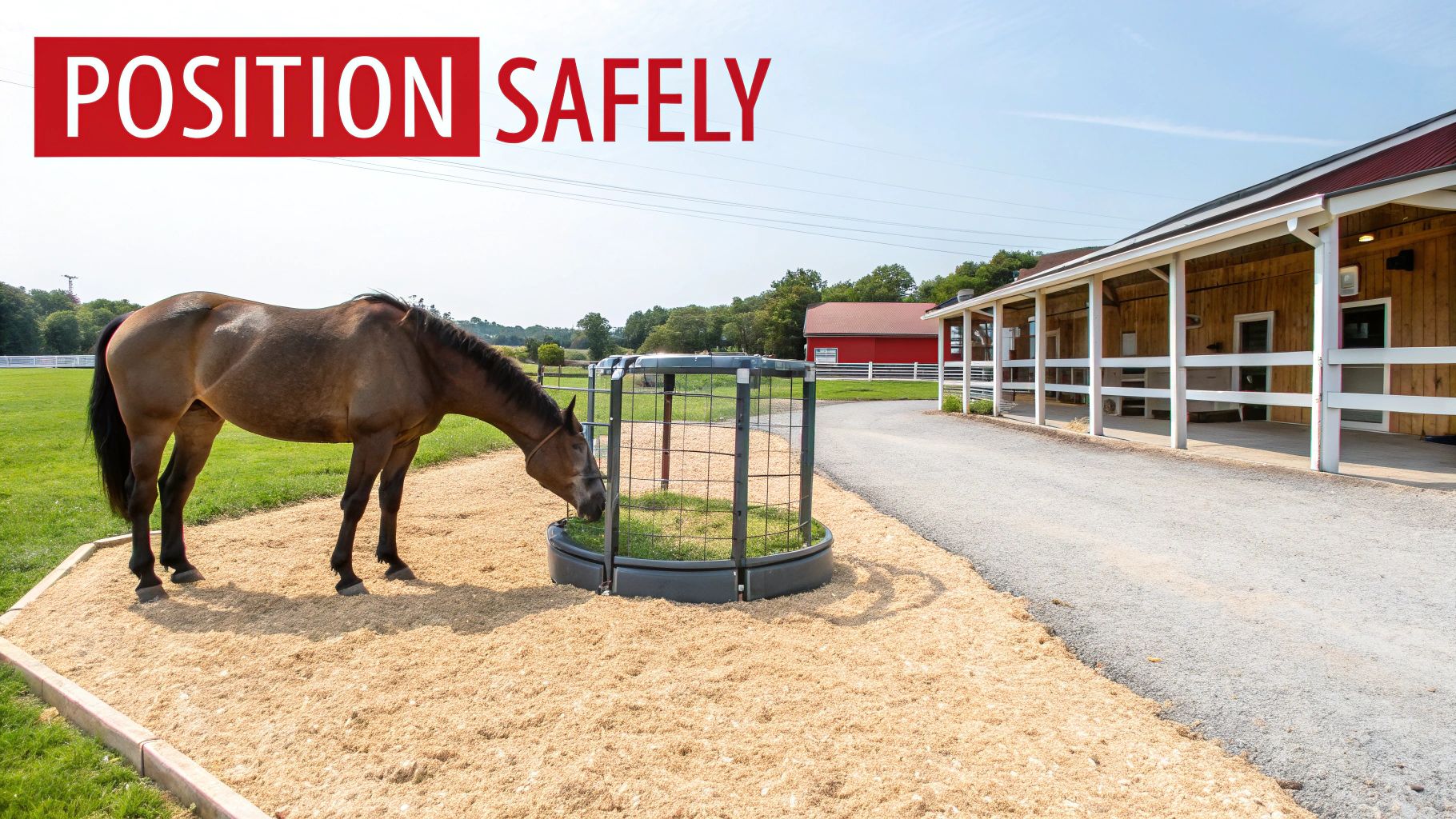
The best location is almost always a well-drained, high-traffic spot. Plonking a feeder on a patch of ground that turns into a bog after a bit of rain is just asking for a sloppy mess. It doesn’t just wreck your pasture; it creates a perfect breeding ground for bacteria, increasing the risk of problems like mud fever.
A good spot is often near a gate or water trough since these areas are usually already compacted from regular use. If you’re worried about one patch of ground getting completely destroyed, think about a portable feeder. This lets you shift it around the paddock, spreading out the wear and tear and giving the grass a chance to bounce back.
Also, think about how the feeder fits into the bigger picture of your property. Thoughtful placement can create a more organised and efficient space. It's a bit like planning the layout of a horse round yard for safe and effective training—the same logic of flow and safety applies.
Before you let your horses anywhere near a new feeder, a thorough safety inspection is an absolute must. Horses are curious creatures, and that curiosity can lead to trouble if a feeder isn't built with their safety front and centre.
Here’s a quick checklist to run through:
At Super Rack, our design philosophy puts horse safety first. Our gear is engineered with smooth, rounded edges and solid, no-nonsense construction to minimise risks and give you complete peace of mind.
Different feeders naturally come with their own unique safety points. Slow-feed hay nets, for instance, have to be secured just right to prevent a horse from getting tangled.
A good rule of thumb is to tie them high enough that a horse can’t get a hoof caught in the net, but still low enough to allow for a natural, head-down eating posture.
By taking a bit of extra time to position your feeder correctly and run through these simple safety checks, you'll create a feeding environment that’s safer, healthier, and more efficient for everyone involved.
It’s easy to look at a hay feeder for horses and just see the price tag—another expense to add to the list. But that's the wrong way to think about it. A well-made feeder is a long-term asset that pays you back, often much faster than you’d expect.
The most immediate saving is the big one: slashing hay waste. As we've covered, feeding hay straight on the ground can mean over 30% gets trampled, soiled, and simply goes to waste. With Aussie hay prices often sitting around AUD $300-$400 per tonne, that’s a lot of money literally turning into mud.
Let's crunch some simple numbers. Say you have a small mob of three horses and you’re going through one tonne of hay a month, costing you AUD $350.
If you're losing 30% of that to waste, you're throwing away AUD $105 every single month. Over a year, that adds up to a staggering AUD $1,260 in wasted hay. A quality feeder can knock that waste right down to less than 5%. Suddenly, you're saving nearly $1,200 a year, just on hay.
A durable, well-designed hay feeder isn’t a cost—it’s an investment that can pay for itself in under a year through hay savings alone, and then continue to save you money for many years to come.
But the savings don't stop at the hay bill. There are other, less obvious financial perks that really add up over time, boosting both your bottom line and your horse’s wellbeing.
One of the biggest is the potential for lower vet bills. By keeping hay clean and off the ground, a feeder helps slash the risk of sand colic, respiratory issues from dusty hay, and other digestive upsets. Dodging just one emergency vet visit for colic could save you thousands—more than covering the cost of the feeder right there.
Then there's the time you get back. Purpose-built paddock and bale feeders make your life easier by cutting down on manual feed-out time and preventing contamination. For larger properties, this means fewer hours spent on daily chores, freeing you up for other important jobs. Australian farm advisories often point out that using bale feeders reduces labour by requiring fewer manual feed runs. You can learn more about how feeders improve farm efficiency on stephenirwinequine.com.au.
When you add it all up—the direct hay savings, reduced vet bills, and your own valuable time—it’s clear that a Super Rack feeder is a savvy investment. With our commitment to superior quality, competitive pricing, and fast nationwide delivery, we help you secure an asset that delivers returns for years.
A little bit of upkeep on your hay feeder for horses goes a surprisingly long way. It's not just about looking tidy; regular maintenance is a non-negotiable part of responsible horse ownership that protects your horse's health and the money you've invested in your gear.
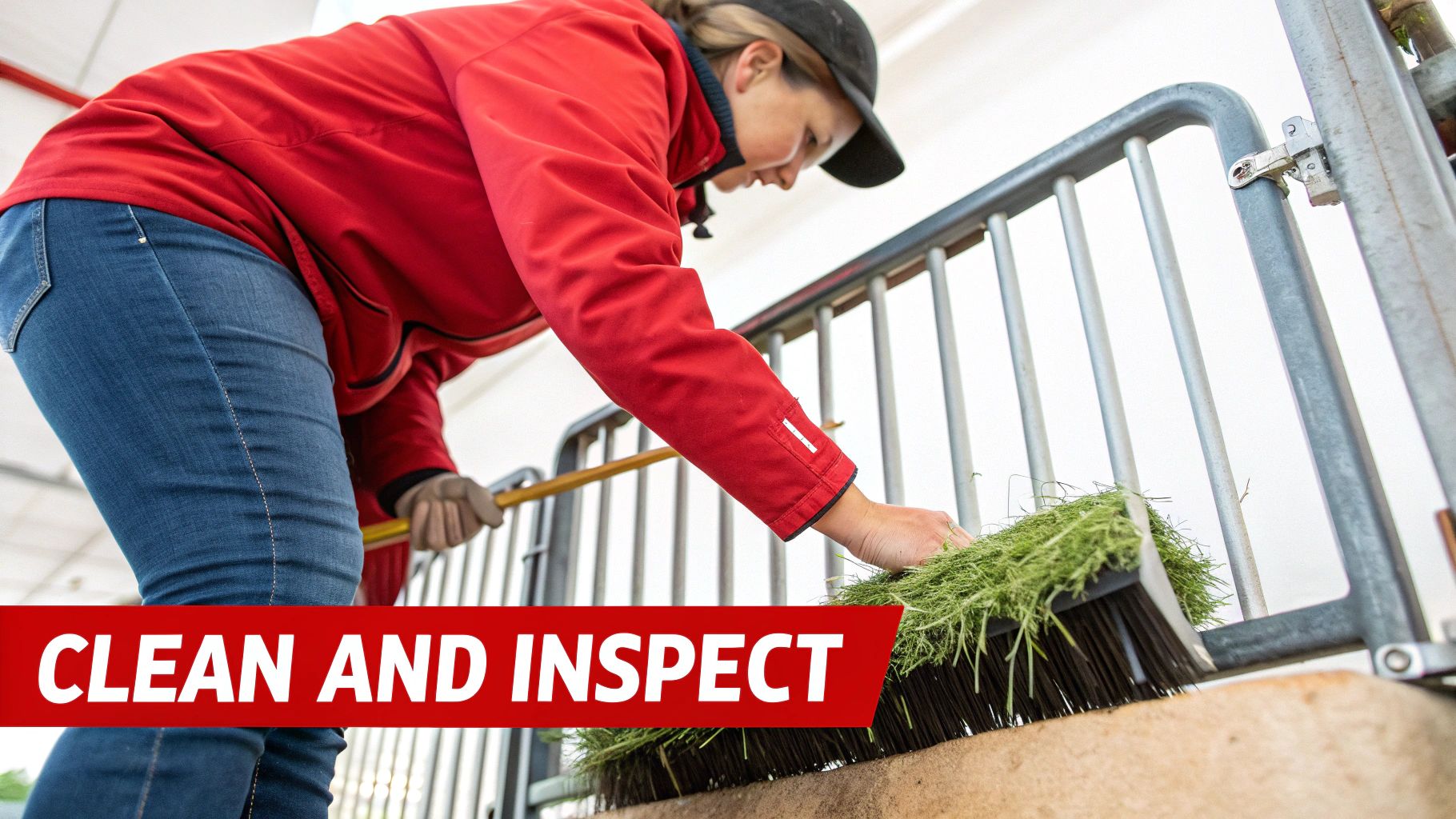
Think about it: old, damp hay left to fester at the bottom of a feeder is the perfect breeding ground for mould and nasty bacteria. When a horse inhales or eats that stuff, it can lead to serious respiratory problems, digestive upsets, and other health issues that are stressful for your horse and expensive to fix.
The good news is, keeping a feeder clean doesn't have to be a huge chore. A quick, regular clean-out is far easier than trying to tackle a massive, built-up mess later on.
Here’s a straightforward guide that works for most feeder types:
While you’re cleaning, take a minute to give your feeder a quick once-over. Spotting small problems early stops them from becoming bigger, more dangerous ones down the track.
Keep an eye out for these things:
Of course, starting with a feeder made from high-quality, durable materials makes this whole process much simpler. Super Rack’s livestock equipment is built from heavy-duty, weather-resistant materials designed to handle the tough Australian climate. This robust construction, similar to what you’ll find in our dependable modular mesh panels, means less time spent on repairs and more time enjoying your horses. With our competitive pricing and fast, nationwide delivery, you get outstanding value that's built to last.
To wrap things up, let’s tackle some of the most common questions horse owners have when choosing and using a hay feeder for horses. These practical, straightforward answers will help you feel completely confident in your decision.
Not at all. A correctly used slow feeder is designed to manage the speed of eating, not the total amount of food your horse gets. Think of it as turning a quick meal into a slow, satisfying graze.
By making your horse work a little bit for each bite, it mimics their natural foraging behaviour and extends feeding time, which is much healthier for their digestion. You still provide the same total amount of hay your horse needs daily, which is typically 1.5% to 2.5% of their body weight to keep them in top condition.
Patience is your best friend here. Don't just throw the new feeder in the paddock and expect them to use it straight away.
Start by placing the new feeder in the paddock or stable while it’s still empty, and just leave it there for a few days. Let your horse investigate it on their own terms, without any pressure. Once they seem calm around it, put a small pile of loose hay right next to the feeder while putting the rest of the hay inside. This helps them build a positive association with the new object.
Over a few days, gradually reduce the amount of 'free' hay outside until they are comfortably eating only from the feeder.
This is a very sensible question to ask, especially here in Australia. While any large metal object can carry a small risk, purpose-built hay feeders are generally considered low risk—especially when compared to long stretches of wire fencing or tall, isolated trees.
The best practice is always to ensure your horses have access to proper shelter during storms. If your paddock is open, placing the feeder in a lower-lying area rather than on an exposed hilltop can also help reduce any potential risk.
Expert Insight: It is strongly advised not to use cattle feeders for your horses. Equipment designed for cattle often has bar spacing and design features that are extremely dangerous for horses. A horse can easily get its head or a hoof trapped, which can lead to severe and heartbreaking injuries.
Always choose a feeder that has been specifically designed for equine use. Horse-safe feeders, like those from Super Rack, are built with the right dimensions and safety features to suit a horse's unique anatomy and behaviour. This ensures they are both durable and, most importantly, safe.
Choosing the right hay feeder for horses is a smart move for your horse's health and your wallet. At Super Rack, we provide expert advice to help you select the perfect, high-quality solution for your property. With competitive pricing and fast, nationwide delivery, we're here to help. Explore our durable livestock solutions today by visiting https://www.superrack.com.au.
