When fitting out a warehouse, the question of new versus used industrial racking always comes up. It's usually a debate that circles back to one thing: cost. While a second-hand system might look like a bargain, the real decision is about balancing that upfront saving against long-term safety, compliance, and potential headaches.
Ultimately, the smart money is on guaranteed quality and peace of mind, not a short-term deal that could cost you dearly down the track.
Choosing the right racking is one of the most important decisions you'll make for your warehouse. The lure of used racking is strong, especially for a business keeping a close eye on the budget. But it's a path full of hidden risks that can quickly swallow any initial savings.
Think about a growing e-commerce business in Sydney needing more storage fast. They spot a listing for used racking at a fraction of the price of a new system. It looks like the perfect answer. What they can't see, though, is its history. Has it been overloaded? Was it damaged and patched up with a dodgy repair? Does it even meet current Australian safety standards?
This scenario gets to the heart of the problem with used racking: you're buying a complete unknown. You aren't just buying steel; you're inheriting its entire, undocumented life story.
When you opt for used racking, you're taking on several big risks that just don't exist with new gear. These issues can lead to expensive downtime, compliance fines, or, in the worst-case scenario, a catastrophic collapse.
The main risks include:
This decision tree gives you a visual on how to weigh up budget-focused choices against safety-focused ones.
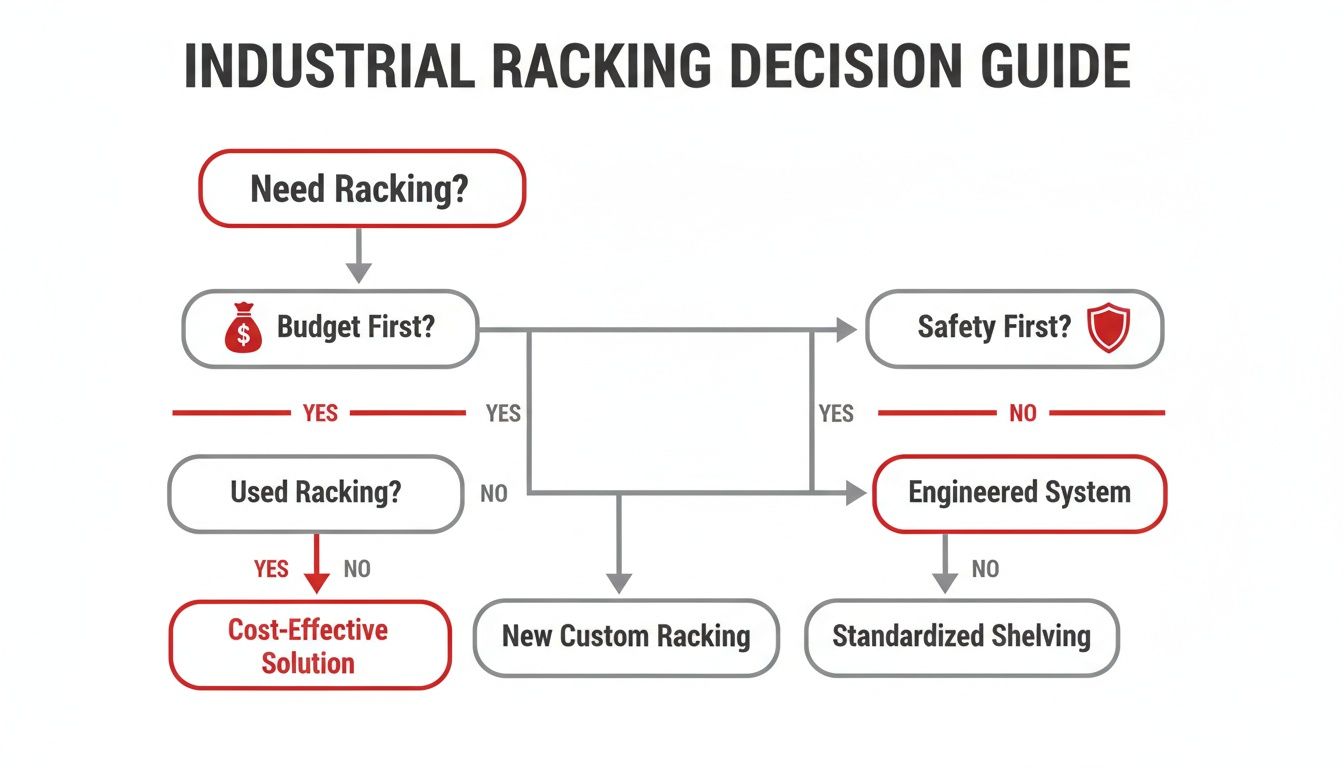
As the flowchart shows, the path of used racking starts with budget but quickly gets complicated with safety checks and compliance hurdles. In contrast, new systems from a trusted supplier like Super Rack give you a direct route to guaranteed safety and engineering assurance from day one.
Let's look at the numbers. While some sources claim used racking can slash upfront costs by up to 60%, that figure doesn't tell the whole story. It ignores the cost and effort of getting that racking compliant with AS 4084—a standard that all new systems from a reputable supplier like Super Rack meet right out of the box.
Investing in a new system from Super Rack means every single component is brand new, engineered to precise specs, and fully certified. You get guaranteed load capacities, a full warranty, and the confidence that your workplace is safe and compliant from the moment it's installed.
Our competitively priced pallet racking solutions deliver far better long-term value by eliminating the gamble. For a deeper dive into the factors you should be considering, this comprehensive guide to selecting pallet rack for your warehouse is a great resource.
With our fast, nationwide delivery and expert advice, you can have a reliable, top-quality storage system up and running without rolling the dice. The choice becomes clear: buying new racking isn't just an expense; it's a strategic investment in your business's safety, efficiency, and future.
In any warehouse, safety isn't just a box to tick; it's a legal and moral responsibility. The backbone of that responsibility here in Australia is AS 4084:2023 Steel Storage Racking. This isn’t a friendly suggestion—it’s the mandatory Australian Standard that governs how industrial racking is designed, installed, and looked after to prevent collapses and keep your people safe.
Getting your head around this standard is non-negotiable, especially when you're looking at used industrial racking. AS 4084 is your guarantee that a racking system can actually handle the loads it claims to. It covers everything from the quality of the steel to the engineering of the components, right down to the installation methods and the clear load signs that must be displayed.
For any business, cutting corners on compliance is a risk you can't afford to take. It opens you up to serious workplace accidents, massive fines, and even having your operations shut down.
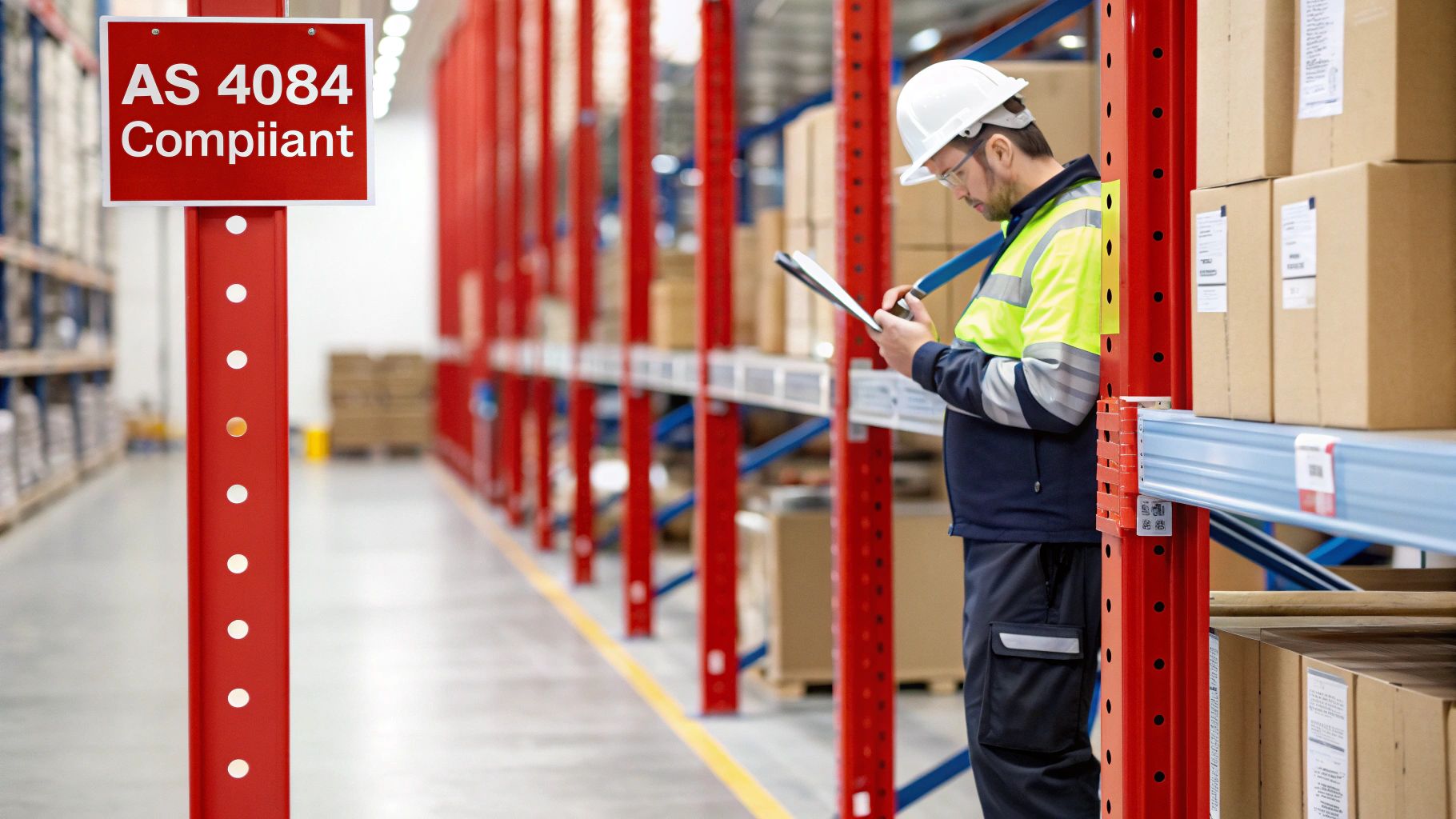
A golden rule within AS 4084 is a flat-out ban on mixing components from different manufacturers. It can be tempting to grab some cheap uprights from one seller and beams from another, but cobbling them together creates an uncertified, unstable, and incredibly dangerous system.
Think of it like trying to build a car with parts from different brands. A Toyota door won't fit a Ford frame properly, and even if you manage to jam it on, you've completely compromised its structural integrity. Racking is exactly the same. Each manufacturer’s system is a precisely engineered unit.
This is where the real gamble with used industrial racking becomes clear. A second-hand system might have been perfectly compliant in its old home, but its history is a total mystery. You have no idea if it’s been overloaded, hit by a forklift, or repaired with the wrong parts.
Getting that used racking re-certified to AS 4084 is a tough and often costly headache. It means hiring a qualified engineer to inspect every single beam and frame, try to identify the original manufacturer, and then run complex calculations to figure out a safe load rating. More often than not, without the original paperwork, getting it certified is just impossible.
As Australia’s warehousing and logistics sectors boom, the need for guaranteed-safe racking has never been more important. You can read more about the growing Australian market for pallet racking systems and its drivers.
Choosing new racking from Super Rack takes that gamble completely off the table. All our systems are engineered from day one to meet and exceed AS 4084 requirements. We supply full compliance documentation from the start, giving you total peace of mind. With our competitive pricing and fast, nationwide service, you get guaranteed safety without compromise.
Knowing what to look for when you're sizing up an industrial racking system is critical. A bargain price on used industrial racking might look tempting, but a close inspection often tells you exactly why it’s so cheap. The number of things that can go wrong is huge, and missing just one weak point can have disastrous consequences.
This checklist is a real-world guide to what you should be inspecting, step-by-step. It covers the common problems we see in older, second-hand systems and shows why a clean, factory-guaranteed system from Super Rack is always the safer, smarter investment.
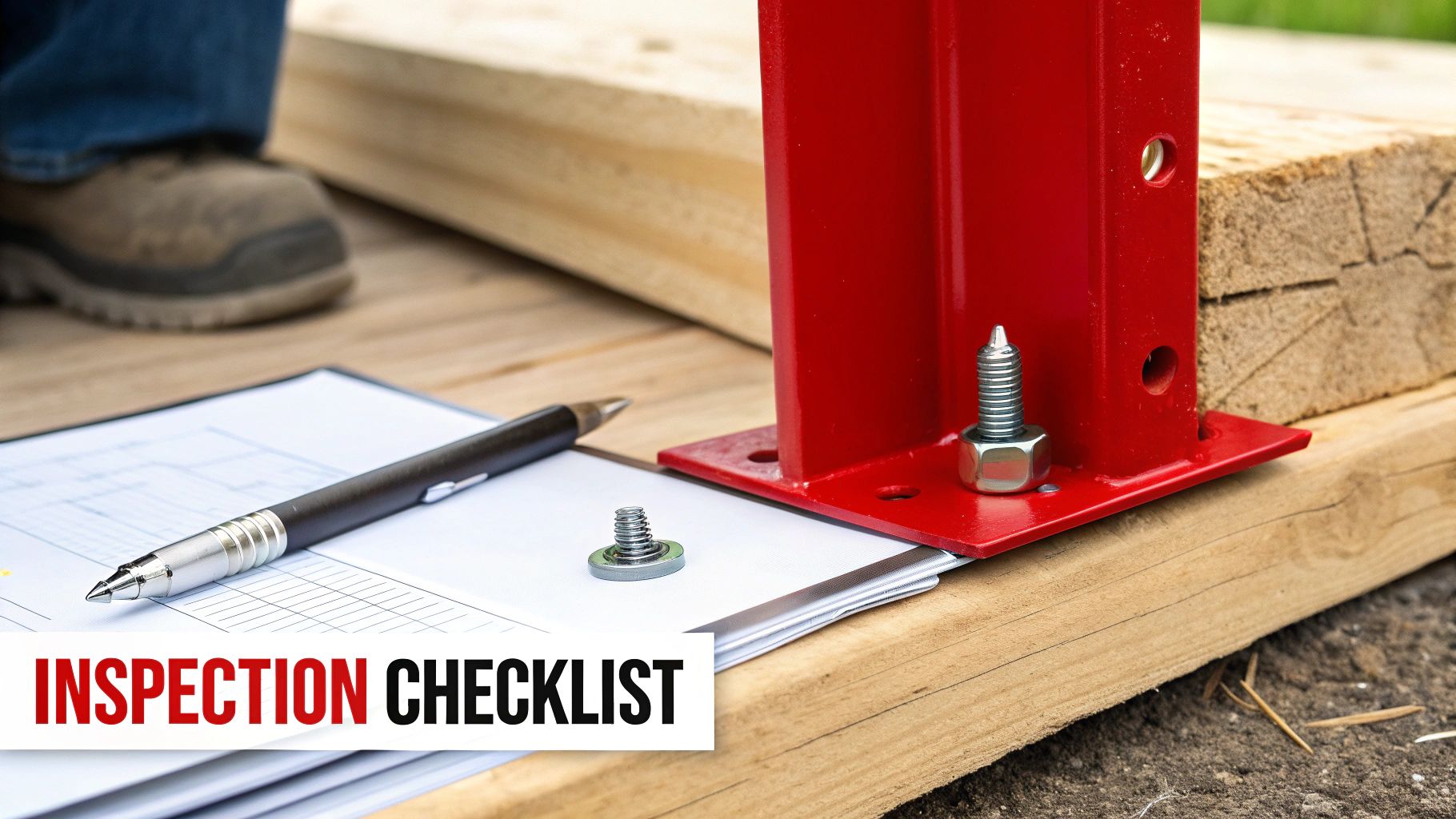
The uprights—also known as frames—are the absolute backbone of your racking. If they're compromised, the whole structure is at risk. You have to be meticulous here.
Start at the bottom of each upright. Get a good look at the baseplates and check for any rust and corrosion, especially in spots where moisture tends to pool. Rust isn't just ugly; it actively weakens the steel. While you're there, make sure every upright is perfectly vertical. Even a slight lean puts immense, uneven stress on the frame.
Next, run your hands along the uprights and the diagonal bracing. You're feeling for any bends, dents, or twists. A small dent of just a few millimetres can slash a component's load capacity significantly.
Finally, give all the horizontal and diagonal braces a once-over. Are any missing? Are they bolted on tight? A missing or loose brace is a massive red flag. They’re what stop the frame from twisting or buckling under load.
The beams are what actually hold the weight, so their condition is completely non-negotiable. A dodgy beam is one of the most frequent culprits behind racking collapses.
Your inspection needs to cover these key points:
The racking's connection to the floor is its anchor. If that connection is weak, the entire system is unstable from the ground up.
First, confirm that every single upright baseplate is securely anchored to the concrete floor. You should see at least one anchor bolt per baseplate, though two are often required. Check that these bolts are tight and aren't showing any signs of rust or stress.
Also, keep an eye out for shims—the small metal plates slipped under baseplates to level the rack on an uneven floor. They need to be installed properly and free of corrosion. A poorly levelled rack distributes weight all wrong.
This checklist gives you a good idea of just how many things can be wrong with a second-hand system. The simpler, safer path is to invest in a new system from Super Rack that arrives damage-free and ready for a fully compliant installation. Better yet, you can browse our complete range of certified pallet racking accessories to make sure your setup is perfectly configured and safe right from day one.
One of the biggest gambles you take with used industrial racking is not knowing its true load capacity. A second-hand beam might look perfectly fine, but you have zero idea what stresses and strains it has endured over the years. This is a critical safety risk that can have devastating consequences for your inventory, your business, and most importantly, your team.
Getting this right isn't just about avoiding a collapse. It's about building a warehouse that’s safe, efficient, and reliable from the ground up. Without certified load data, you're not making an informed decision—you're just crossing your fingers and hoping for the best.
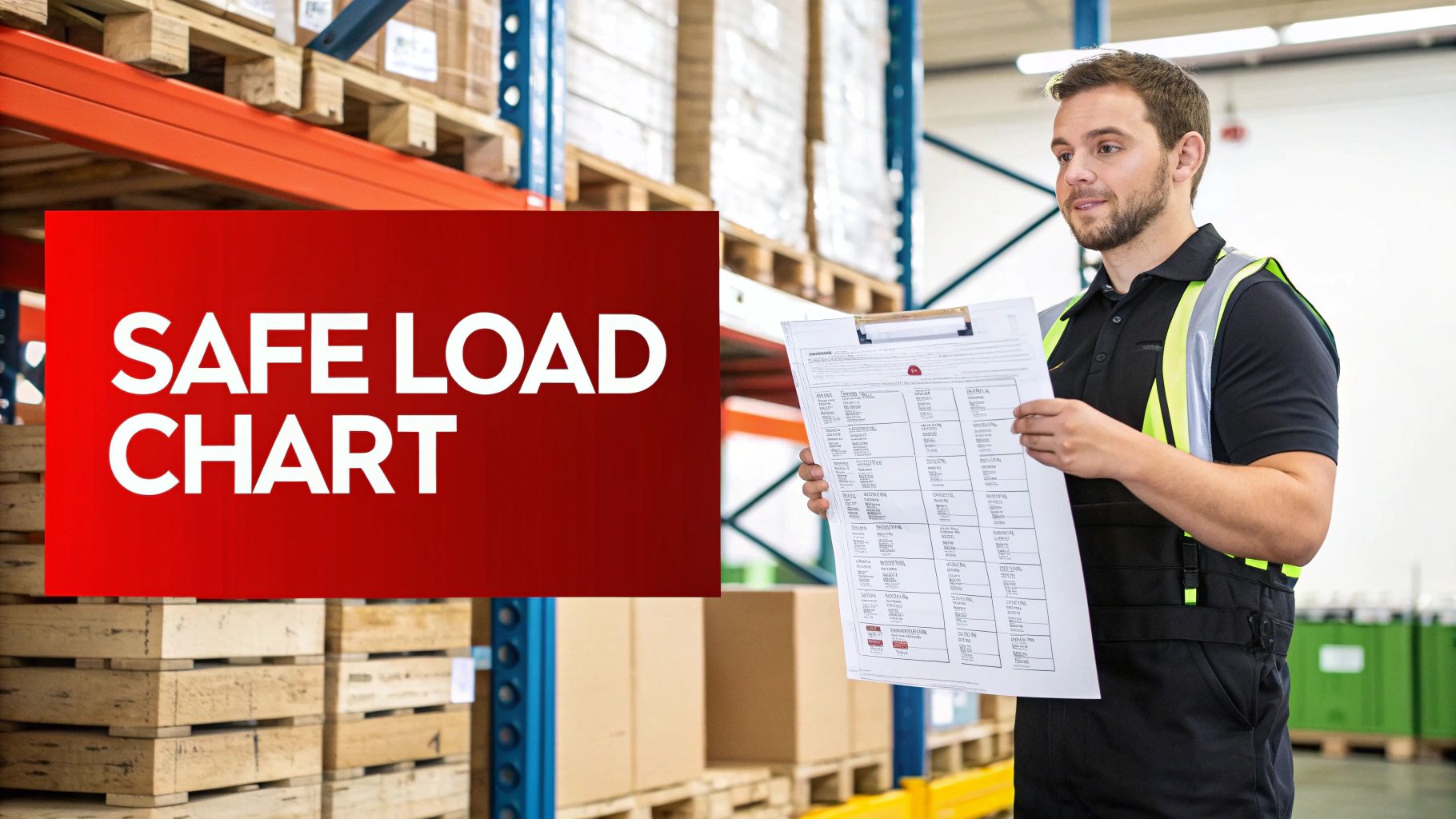
When you see a load rating on pallet racking, it’s almost always given as a Uniformly Distributed Load (UDL). This just means the calculation assumes the weight of your pallet is spread evenly across the entire length of the beams. If your load is concentrated in one spot, the beam’s actual capacity can be much lower than its official UDL rating suggests.
Equally important is the Safe Working Load (SWL) signage. Under Australian standards, every single racking bay must have a clearly visible sign stating its maximum UDL per pair of beams and the total maximum load for the entire bay. With used racking, these signs are often long gone or completely wrong, making it impossible to operate safely.
Imagine a manufacturing business in Melbourne that buys used racking to store heavy machinery parts. The system came without load charts. Assuming the beefy-looking beams can handle the weight, they load them up. Weeks later, a beam starts to visibly sag—a classic sign of overloading and imminent failure. This is exactly the scenario that certified load ratings are designed to prevent.
This is where the difference between new and used becomes crystal clear. At Super Rack, every single component we sell has been precisely engineered, tested, and certified for a specific load rating. We take all the guesswork out of the equation.
When you invest in a Super Rack system, you get:
While our experts are always here to help you design the perfect layout, it’s useful to get a head start by calculating your basic requirements.
Here’s a simple way to figure it out:
Running these numbers makes it obvious why you can’t afford to guess. Only new, certified products from a trusted supplier like Super Rack can give you the guaranteed specifications you need to run a safe and efficient warehouse.
Don't risk your business on the unknown history of used industrial racking. Contact the Super Rack team today for expert advice and a competitively priced system with load ratings you can trust.
When you start looking for industrial racking, the market can feel a bit like the Wild West, especially if you’re dipping your toes into second-hand options. Understanding the total value of what you’re buying—not just the ticket price—is what really matters.
Common spots to find used racking include online marketplaces and equipment liquidators. While these places can dangle some tempting upfront prices, they often come with serious risks. Most sales are ‘as-is,’ which means what you see is what you get, with no warranties. You're left to figure out compliance, installation, and safety all on your own.
Let's walk through a real-world scenario. Say you find a bay of used industrial racking from a private online seller for $350 AUD. It looks decent enough in the photos. At the same time, Super Rack has a brand-new, certified bay for $500 AUD. That $150 saving seems like a no-brainer, right?
But hold on. Let’s add up the hidden costs:
All of a sudden, your $350 "bargain" has blown out to over $1,025, and you haven’t even stored a single pallet yet. It’s a classic tale of a cheap purchase becoming a very expensive problem.
That $500 for a new bay from Super Rack? That’s the full, predictable cost. It comes with a full warranty, guaranteed AS 4084 compliance straight out of the box, and every single component you need. Our competitive price is just the starting point; the real value is in the complete service. We offer fast, nationwide delivery, expert advice on your layout and installation, and the peace of mind you only get from a certified, brand-new system.
When you factor in the value of expert support, guaranteed safety, and zero hidden costs, the total cost of ownership for a new Super Rack system is significantly lower than the unpredictable expenses tied to used equipment.
The Australian storage market is seeing a push towards used racking, driven by sustainability goals and the need for quick upgrades. While used racking might offer initial cost savings, that means very little if the system can't meet AS 4084 compliance—a non-negotiable for workplace safety. You can read more about trends in the Australian storage market and the ongoing tug-of-war between cost and reliability.
At the end of the day, ‘cheaper’ rarely means better value. When the safety of your team and the smooth running of your operations are on the line, investing in a new, certified system from a trusted partner like Super Rack is the only choice that makes real business sense.
Setting up your warehouse isn’t just about putting up some shelves; it’s about creating a safe, efficient workspace that flows. A smart layout is the engine of your entire operation, streamlining everything from receiving goods to dispatching orders and making sure you get the most out of every square metre.
This is where the hidden dangers of used industrial racking really come to light. The installation can quickly turn into a frustrating puzzle. You might discover non-standard parts that refuse to fit together, or worse, find that crucial hardware like floor fixings are missing altogether. Suddenly, your project grinds to a halt while you waste time and money hunting for compatible parts.
Optimising your warehouse layout begins with a solid plan. The main goal is to create a seamless path for your products and people, cutting down on travel time and unnecessary handling.
Think about these key elements:
And when you're optimising your layout, don't forget about other critical elements like good energy-efficient industrial lighting to improve visibility and keep running costs down.
Investing in a well-planned layout isn't an expense; it's a direct investment in your business's productivity and safety. A disorganised warehouse costs you money every single day in wasted time and potential accidents.
This is where Super Rack becomes more than just a supplier—we become your partner. Our new racking systems are designed for a smooth, straightforward assembly, arriving with all the high-quality, fully compatible hardware you need. No missing pieces, no frustrating delays.
Even more importantly, our expert team is here to offer real-world advice on your layout. We’ll work with you to design a system that not only maximises your storage density but also supercharges your operational flow. It's a dedicated level of service you simply won't get from an anonymous online seller of used parts.
By thinking vertically, you might even discover that a well-designed mezzanine floor could double your usable space.
Let us bring our expertise to your project from day one. Together, we can design a new, efficient, and safe storage system built for your success.
It's a huge gamble. When you buy used racking, you're buying its entire unknown history—every overloaded pallet, every forklift knock, every dodgy repair. You have no way of knowing its original engineering specs, which makes verifying its compliance with the mandatory Australian Standard AS 4084 almost impossible. For guaranteed safety and compliance from day one, investing in new, certified racking from a trusted supplier like Super Rack is always the smarter choice.
The initial ticket price of used racking might look tempting, but that’s rarely the final figure. The total cost of ownership is what really matters. Hidden expenses like hunting down missing parts, paying for repairs, and commissioning costly engineering assessments to check for safety compliance can quickly chew through any initial savings. In contrast, new racking from Super Rack has a predictable, all-in price, offering far better long-term value.
Absolutely not. This is one of the most dangerous mistakes you can make. Each racking system is engineered with beams, uprights, and connectors that are designed to work together perfectly. Combining components from different brands creates an unstable structure, voids any load ratings, and makes your entire system non-compliant with AS 4084. At Super Rack, we only supply complete, integrated systems engineered for total structural integrity.
At Super Rack, we believe safety and certainty are the best investments you can make. Our new, certified industrial racking solutions offer superior quality, competitive pricing, and peace of mind.
