Ever tried drafting cattle in a remote paddock, miles from the main yards? It’s usually a recipe for a long, stressful muster. But what if you could take the yards to the cattle? That's the simple genius behind mobile cattle yards. They're basically a set of transportable, modular panels and gates you can set up anywhere, turning any corner of your property into a fully functional working area on the fly.
For any modern Aussie farmer, flexibility is everything. Your permanent stockyards are the heart of the operation, no doubt, but they also chain you to one spot. Mobile cattle yards completely shatter that limitation, letting you manage your herd far more effectively right across your property.
This means you can work your stock closer to where they're grazing, which dramatically cuts down on mustering time and effort. Less movement means less stress on your animals, which helps with weight retention and reduces the risk of injury. It's just a smarter, more efficient way to work that saves you time, fuel, and labour costs.
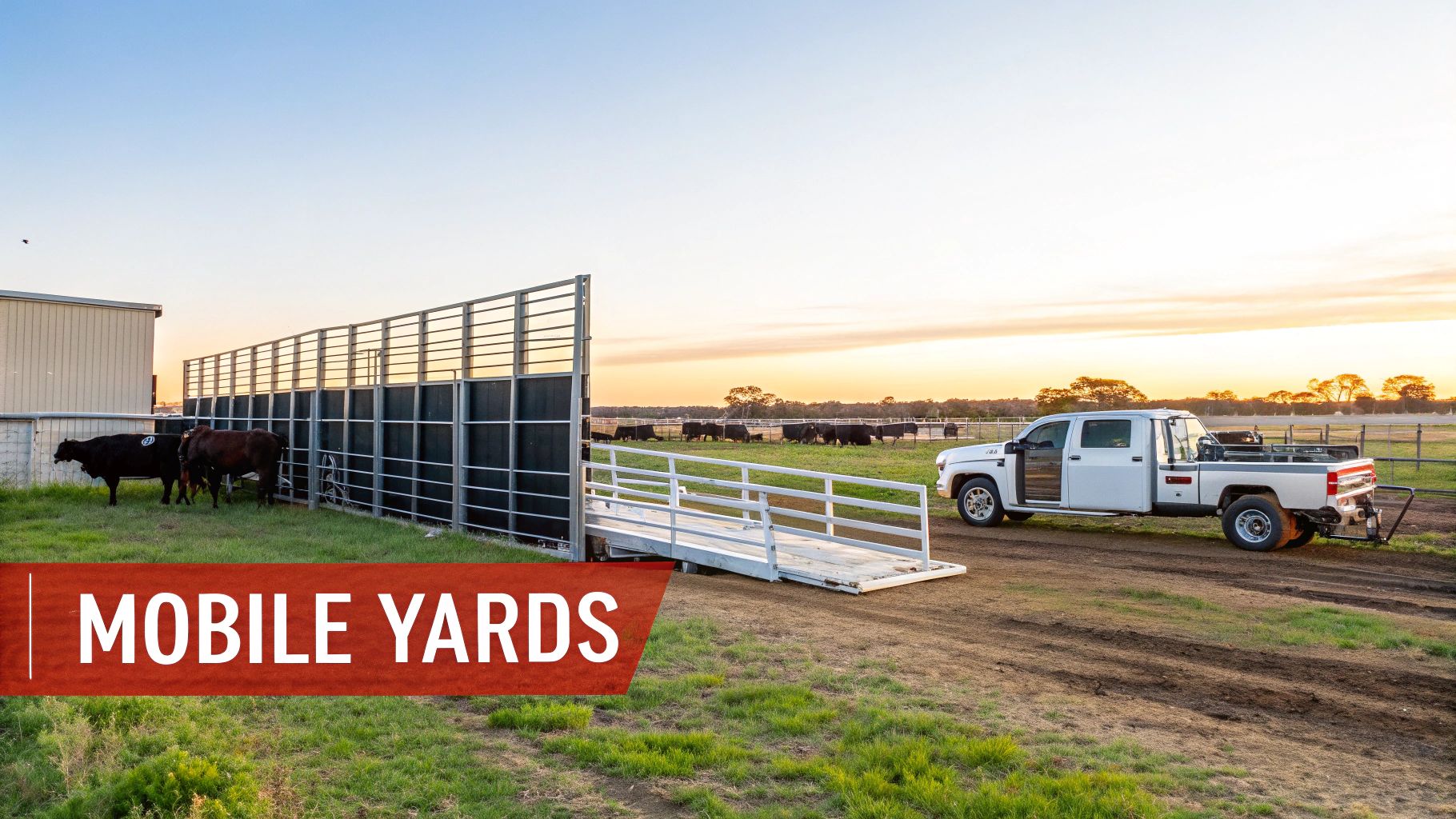
Let’s put it into a real-world context. You've got a mob of weaners that need drenching in a back paddock, a good 10 kilometres from the main yards. The old way meant a half-day muster, pushing stressed-out young cattle over rough country. Not ideal for them or you.
Now, imagine you could load the panels and gear onto a ute or trailer and drive directly to that paddock. Within an hour, you've got a secure set of yards assembled and ready to go. The job gets done quickly and calmly, right where the cattle feel most comfortable.
This one change turns a massive logistical headache into a smooth, straightforward task. It’s not just about making life easier; it’s about better animal husbandry and smarter farm management.
Of course, a mobile yard system is only as good as its construction. Out in the tough Australian elements, you need gear that can handle the pressure of heavy stock, rough transport, and constant assembly.
Quality design isn't just a nice-to-have; it's essential for safety, stock flow, and the longevity of your investment. You need to look for heavy-duty galvanised steel, strong locking mechanisms, and a layout that encourages cattle to move calmly.
This is where Super Rack's focus on rock-solid engineering really stands out. Our systems are built tough to give you a reliable and safe solution that will last for years. With competitive prices and genuine expert advice, we'll help you find the perfect setup for your operation.
Ready to bring this level of flexibility to your livestock management? Check out our range of durable temporary fencing solutions, designed to meet the real-world demands of Australian farms.
Investing in mobile cattle yards is about more than just convenience; it’s a strategic move that delivers real, measurable returns for your operation. The advantages hit your bottom line, improve animal welfare, and make your day-to-day work safer and more efficient.
At its core, the biggest win is unmatched flexibility. Instead of spending hours mustering cattle back to a fixed set of yards, you bring the yards directly to them. This simple change drastically cuts down on fuel costs, vehicle wear and tear, and the time you spend moving stock. It’s the classic case of working smarter, not harder.
One of the biggest impacts of a mobile setup is on your labour. A well-designed system lets a small crew—often just one or two people—safely handle and process a serious number of cattle. This is a massive advantage, especially when skilled farmhands are tough to come by.
Modern mobile cattle yards are built with safety front and centre. Features like heavy-duty locking pins, solid panel construction, and logical flow are all designed to minimise the risk of accidents. When your gear is secure and reliable, your team can work with confidence, knowing it won’t fail under pressure. This reduces the chance of injury to both people and animals.
Investing in a high-quality mobile system is an investment in safety. It empowers your team to manage stock calmly and effectively, reducing physical strain and the risk of dangerous situations that can arise in poorly designed or aging permanent yards.
For instance, jobs like drenching, tagging, or drafting can be knocked over in a fraction of the time with a portable setup in a nearby paddock. This frees up hours that can be put into other critical farm jobs, lifting your overall productivity.
Calmer cattle are healthier and more profitable cattle. It’s that simple. The stress from long musters can lead to significant weight loss—known as shrinkage—which directly eats into your profits. By processing animals in a familiar environment, you keep that stress to a minimum.
Less stress also means fewer injuries. When cattle are pushed and rushed, they’re far more likely to get bruised or hurt, which can downgrade carcase quality at the works. A mobile yard encourages low-stress stock handling, letting animals move at their own pace through a properly designed race and crush.
Research shows this can lead to massive savings, with better handling practices improving both meat quality and weight gain.
Here are the key benefits for your stock:
On large properties, building multiple sets of permanent yards can be astronomically expensive, running into tens of thousands of dollars for each one. A single, well-built mobile cattle yard system is a far more cost-effective solution.
This one-time investment gives you the functionality of several permanent yards for a fraction of the price. The return on investment becomes crystal clear when you add up the savings on construction, labour, fuel, and the extra value from improved animal health. When weighing up your options, it pays to look at versatile packages that can be adapted for multiple uses, like temporary fencing combos that offer flexibility for all sorts of on-farm jobs.
Super Rack offers competitively priced, superior quality mobile yards built for tough Australian conditions. With nationwide service and expert advice, we can help you configure a system that pays for itself through greater efficiency and better livestock outcomes.
Putting together the right mobile cattle yards is a lot like building the perfect toolkit for your property. It’s not a one-size-fits-all deal; it’s about picking the right components for your herd, your handling style, and the jobs you need to get done. By hand-picking each piece, you build a system that’s safe, efficient, and perfectly suited to your operation, whether it's a simple holding pen or a full-scale processing setup.
The whole point is to assemble a layout that works with your animals, not against them. A well-designed system makes stock handling smoother and a hell of a lot less stressful for man and beast. Let's break down the essential building blocks you’ll need to construct a mobile yard that actually works.
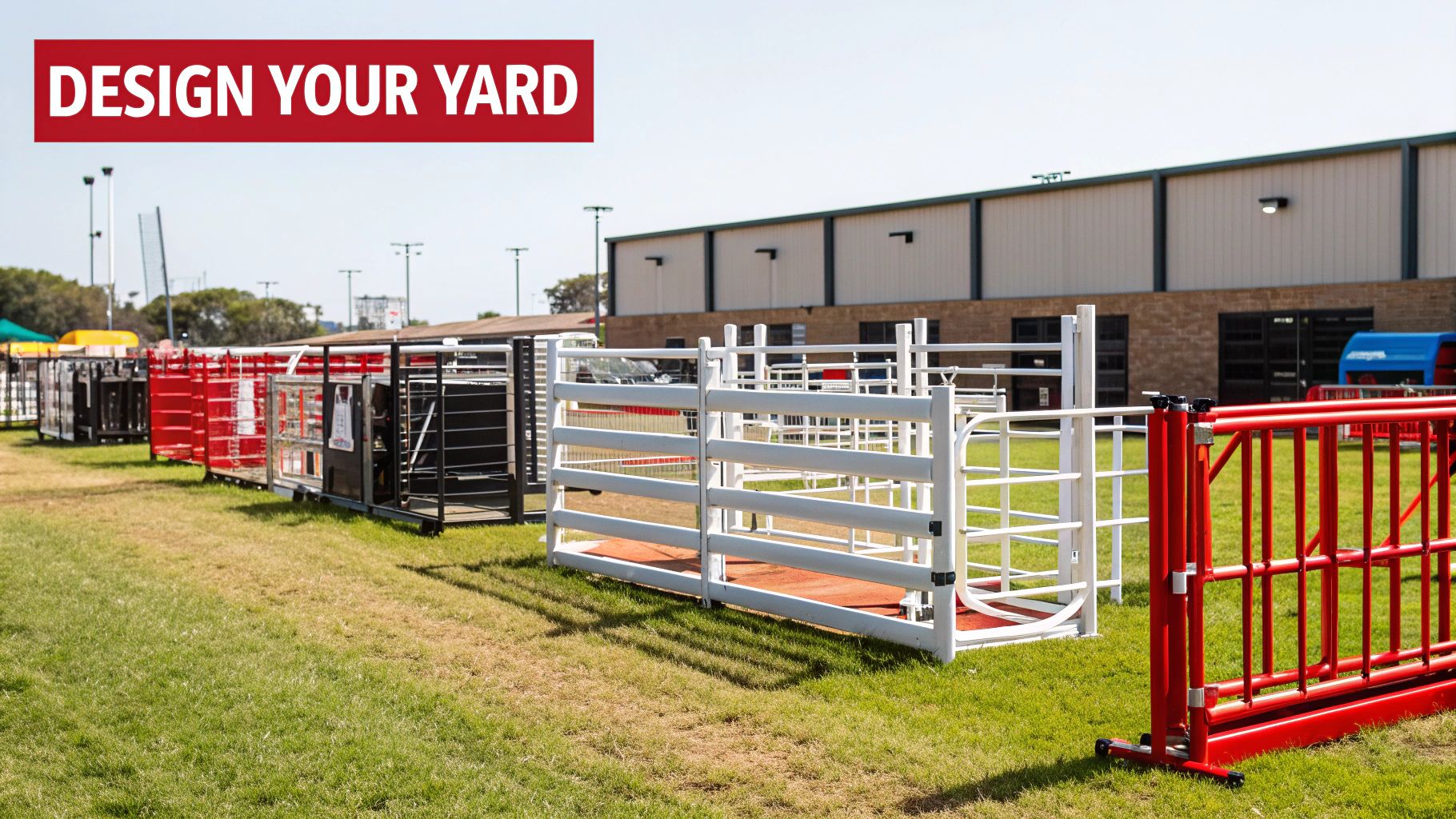
Every functional mobile yard is built from a few core pieces. Get your head around what each part does, and you’ll be able to figure out exactly what you need.
Standard Cattle Panels: These are the absolute backbone of your yard. You want panels that are at least 1.8 metres high with six rails—that’s the sweet spot for most breeds. Don’t even think about anything less than heavy-duty, hot-dipped galvanised steel. It needs to stand up to rough handling and the harsh Aussie weather, warding off rust and giving you years of service.
Gates-in-Frames: These are incredibly handy. They act as both a panel and a gate, letting you create access points exactly where you need them without messing with the yard's structure. They’re perfect for sectioning off smaller pens or just giving yourself an easy way in and out.
Drafting Gates: A drafting or sorting gate is a must-have for separating cattle. It lets you direct animals into different pens with a simple swing—think sending weaners one way and their mums another. A well-placed drafter is the key to an efficient workflow.
These are the foundational bits that form the perimeter and internal divisions, but the real grunt work happens with more specialised gear.
Once you’ve got your basic structure sorted, a couple of key pieces of equipment will handle the heavy lifting. This is where you don't skimp on quality or safety.
A cattle crush (or squeeze chute) is the heart of any serious working yard. This is where you’ll handle individual animals for jobs like vaccination, tagging, or vet checks. A good crush needs to be rock-solid, with a reliable head bail to secure the animal and easy-to-use squeeze and vet access gates. Safety for both the animal and the operator is everything here.
The loading ramp is the other non-negotiable. It has to be strong, stable, and have a non-slip floor to stop cattle from going down when loading onto a truck. An adjustable ramp is a massive plus, as it lets you easily match the height of different trucks and trailers.
When you're picking these core components, think about longevity and safety above all else. Secure, easy-to-use locking pins on all your panels and gates are a must. Fumbling with dodgy pins when you've got a yard full of cattle is asking for trouble. A simple, reliable drop-pin system is always the best bet.
With the right pieces, you can design a yard for just about any task. A small setup might be ten panels and a gate-in-frame to make a simple holding yard for drenching. For more complex jobs like drafting and loading, you’d add a race, a crush, a drafting gate, and a loading ramp into the mix.
The beauty of a modular system is its flexibility. You can start with a basic layout and add more components as your operation grows or your budget allows.
At Super Rack, we offer a massive range of panels, gates, crushes, and ramps, all built to a superior quality standard. Our team can give you practical advice to help you pick the perfect cattle yard panel and gate accessories to create a system that works as hard as you do. With competitive pricing and fast nationwide delivery, we make it easy to build the ideal mobile cattle yard for your farm.
A well-designed mobile cattle yard does more than just hold your stock; it actively works with their natural instincts. The real goal is to create a low-stress environment where cattle move smoothly from one point to the next, almost on their own. It all comes down to understanding a bit of cattle psychology—how they see, think, and react—and using that to your advantage.
When you get the layout right, the entire job becomes calmer, safer, and a whole lot quicker. You’ll see less balking and agitation, which is not only better for the animals but also massively reduces the risk of injury to both your stock and your team. Let's break down the principles that turn a simple set of panels into a highly efficient system.
Cattle have a few hard-wired instincts that you can use to your advantage when designing a yard. Getting a handle on these is the first step to a layout that encourages calm movement instead of causing a jam.
One of the most common mistakes is building a yard that's either way too big or far too small. A yard that’s too large gives them room to bunch up and turn around, creating chaos. A yard that's too small leads to dangerous overcrowding and sky-high stress levels.
The trick is to work out the space you need based on the average mob size you'll be handling. As a general rule of thumb, allow for roughly 1.5 to 2.0 square metres per head for mature cattle in the holding pens.
For instance, if you usually work mobs of 50 head, you’ll want a holding area of at least 75 to 100 square metres. It’s always a good idea to sketch this out on paper first. It helps you visualise how many panels you'll need before you even start setting up in the paddock.
The forcing pen, often called a ‘tub’, is a critical funnel. It smoothly transitions cattle from a wider holding pen into the single-file race leading to the crush. Get this part right, and you’ll prevent jamming and keep a steady, calm flow of animals.
A circular or semi-circular ‘tub’ design is hands-down more effective than a square one. The curved sides stop cattle from getting stuck in corners and naturally guide the lead animal into the race. This simple design feature makes it much easier for one person to keep the mob moving without having to yell or use a prod.
A great layout isn’t just about the panels and gates; it’s about the flow between them. The journey from the holding pen, through the forcing tub, into the race, and finally to the crush should be a seamless progression that cattle can follow with minimal stress.
It helps to think about how crowds are managed in other situations. Well-designed control barriers at events guide people smoothly without causing bottlenecks—the same principles of flow and direction apply to livestock.
Nailing the layout takes a bit of thought, but it pays off every single time you bring stock in. For expert advice on putting together a system for your property, the team at Super Rack is always ready to help. We can help you pick the right components to build a mobile yard that’s not just efficient, but also promotes better animal welfare.
Deciding to invest in a set of mobile cattle yards is a big move, and it’s smart to crunch the numbers first. While the upfront cost is what everyone looks at, the real value is in the long-term return on investment (ROI). This isn't just another bit of kit; it's a genuine asset that pays you back in efficiency, better animal welfare, and lower running costs.
Let's break down the financials. A simple mobile setup, maybe just a few panels and a gate, could start from a couple of thousand dollars. For a more serious system with a crush, loading ramp, and enough panels for a decent-sized mob, you’re likely looking at a range of $10,000 to $25,000 AUD or more, depending on what you need. That might sound like a lot, but you have to weigh it against the alternative.
Putting in a new set of permanent yards is a massive project. It often costs well over $50,000 to $100,000 once you add up materials, earthworks, and labour. A mobile system gives you the same functionality as multiple permanent yards for a fraction of that price, making it a savvy financial choice for any property.
This image shows the straightforward, three-step approach to planning a yard layout that gets you the best bang for your buck.
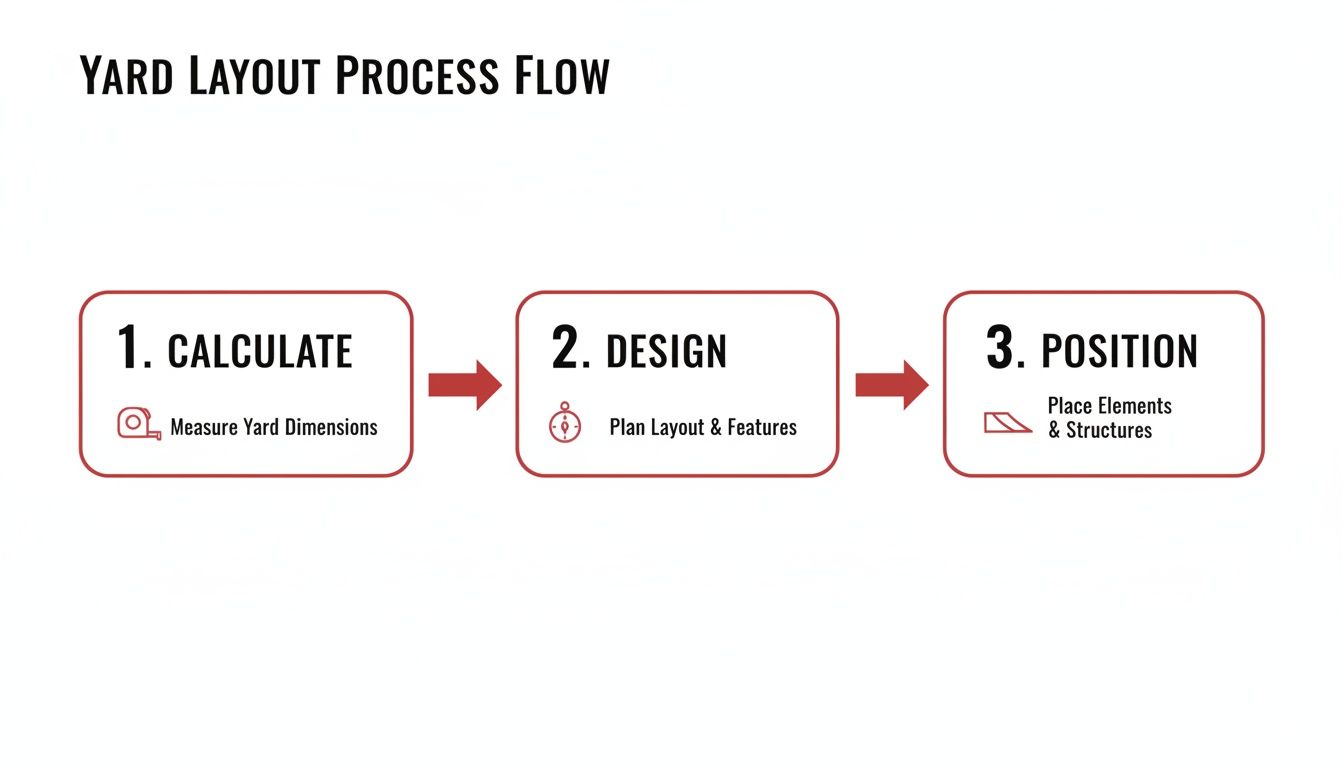
By working out your needs, designing a clever layout, and setting it up in the right spot, you can be sure the system works as hard as you do.
The true financial upside of mobile cattle yards becomes crystal clear once you look past the purchase price. The ROI comes from real-world savings and productivity boosts that add up over time.
Think about your labour bill. An efficient mobile system lets a smaller crew handle stock safely and quickly. This can lead to significant cost savings, especially on larger operations where handling cattle is a frequent, time-consuming task.
The return on your investment isn't just about what you save on day one. It's about the compounding value of reduced mustering time, lower fuel bills, fewer stock injuries, and better weight retention year after year. A quality mobile yard is a long-term asset that actively improves your bottom line.
The financial wins don't stop with labour and fuel. Think about these other returns:
When you invest in a Super Rack mobile yard, you’re not just buying steel; you’re buying efficiency. Our gear is built tough to handle Australian conditions for years, while our competitive pricing makes your initial investment smart and manageable. With fast, nationwide delivery and expert advice ready to go, we'll help you put together a solution that starts paying for itself from the moment it lands on your property.
A set of mobile cattle yards is a seriously useful bit of gear, but it's only as good as the operator. Getting safety and animal welfare right is non-negotiable—it protects your livestock, your staff, and yourself. It all comes down to good habits and doing the basics right every single time.
Before a single beast steps into the yard, a quick but thorough safety check is a must. This simple walk-around can prevent a world of trouble. Check that every drop-pin is locked in tight and give each gate a swing to make sure it opens and closes smoothly without catching. A sticky gate is a disaster waiting to happen when you need to move quickly.
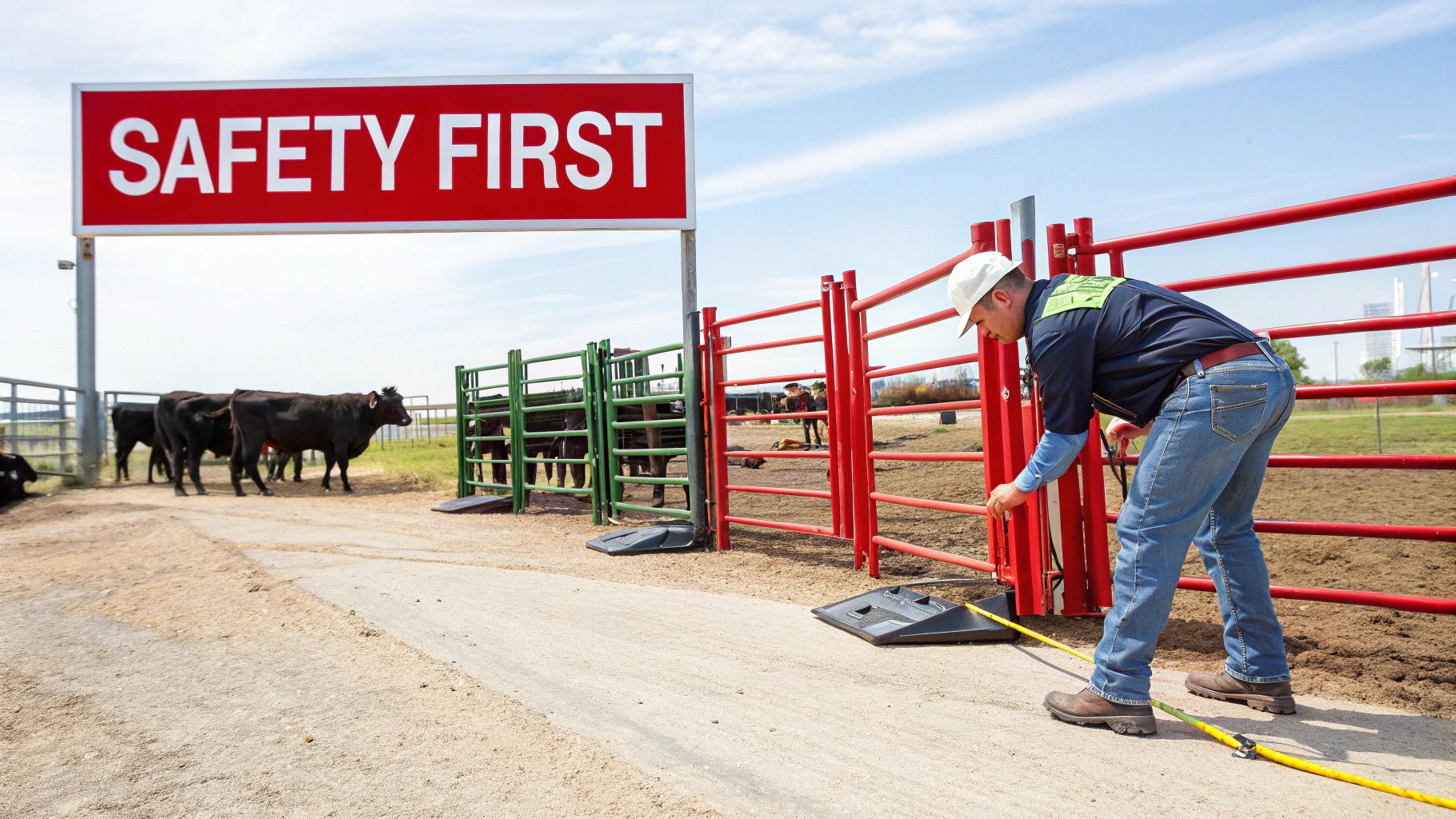
Working with cattle always has its risks, but smart handling makes all the difference. The golden rule is understanding stock behaviour. Know their flight zone and use it to your advantage. Work calmly and quietly to guide animals; never try to force them.
Most importantly, always have an escape route. Before you step in, clock the gaps between panels or the nearest gate you can duck through if an animal gets stirred up. Never, ever back yourself into a corner where you can’t get out.
A safe yard is a well-maintained yard. Your investment in quality equipment is protected by regular care, ensuring it remains strong and reliable for decades of hard work.
For a more structured approach, consider implementing a comprehensive risk register as part of your safety management plan. It’s a formal way to identify, assess, and control potential hazards before they cause an incident.
Good stock handling and animal welfare are two sides of the same coin. A well-designed mobile yard promotes low-stress handling with features like smooth, rounded corners on panels and gates to prevent bruising and injury. A logical layout that encourages natural flow keeps cattle moving forward calmly.
Of course, maintenance is a huge part of the safety equation. Here are a few things to keep on top of:
At Super Rack, we get that farming is a tough business. Our mobile yards are designed with safety and low-stress handling built-in, helping you create a system that’s not just productive, but humane and built to last.
Thinking about investing in a mobile cattle yard? It’s a big decision, and you’ve probably got a few questions. We get calls from farmers and station managers all the time, so we’ve put together some straight answers to the most common queries we hear.
There's no single answer to this, as it all comes down to the setup you build. A small, basic kit with a dozen or so panels might be perfect for handling 20 to 30 head for some light drafting. On the other hand, a more complex layout can comfortably manage over 100 head for full-scale processing.
The real beauty of a mobile system is that it grows with you. You can start with a simple yard and just add more panels, gates, or a race as your herd grows or your needs change. We can help you work out the right number of panels for your average mob size, ensuring you’ve got a safe, low-stress working area without dangerous overcrowding.
Not at all. Any decent set of mobile cattle yards is designed to be put up and pulled down quickly, often by just one or two people without any fuss. The panels are built to a manageable weight, and they lock together with a simple drop-pin system. It’s dead simple but surprisingly strong.
Most setups will fit neatly on the back of a ute or a small trailer. That means you can shift your entire yard from the home paddock to the back block in one go, ready to work wherever your cattle are.
Look, a cheap second-hand yard can seem like a bargain, but buying new from a reputable supplier like Super Rack is almost always the smarter long-term play. With new gear, you get a guarantee of structural integrity. You won't find any hidden rust, stress fractures from past knocks, or bent rails that could give way right when you need them most.
Peace of mind is priceless. Investing in new, quality-assured equipment protects your team, your livestock, and your business from the costly fallout of gear failure.
You also get the benefit of modern designs that improve stock flow and make the whole operation safer for everyone involved. A new system isn't just a purchase; it's an asset built to serve your property for decades.
When you’re kicking the tyres on new panels, a few key details separate the good stuff from the gear that won't last. These are the things that really matter when they're under pressure in the real world.
At Super Rack, we build livestock management gear for the realities of Australian farming. Our team knows this stuff inside and out and is ready to help you design a mobile yard system that’s perfect for your operation.
Check out our range and see how you can build a safer, more efficient future for your farm by visiting us at https://www.superrack.com.au.
