Running out of warehouse space is a classic growing pain for Aussie businesses, but moving is a massive—and expensive—headache. A warehouse racking mezzanine is a smart, cost-effective way to expand upwards. It turns your unused overhead space into a valuable, productive area without needing to relocate.
Before you even think about looking for a new facility, just look up. That empty space above your current racking holds incredible potential. A warehouse racking mezzanine is a strategic investment that unlocks this dormant area, effectively doubling your usable floor space within your existing footprint.
This isn't just about adding more shelves; it's about improving how your whole business operates. By creating a second level, you can streamline workflows, reduce congestion on the ground floor, and create dedicated zones for different tasks. It’s a solution that grows with you, offering flexibility a fixed building extension can't match.
Across Australia, the rapid growth of e-commerce has put huge pressure on warehouses and storage. With industrial land prices in major cities like Sydney and Melbourne climbing, expanding outwards is no longer a viable option for many businesses.
This is exactly why vertical expansion is so critical. A mezzanine racking system lets you add a second or even a third floor, increasing your usable space by 30–100%. For many small to medium businesses, this approach can put off relocation costs that often soar past AUD 500,000.
A racking mezzanine lets you handle growth without the huge disruption of a move. Imagine creating brand-new, dedicated areas for:
For businesses looking for a practical way of resolving space planning issues, a racking mezzanine is a seriously compelling solution.
At Super Rack, we see a mezzanine as more than just steel and flooring. It’s a pathway to greater efficiency, lower costs, and smarter growth, all delivered with our expert advice and nationwide service.
Investing in a high-quality mezzanine from a trusted supplier like Super Rack means you get a durable, engineered solution built to meet strict Australian standards.
So, what exactly is a warehouse racking mezzanine? The simplest way to picture it is like a heavy-duty industrial loft built inside your warehouse. It’s a raised floor supported by the same tough components used in pallet racking.
This clever approach makes it completely different from a ‘structural mezzanine,’ which is a much bigger project. A structural mezzanine is basically a small building within your building, supported by massive, independent steel columns and requiring major construction work.
The genius of a racking-supported mezzanine is that it uses the built-in strength of your pallet racking. It turns all that empty overhead air into valuable, usable floor space, creating one integrated and incredibly efficient storage solution.
A warehouse racking mezzanine is built using the same core parts as standard pallet racking. Upright frames act as the vertical legs, while horizontal beams connect them to create a strong, stable grid. We then lay a durable flooring material—like particleboard, steel plate, or mesh—over the beams to create your new upper level.
This all-in-one design means the structure is both the support for the new floor and a storage system. The space underneath the mezzanine stays completely usable for storing pallets, while the new level above can be used for something else entirely.
For example, a fast-growing online retailer could use the ground level for bulk pallet storage of incoming stock. At the same time, the mezzanine level above becomes a dedicated area for picking, packing, and sending out customer orders, keeping the two operations separate but still connected.
A key benefit of this system is its flexibility. Unlike a permanent structural addition, a racking mezzanine from Super Rack can be modified, expanded, or even relocated as your business needs change, offering unmatched flexibility.
The integrated design of a warehouse racking mezzanine is what makes it such a smart choice for Australian businesses. Because it relies on standard components, installation is much faster and less disruptive than a major construction project. At Super Rack, our expert team ensures a quick setup with minimal downtime, thanks to our fast delivery and nationwide service.
This system lets you create specific zones in your facility without building permanent walls. You could have a storage area on one side of the mezzanine and a light assembly station on the other, all while your forklift drivers keep working on the ground floor. This smart separation helps cut down on foot traffic jams and makes your whole workflow smoother.
By using an integrated design, you’re not just adding square metres; you’re creating a smarter, more organised, and more productive workplace. Super Rack’s high-quality systems give you a durable and reliable foundation to build on. You can see how these core components work together by exploring our superior pallet racking solutions.
When you’re looking to expand upwards, you’ll find there are two main ways to build a mezzanine floor. Each is designed for a different job, and picking the right one comes down to what you need to do, your budget, and your plans for the future.
Your choice boils down to this: do you want a mezzanine that’s part of your storage system, or one that stands on its own? A Pallet Racking Supported Mezzanine uses your racking as its foundation, while a Structural Mezzanine is a completely separate structure built with its own steel columns. Let's look at what that means for your warehouse.
Here’s a quick visual of how a racking mezzanine fits into the bigger picture.
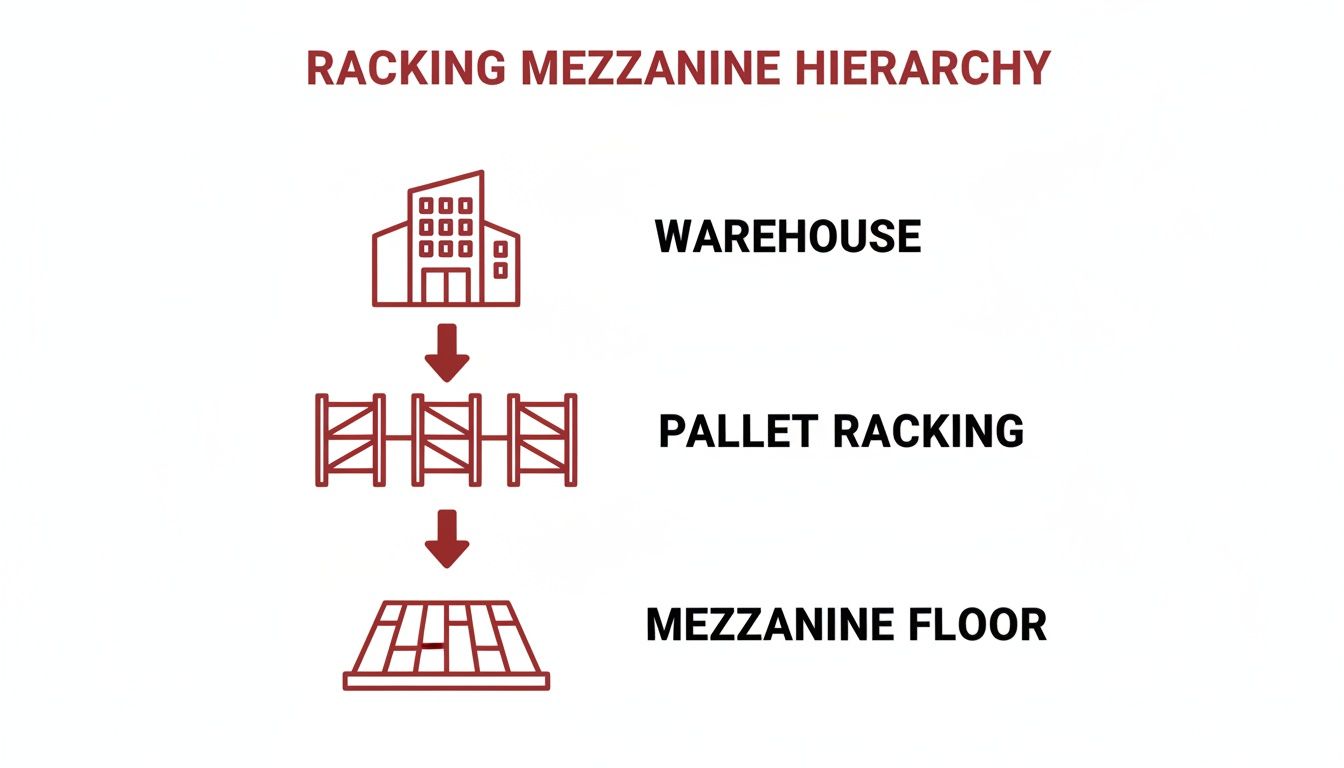
As you can see, the mezzanine floor is built right on top of the pallet racking, turning one system into a multi-level workspace.
This is by far the most common and budget-friendly way to add a warehouse racking mezzanine. Think of it as a smart extension of the pallet racking you already know. We use the same heavy-duty uprights and beams to create a solid, engineered base for a second level.
Because it’s built from standard racking components, it’s a seriously versatile and affordable option. Installation is much faster and causes less disruption to your daily workflow. Super Rack’s expert teams can often get these mezzanines built and ready to use in a fraction of the time needed for a major construction project.
A classic example is an e-commerce warehouse. The ground floor can be used for bulk pallet storage for fast-moving items, while the new mezzanine level above becomes a dedicated area for pick-and-pack stations or processing returns. It’s a simple way to create a slick, two-tier operation in the same footprint.
The real magic is the integration. You’re not just getting a new floor; you're getting a complete storage system underneath it, all in one package.
A structural mezzanine, on the other hand, is a completely independent, freestanding platform. It’s supported by its own heavy-duty steel columns and doesn’t rely on pallet racking for any of its strength. It’s much more like a traditional building extension, just constructed inside your shed.
This design is perfect for creating wide, open spaces. If you need to build a large in-plant office, install a production line with heavy machinery, or run a complex conveyor system, a structural mezzanine is usually the best fit because there are no racking posts in the way.
But all that heavy-duty steel comes at a cost. The engineering, foundations, and construction are more involved, which means a higher price tag and a longer installation time. While it’s a great solution for specific, heavy-load applications, it’s often overkill for businesses that simply need more storage or light operational space.
So, how do you decide? It really comes down to three things.
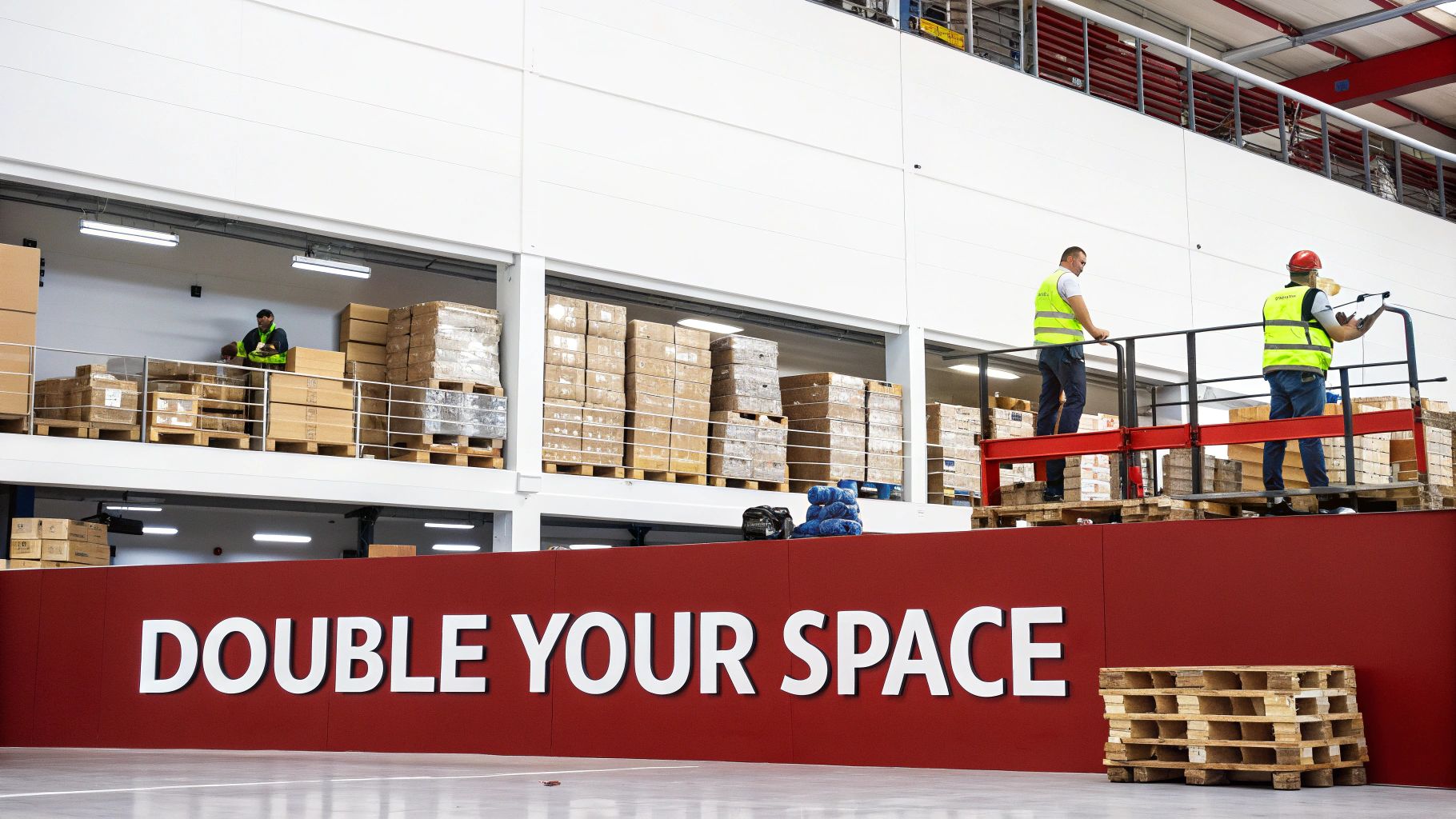
Putting in a warehouse racking mezzanine is more than just getting extra floor space. It's a smart business move that delivers real, tangible benefits to your operations and your bottom line.
The first thing you'll notice is the huge boost in usable space. By building up, you can easily double your floor area without the cost and disruption of moving or extending your building. That alone translates into massive financial savings.
When you compare the costs, the value of a mezzanine becomes obvious. Relocating a medium-sized warehouse can set you back hundreds of thousands of dollars, and that's before you factor in the operational downtime. A full building extension is an even bigger, more complicated headache.
A warehouse racking mezzanine is a much more affordable way to grow. With typical costs in Australia sitting between AUD 250 to AUD 400 per square metre, it's a financially savvy alternative. This frees up capital you can put back into other parts of your business, like buying more stock or hiring new staff.
By using the vertical space you already pay for, you turn a dormant area into a productive asset. It's one of the smartest ways to get more value from your existing lease.
At Super Rack, we specialise in delivering these high-value solutions with competitive pricing, so you get a fast return on your investment. With our nationwide service, we can help businesses all over Australia make this clever upgrade.
A mezzanine isn't just for storage; it’s a powerful tool for organising your entire operation. It lets you create dedicated zones for different tasks, which has a huge knock-on effect on your day-to-day efficiency.
Think about how it could work for an e-commerce business:
This simple separation of tasks cuts down on foot traffic, reduces the time your team spends walking from one end of the warehouse to the other, and makes your whole operation run smoother. With clearer workflows, you can process more orders with fewer mistakes, which is a direct boost to productivity.
One of the best things about a racking-supported mezzanine is its flexibility. Unlike a permanent structural addition, these systems are modular. That means they can change and adapt as your business grows.
If you need more space down the track, you can often extend the mezzanine. If you decide to rejig your warehouse layout, the structure can be modified. And if you ever move to a new facility, you can often dismantle the mezzanine and take it with you—something you could never do with a fixed build.
This adaptability makes a warehouse racking mezzanine a future-proof investment. With Super Rack’s superior quality systems and expert advice, you can be confident you’re installing a solution that will serve your business well for years to come.
A warehouse racking mezzanine is a serious structural upgrade, so getting the design and compliance right from day one is non-negotiable. Proper planning isn't just about a smooth installation—it's about the long-term safety of your team and the integrity of your entire operation. This is where attention to detail really pays off.
The whole process comes down to smart calculations, a practical layout, and a rock-solid understanding of Australian regulations. Getting this wrong can lead to expensive delays, council knock-backs, or worse, dangerous structural problems down the track.
First things first: what are you going to put up there? The answer to this question determines your load capacity—the maximum weight your new floor can safely handle. It’s not just one number; it’s broken down into two crucial types.
Uniformly Distributed Load (UDL): This is the weight spread evenly across the entire surface, like when you’re storing boxes or just have general foot traffic. We measure this in kilopascals (kPa), where 1 kPa is roughly equal to 100 kg per square metre. A light-duty mezzanine for simple storage might be rated for 3 kPa, while a heavy-duty work area could need 5 kPa or more.
Point Loads: Think of these as heavy, concentrated weights in one spot—like the legs of machinery or the wheels of a pallet jack. These forces put intense stress on a small area and have to be accounted for separately in the design.
For example, if you plan on running pallet jacks across the mezzanine, the engineering must include extra support under those main travel paths. Getting these calculations spot-on is absolutely critical for a safe structure.
A great warehouse racking mezzanine should feel like a natural part of your ground-floor workflow, not a clunky add-on. The layout has to be planned for efficient, safe movement of both people and goods.
Key things to map out are the placement of staircases for easy team access and pallet gates for safely lifting goods with a forklift. Putting a pallet gate right near your packing benches, for instance, slashes handling time and makes the whole process smoother. The goal is to cut down on wasted steps and create a logical flow from one task to the next.
A thoughtfully designed mezzanine doesn't just add space; it actively improves your operational efficiency. By planning access points and work zones logically, you reduce bottlenecks and create a safer, more productive environment for your team.
In Australia, any significant structural installation is governed by strict rules to guarantee safety. A warehouse racking mezzanine is no different and must comply with several key codes and standards.
First, your design has to adhere to the strict guidelines of the Building Code of Australia (BCA). This national code sets out the minimum requirements for structural integrity, fire safety, and access.
On top of that, the racking components themselves must comply with AS 4084-2023 for steel storage racking. This standard covers everything from engineering and design to installation, ensuring the system is safe and fit for purpose. Compliance isn't a suggestion; it's a legal requirement for workplace safety.
At Super Rack, our expert team ensures every one of our installations is fully engineered to meet or exceed these critical Australian standards. We handle the complex compliance details so you can focus on running your business, confident that your new structure is both safe and legal. To start planning a compliant and efficient vertical expansion, you can learn more about our custom mezzanine floor solutions.
A new warehouse racking mezzanine needs to be more than just an extra floor; it has to become a seamless part of your daily workflow. To get the most out of your investment, it should feel like a natural extension of your ground-level operations, not some isolated island. Good integration is all about creating a smooth, efficient flow of people, goods, and information between both levels.
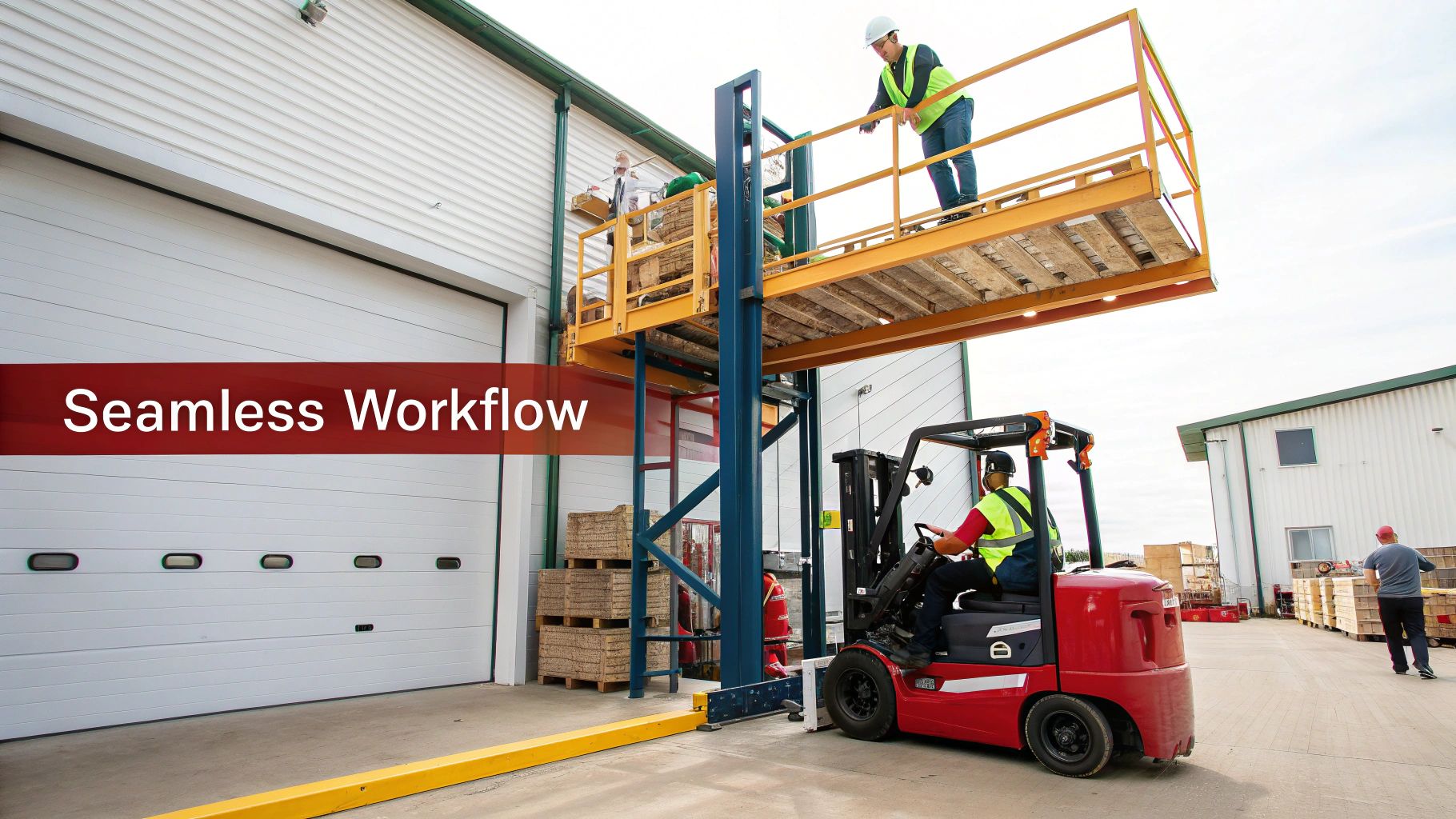
The first step is thinking about how your team will move between floors and how products will get up and down. A well-placed staircase is a must-have for staff, but you’ll need a smarter solution for shifting inventory. This is where specialised equipment is critical for connecting your operations safely and effectively.
The most common way to get goods onto a mezzanine is with a forklift. But just lifting a pallet up to an open edge is a huge safety risk. The solution? A purpose-built pallet gate, which creates a secure and controlled loading zone.
These gates are designed with a clever swing or sliding mechanism. When the gate is open for a forklift to place a pallet, a barrier automatically blocks off the edge for workers on the mezzanine. Once the pallet is safely down, the gate resets, allowing your team to access the goods while keeping the edge fully protected.
This is a non-negotiable safety feature. Think of a manufacturing business using its mezzanine for a new assembly line. A forklift on the ground can efficiently feed pallets of components up to the gate, letting workers above safely grab what they need without ever being exposed to a dangerous fall. It creates a continuous, safe, and highly efficient supply chain right inside your own facility.
Proper integration goes way beyond just moving stock. You also have to extend your warehouse’s essential services to the new level to make sure it’s a safe and productive workspace. Skipping this step can lead to serious operational headaches and compliance issues down the track.
Key integrations you’ll need to plan for include:
By treating your mezzanine as a complete operational zone—with its own access, safety, and utility requirements—you ensure it enhances your business from day one. This holistic approach is what transforms a simple storage platform into a genuine productivity booster.
At Super Rack, our experts help you plan for these crucial integrations right from the design phase. We give you the practical advice you need to ensure your warehouse racking mezzanine is not only built to last but is also a fully functional and compliant part of your operation, supported by our quality products and fast, nationwide delivery.
When you're looking at a big investment like a warehouse racking mezzanine, it's natural to have questions. Getting straight answers is the first step to making a smart decision, so we’ve put together the most common queries we get from Aussie business owners just like you.
Almost certainly, yes. A warehouse racking mezzanine isn't just a big shelf; it’s a major structural addition to your building. Because of this, it needs the green light from your local council to make sure everything is safe and up to scratch with the National Construction Code (NCC) and relevant Australian Standards.
This is where working with an experienced supplier really pays off. A team like Super Rack will provide the fully engineered drawings you need to make the council approval process as smooth as possible.
The final price tag always depends on the specifics—how much weight it needs to hold, the type of flooring you go for, and extras like stairs or safety gates. But as a ballpark figure, a pallet racking supported mezzanine in Australia typically lands between AUD 250 and AUD 400 per square metre.
When you stack that number up against the massive cost and disruption of moving to a new facility or building an extension, you can see why mezzanines are such a popular choice. It's a much more budget-friendly way to get the space you desperately need.
There's no single answer here, because the load capacity is engineered specifically for what you need to store. It’s a careful calculation based on the strength of the supporting pallet racking, the specs of the beams, and the type of flooring used.
For example:
Getting your load requirements right from the very beginning is absolutely critical for building a safe and functional structure that will last for years.
This depends on the size and complexity of the job, but you might be surprised at how quick it is. Because a warehouse racking mezzanine is a modular system, a professional team can get a small, straightforward installation done in just a few days.
Even larger, more involved projects are usually wrapped up in one to two weeks. This quick turnaround from Super Rack means less downtime for your operations, so you can start using your valuable new space much sooner.
Ready to unlock the hidden potential in your warehouse? The team at Super Rack provides expert advice, superior quality systems, and fast, nationwide delivery to help you expand efficiently.
Get in touch with our specialists today for a free, no-obligation quote!
