

A Practical Guide to Shelves in Warehouse Operations

It's easy to think of shelves in a warehouse as just static furniture, but that's a mistake. The right system is the engine of your entire operation. It's the difference between a chaotic mess and a slick, profitable workflow, and it directly impacts everything from how fast you can get an order out the door to the safety of your team.
Why Your Warehouse Shelving Is Your Greatest Asset
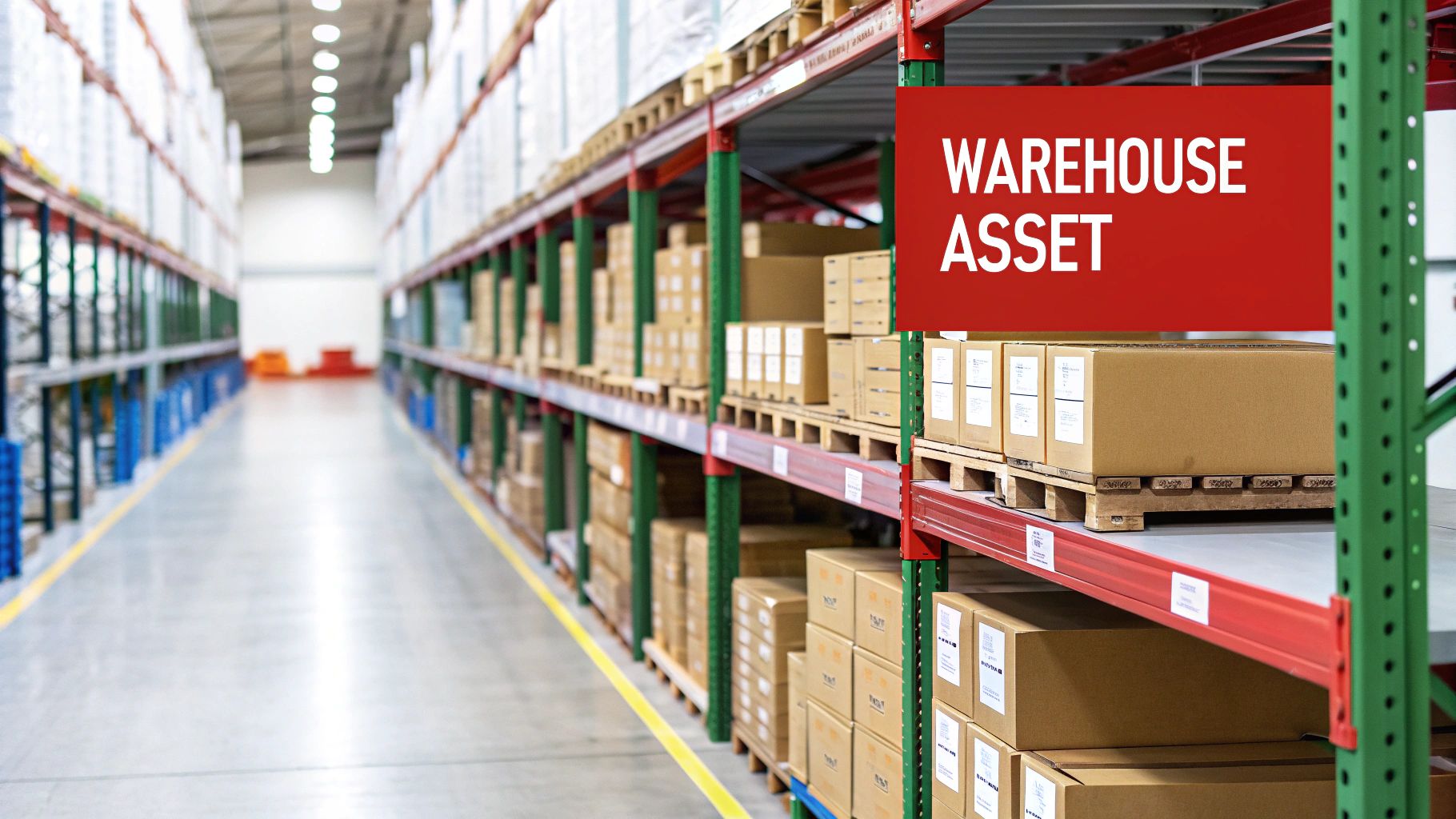
Many businesses treat shelving as a one-and-done purchase—a necessary cost when setting up shop. This view misses the bigger picture entirely. Your shelving is an active, fundamental investment that dictates your operational efficiency every single day.
A well-planned system does more than just hold stock. It organises your inventory in a logical way, making products easy to find, pick, and send out. This translates directly to faster order processing and fewer mistakes, which is exactly what you need to keep customers happy.
The Foundation of an Efficient Operation
Choosing the best shelves for your warehouse is a major strategic decision. Just look at the layout of a highly efficient retailer like Costco. Their industrial steel racks are central to their high-volume, low-cost model. They use their shelving to maximise every square metre of space, minimise product handling, and keep everything moving fast. It proves a key principle: your shelving should actively support your business goals.
The right system can help you:
- Maximise Storage Density: Use your vertical space to store more without needing a bigger building.
- Improve Workflow: A logical layout cuts down the time your team spends walking or driving between picking locations, reducing labour costs.
- Enhance Safety: Properly specified and installed shelves prevent collapses and product damage, creating a much safer work environment for everyone.
- Increase Stock Accuracy: When every single item has a designated spot, managing inventory becomes simpler and far more accurate.
Think of your shelving as a dynamic tool, not just static furniture. It’s the physical framework that your entire logistics process is built on. Get it right, and you unlock its potential to drive real productivity and profit.
At Super Rack, we get it. We provide more than just steel; we offer genuine expert advice to help you choose a system that grows right alongside your business. With superior quality materials, competitive pricing, and fast nationwide delivery, we make sure your greatest asset is built to last.
This guide will walk you through everything Australian businesses need to know to select, design, and maintain the perfect shelving for your warehouse. Let's turn a complex decision into a clear, actionable plan for success.
Decoding the Main Types of Warehouse Shelves
Picking the right shelves for your warehouse can feel like a massive job, but it really boils down to one thing: matching the system to your products. Think of it like choosing the right vehicle. You wouldn't use a sports car to haul timber, and you wouldn't use a massive truck for a quick trip to the shops.
Let's break down the main options to make it clear which one fits your operation.
The Australian warehousing market is huge—valued at around $11 billion AUD in 2024—and it's only getting bigger. With massive expansions underway in Melbourne, Sydney, and Western Australia, new facilities are being built to hold anywhere from 17,500 to over 66,000 pallets. This growth, pegged at about 3.5% annually until 2030, shows just how vital smart storage is for any modern business.
Pallet Racking: The All-Rounder
If your business moves goods on pallets, pallet racking is your go-to. It’s the most common system you’ll see in Australian warehouses, and for good reason. It’s versatile, tough, and makes incredible use of vertical space. It’s the reliable workhorse of the storage world.
Picture a busy distribution centre for a major supermarket. They're handling thousands of pallets a day, everything from soft drinks to canned veggies. They need a system that lets their forklifts get to any pallet, at any time, without having to shift a bunch of other stock out of the way.
That’s where Selective Pallet Racking comes in. It’s the most popular setup because it gives you 100% accessibility to every single pallet. This is perfect for businesses with a massive variety of products and a need for fast turnover.
- Best for: High-volume, palletised inventory and a diverse product range.
- Key Advantage: Direct access to every pallet, making it ideal for First-In, First-Out (FIFO) inventory management.
- Common Use Case: Food and beverage distribution, third-party logistics (3PL) warehouses, and general retail storage.
With a Super Rack pallet racking system, you're getting top-quality steel engineered for durability and safety. You can rest easy knowing your most valuable assets are secure. Plus, our competitive pricing and fast, nationwide delivery mean you can get your operations sorted without delay.
Cantilever Racking: For Long and Awkward Items
So, what happens when your inventory doesn't fit neatly on a pallet? What if you’re storing long, bulky, or just plain awkward items like timber, steel pipes, PVC tubing, or furniture? Trying to jam these onto standard pallet racking isn't just inefficient—it's a serious safety risk.
This is where Cantilever Racking shines. This system is designed without front vertical posts, creating wide-open, unobstructed horizontal storage levels. Think of it as a series of strong, supportive arms reaching out to hold your lengthy goods.
For example, a timber and hardware supplier needs to store packs of 4-metre-long beams and 6-metre lengths of steel pipe. cantilever warehouse racking lets them lay these items flat across the arms, giving a forklift easy access without any front posts getting in the way.
Cantilever racking is the specialist solution for items that simply won’t fit into a standard box or onto a pallet. It turns awkward inventory into an organised, easily accessible asset.
Long Span Shelving: The Flexible Option
Not everything in a warehouse is heavy enough to need a forklift. For businesses dealing with hand-picked items, spare parts, or archive boxes, long span shelving is the perfect fit. It’s a lighter-duty system but still incredibly strong and versatile, designed for stock that’s loaded and unloaded by hand.
Think of an e-commerce business selling a huge range of products, from small electronics to boxes of clothing. Their team needs to grab individual items fast to get customer orders out the door. Long span shelving provides wide, open shelf spaces that can be easily adjusted to fit products of all shapes and sizes, making it perfect for this kind of fast-paced, manual picking.
- Best for: Hand-loaded goods, archive boxes, spare parts storage, and e-commerce fulfilment centres.
- Key Advantage: It's highly customisable and adjustable, letting you adapt the shelving to your ever-changing inventory.
- Common Use Case: Backroom storage for retail shops, workshops, and small parts distribution.
Choosing the right shelves really comes down to knowing your products and your workflow. Whether you need the heavy-lifting muscle of pallet racking, the specialised design of cantilever, or the flexible nature of long span shelving, making the right choice lays the foundation for a safe and efficient operation.
How to Choose the Right Shelves for Your Business
Choosing the right shelves in a warehouse is more than just filling an empty space—it’s a fundamental decision that dictates how your entire operation runs. Nail this, and you set yourself up for efficiency and growth. Get it wrong, and you'll be dealing with bottlenecks and safety risks for years.
To get it right, you need to answer four key questions, starting with the most critical one: how much weight can your shelving handle?
Understanding Your Load Capacity
First things first, you have to know the weight of the goods you’ll be storing. And this is not the time for guesswork. Overloading racks is one of the most common—and dangerous—mistakes in any warehouse, leading to catastrophic collapses that can destroy inventory and seriously injure your team.
Start by calculating the maximum weight of a single, fully loaded pallet or box. Next, multiply that by the number of items you plan to put on one shelf level. This figure gives you the Uniformly Distributed Load (UDL) capacity you need, which is just the technical term for the total weight a shelf can safely hold when everything is spread out evenly.
Always choose shelving with a load rating that is comfortably higher than your calculated maximum weight. Think of it as a non-negotiable safety buffer. It’s the bedrock of a secure and compliant storage system.
At Super Rack, safety is our priority. Our products are built from high-quality steel with clear load ratings, so you know exactly what you’re getting. Our team is always on hand to provide expert advice, ensuring you get a system perfectly matched to what you’re storing.
Analysing Your Space and Layout
Next up, grab a measuring tape. You need the exact dimensions of your facility—the total floor area, the location of any pesky columns or doorways, and especially the clear height. That’s the usable space from the floor to the lowest hanging obstacle, like a sprinkler head or light fitting.
These numbers will tell you how high you can build your racking and how the layout will flow. A massive consideration here is aisle width. You need enough room for forklifts, pallet jacks, and people to move around without bumping into each other. Wider aisles make life easier, but narrower aisles can boost your storage capacity by up to 40%. It’s a classic trade-off between easy access and sheer volume.
Think about how goods move through your warehouse. Where do they arrive? Where are they stored? Where do they get dispatched? A smart layout that follows this natural workflow will cut down travel time and prevent logjams, making your whole operation smoother.
Matching Shelving to Your Inventory Type
The kind of products you handle is the biggest clue to the style of shelving you need. Are you dealing with neat, uniform pallets coming straight from a supplier? Or are you picking and packing a chaotic mix of different-sized boxes for online orders?
This simple visual guide helps break it down based on what you're storing.
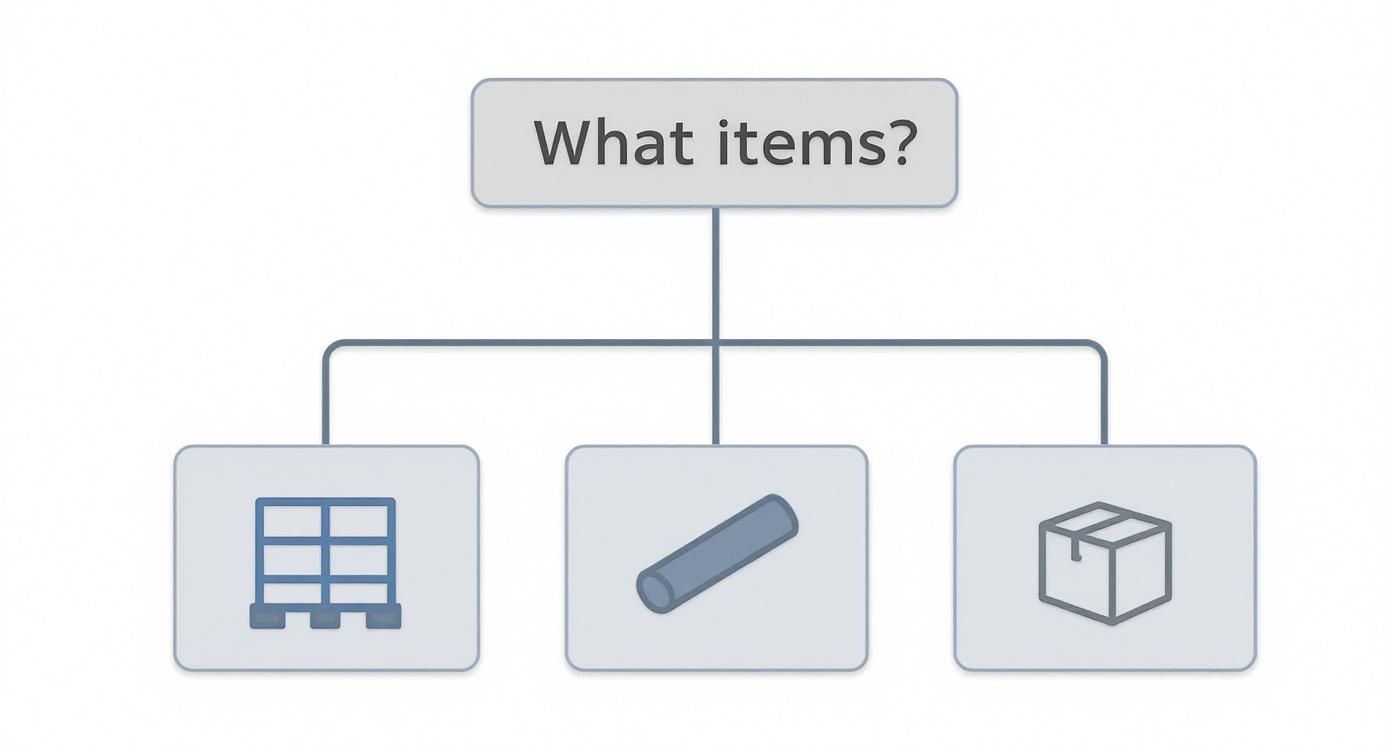
As you can see, the physical shape and size of your inventory—whether it’s on a pallet, long and awkward, or small enough to be picked by hand—points you directly to the best storage solution.
- Standard Pallets: If you mostly store uniform, palletised goods, standard pallet racking is the undisputed champion for its strength and efficiency.
- Long or Awkward Items: For anything like timber, pipes, or furniture, you need the unobstructed horizontal space that only cantilever warehouse racking can provide.
- Mixed, Hand-Picked Goods: If you’re managing varied items like archive boxes or e-commerce stock, the versatility of long span shelving is the perfect fit.
Considering Your Workflow and Accessibility
Finally, how does your team actually handle the stock day-to-day? Your picking and packing methods should be a major factor in your decision.
For instance, a business with a high turnover of many different product lines needs a system where every single item is accessible at all times. This calls for a selective pallet racking system, which is ideal for a "First-In, First-Out" (FIFO) workflow because no pallet is ever blocked in.
On the other hand, an operation that stores huge quantities of the same product might prefer to maximise storage density over immediate access to every pallet. Thinking through these daily processes ensures you end up with a system that doesn’t just hold your goods, but actively makes your team more productive.
By carefully working through these four areas—load, space, inventory, and workflow—you'll have all the information you need to make a smart choice. With Super Rack’s competitive pricing and fast, nationwide delivery, you can get the right solution in place to drive your business forward.
Designing a Warehouse Layout for Maximum Efficiency
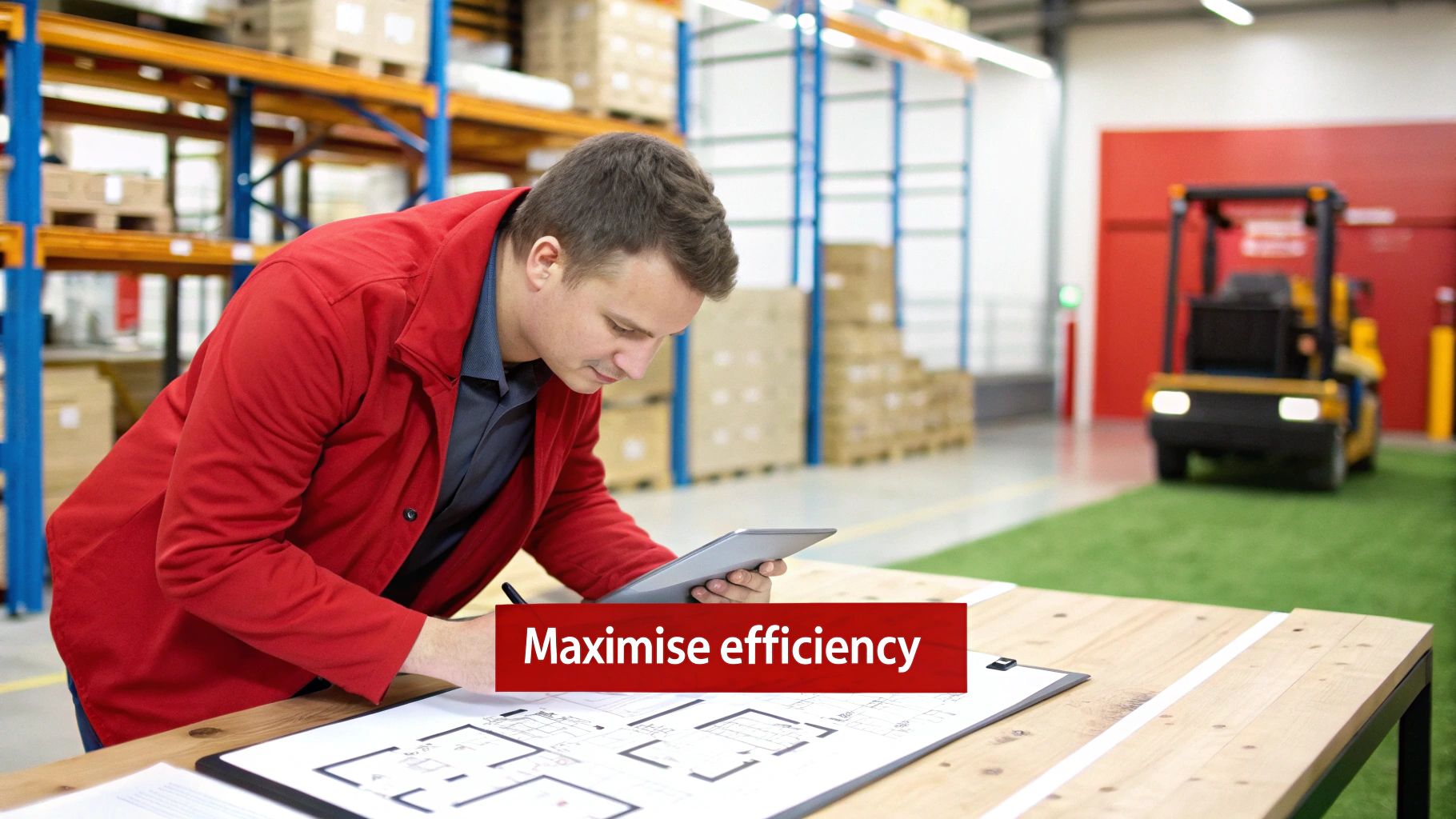
Once you’ve picked the perfect shelves in warehouse operations, the next big win comes from your layout. A smart floor plan is your blueprint for a high-performance operation, turning a simple storage area into a streamlined logistics hub.
It's all about making every square metre work for you. Get the layout right, and you’ll slash travel times, prevent frustrating bottlenecks, and create a much safer environment for your team.
Creating Logical Zones for a Smooth Workflow
Think of your warehouse as a series of connected zones, each with a specific job. This isn't just about sticking shelves wherever they fit; it’s about mapping out a logical path for inventory to follow from the moment it arrives to the second it leaves.
Most setups are broken down into a few key zones:
- Receiving: This is your entry point. Here, incoming stock is unloaded, checked, and booked into your system before being put away.
- Storage: The main event. This is where your shelves and racking hold inventory until it's needed. Keep your fast-movers close to the front for quick access!
- Picking: Where orders are pulled together. This area needs to be optimised for speed and easy access to your most popular products.
- Packing and Dispatch: The final stop. Orders get packaged up, labelled, and ready to head out the door.
By organising these areas logically, you create a one-way flow that cuts down on congestion and wasted movement, saving serious time and money.
Balancing Aisle Width and Storage Density
One of the biggest calls you'll make is how wide to make your aisles. This single decision has a huge impact on how many shelves you can fit and how easily your team can get around.
Wide aisles give forklifts plenty of room to manoeuvre safely, which is non-negotiable for heavy, palletised goods. The trade-off? That convenience eats into your total storage space.
Narrower aisles, on the other hand, can dramatically increase your storage density. By shrinking the gap between rows, you can pack more racks into the same footprint. Just remember, this often means you’ll need specialised gear like narrow-aisle forklifts. It's the classic compromise between accessibility and capacity.
Maximising Your Vertical Space
Don't just think horizontally—look up! Your warehouse's vertical space is one of its most valuable, and underused, assets. Taller racking systems can effectively double your storage capacity without needing to expand your building. That’s a game-changer for businesses wanting to grow without the massive cost of moving to a bigger site.
This kind of thinking is essential in the Australian warehousing sector. Valued at around AUD 13.5 billion in 2025, the industry is booming thanks to e-commerce and more complex supply chains. Efficient space use isn't just a "nice-to-have" anymore; it's what keeps you in the game.
To take it a step further, integrating technology like shelf tracking systems for smart inventory management can provide the real-time data needed to make your layout even more effective.
At Super Rack, we offer expert advice to help you design a layout that squeezes every bit of potential from your space. A well-thought-out design, combined with professional installation, makes sure your warehouse is both efficient and safe. If you're planning a new setup, our guide to installing warehouse racking is packed with insights for getting it right from day one.
A Practical Guide to Shelving Safety and Maintenance
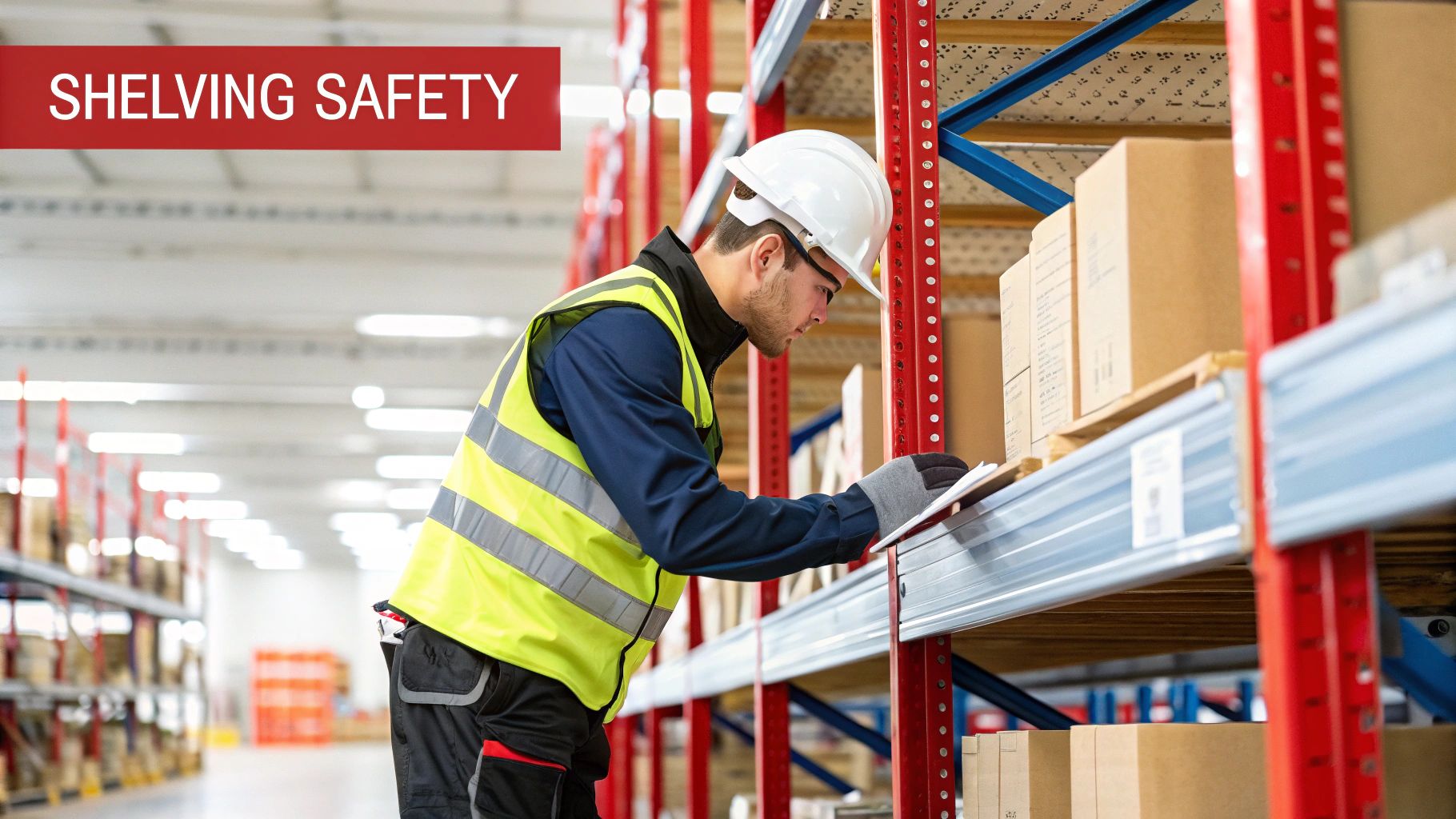
In a fast-paced warehouse, safety isn't a box-ticking exercise—it's got to be part of the culture. Well-maintained shelves in a warehouse are the backbone of a safe workplace, but letting things slide can lead to serious accidents. This is your no-nonsense guide to compliance and upkeep, so you can protect both your team and your inventory.
First things first: professional installation is non-negotiable. While a DIY job might look like it's saving you a few dollars upfront, the risks are huge. An improperly installed system can buckle under load, leading to a catastrophic collapse. Always bring in certified installers who know the engineering inside and out and work to Australian safety standards.
Complying with Australian Standards
Here in Australia, the key document you need to know is AS 4084-2012 Steel Storage Racking. Think of this less as a recommendation and more as the benchmark for ensuring your racking is designed, installed, and maintained the right way.
Sticking to AS 4084-2012 means you're covering off the essentials:
- Correct Installation: The system has to be put together exactly as the manufacturer intended.
- Clear Load Limits: Every single beam and bay needs clear signage showing its maximum load capacity. No guesswork allowed.
- Regular Inspections: The standard requires frequent inspections to spot and fix damage before it turns into a major hazard.
A proactive approach to safety is always cheaper than a reactive one. Investing in new, compliant shelving from a trusted supplier like Super Rack is your first and best line of defence against accidents, damage, and potential fines.
When you're figuring out how to manage risks, a structured approach like the hierarchy of control measures is the best way to systematically make your operations safer. The idea is to eliminate hazards wherever possible, rather than just relying on personal protective equipment as a last resort.
Your Routine Inspection Checklist
Regular visual checks are your early warning system. Get your team on board by training them to look for these common red flags:
- Bent or Dented Uprights: Even a small knock from a forklift can seriously weaken an upright's structural integrity.
- Damaged or Bowing Beams: If a beam is sagging in the middle, it's a dead giveaway that it's overloaded.
- Missing or Damaged Safety Pins: These little clips are what stop beams from being accidentally knocked out of place. They are absolutely critical.
- Corrosion or Rust: Any sign of rust is a sign of weakening steel, which reduces its load-bearing capacity over time.
While these quick checks are vital, they don't take the place of a formal, professional assessment. To keep your racking fully compliant and genuinely safe, it's worth learning more about the requirements for certified pallet racking inspections and how they protect your business.
Small Investments That Prevent Big Accidents
Beyond regular checks, a few simple additions can make a massive difference to the safety of your shelves in the warehouse. Upright protectors, for example, are a cheap and effective way to shield the most vulnerable parts of your racking from forklift bumps. Likewise, high-visibility guards or paint on corners can help prevent collisions in the first place.
By combining professional installation, strict adherence to Australian Standards, routine maintenance, and a few smart safety accessories, you build a warehouse where efficiency and safety aren't competing priorities—they work together. With Super Rack’s quality products and expert advice, you can create a storage system that’s not just productive, but fundamentally safe.
The Future of Warehouse Storage Solutions
Warehouse operations are getting smarter, and the shelves in your warehouse need to keep up. The future isn't about ripping out traditional storage; it's about blending it with new tech to build hyper-efficient spaces. For Aussie businesses, that means planning today for the automation and flexibility you'll need tomorrow.
Investing in a tough, high-quality shelving system now gives you the strong foundation needed to bolt on the technology of the future. Think of it as future-proofing your operations by choosing a framework that can evolve right alongside your business.
The Rise of Automation and Smart Shelving
Automation isn't some far-off concept anymore—it's here, and it's reshaping modern logistics. A perfect example is Automated Storage and Retrieval Systems (AS/RS), where robotic cranes and shuttles work in sync with traditional racking to grab and store goods with incredible speed and accuracy.
Picture a warehouse where robots glide down aisles, picking items and ferrying them to a central packing station. This massively cuts down on manual labour for repetitive jobs, slashes human error, and ramps up order fulfilment times. It frees up your team to focus on more complex, valuable work.
This push towards automation is a major trend transforming Australian warehouses. With e-commerce volumes still climbing, businesses need better storage density and faster picking. This has driven the adoption of robotic systems, RFID tracking, and scalable shelving built for fluctuating stock levels. You can explore more insights on the Australian pallet racking sector to see how these market shifts are playing out.
Adaptable and Modular Systems
The future is also flexible. As your business pivots, your storage system should be able to pivot with you. That's where modular and adaptable shelving systems really shine. They're designed to be easily reconfigured, expanded, or adjusted without needing a complete, costly overhaul.
Think of modular shelving like building blocks for your warehouse. You can add sections, adjust shelf heights, or even change the layout entirely to handle new product lines or a sudden shift in demand. This versatility makes sure your initial investment keeps paying off for years to come.
For instance, a business might kick off with standard pallet racking but later decide to integrate carton flow lanes for faster picking of small items. A modular design makes this kind of upgrade seamless.
Choosing high-quality, durable shelving from Super Rack gives you this built-in adaptability. Our systems are engineered to last and designed for versatility, providing the perfect backbone for whatever tech comes next. With nationwide service and expert advice, we can help you build a storage solution that’s ready for today's demands and tomorrow's innovations. To start building your future-proof warehouse, speak with a Super Rack expert today and see how our superior quality shelving can support your growth.
Your Top Warehouse Shelving Questions Answered
When you're fitting out a warehouse, you're bound to have questions. Getting the right answers from the start helps you make a smart investment that pays off for years to come. Here’s our take on some of the most common queries we get from customers.
What Is the Real Difference Between Shelving and Racking?
This is a classic point of confusion, but the answer is pretty simple. It all comes down to how you handle your stock.
Shelving is built for things you load and unload by hand. Think archive boxes, spare parts bins, or individual products in a small e-commerce operation. Systems like long span shelving are perfect for this, giving your team wide, easy-to-access shelves for manual picking.
Racking, on the other hand, is the heavy-duty stuff. It’s engineered to hold palletised goods that are moved around by forklifts and other machinery. Pallet racking is the absolute workhorse of large distribution centres and warehouses handling bulk inventory. It’s built to take far heavier loads than any standard shelving could safely manage.
How Often Do My Warehouse Shelves Need to Be Inspected in Australia?
To stay compliant with Australian Standard AS 4084-2012, your pallet racking must be formally inspected by a qualified person at least once every 12 months. This is non-negotiable. It’s a critical check-up to spot structural damage, ensure you’re meeting safety codes, and keep your workplace safe.
But don't just rely on the annual check. Best practice is to get your own team into the habit of doing regular visual inspections. A quick walk-through to spot bent uprights, damaged beams, or missing safety pins can help you catch a small problem before it turns into a major hazard.
Is It Safe to Install Warehouse Shelving Myself?
Look, we get the temptation to save a few dollars, but when it comes to industrial storage, DIY installation is a really bad idea. We strongly discourage it. Getting a professional installer is non-negotiable for making sure your system is assembled correctly, anchored securely, and meets all safety standards.
A pro knows exactly how to meet the engineering specs, get the system perfectly level, and verify it can handle the manufacturer’s stated load capacity. Skimping on this step isn't just risky; it could lead to a catastrophic system failure that puts your team and your inventory in danger.
How Do I Accurately Calculate the Load Capacity I Need?
When it comes to load capacity, guessing just won’t cut it. To do it right, start by figuring out the absolute maximum weight of a single, fully loaded pallet or box you plan to store.
Once you have that number, multiply it by how many of those items will sit on one beam level. That final figure is your Uniformly Distributed Load (UDL), and it tells you the minimum capacity your shelf level needs. Always play it safe—choose a system with a certified load rating that’s comfortably above your maximum calculation. That buffer is your margin of safety.
At Super Rack, we do more than just sell high-quality steel. We provide the expert advice you need to build a storage system that's safe, efficient, and fully compliant. Our team is ready to help you navigate these questions and find the perfect solution for your business. Explore our range of superior storage solutions at https://www.superrack.com.au.