

Article
Drive in Pallet Racking: Is It Right for Your Warehouse?

When floor space is tight, drive-in pallet racking offers a seriously high-density storage solution. It’s designed to let a forklift drive right into the racking structure itself to place or retrieve pallets. By getting rid of most of the aisles you’d see in a standard setup, this system can dramatically increase your storage capacity. It's an absolute game-changer for warehouses that handle large volumes of the same product.
Understanding Drive In Pallet Racking
Picture a massive block of storage with deep lanes, but no aisles in between. That’s drive in pallet racking. It’s a powerful way to turn your floor space into a highly efficient storage cube, squeezing the absolute maximum capacity out of your warehouse.
Instead of traditional aisles that eat up valuable real estate, forklift operators simply drive into these deep storage lanes. They place pallets onto horizontal rails that run the full depth of the structure. It’s one of the most space-efficient systems out there, often boosting a warehouse’s storage capacity by up to 75% compared to standard selective racking.
The LIFO Principle Explained
At its heart, drive in racking operates on a Last-In, First-Out (LIFO) principle. This means the last pallet you put into a lane is the first one you have to take out.
Think of it like stacking plates in a cupboard. You load plates in from the front, and the last one you put in is always the first one you grab.
This makes the system a perfect match for:
- Bulk Goods: Ideal for storing huge quantities of identical products that don't have a short shelf life.
- Batch Production: A great fit for manufacturers producing big, uniform batches of the same item.
- Seasonal Items: Perfect for storing goods that get moved in and out of the warehouse all at once.
For example, a beverage company in Sydney might use a drive in system to store thousands of pallets of a single soft drink. Since every pallet is the same, it doesn’t matter which one gets picked first, making the LIFO method a no-brainer.
Drive In vs Drive-Through Racking
It’s easy to mix up drive in racking with its close cousin, drive-through racking. They look almost identical, but how they work is fundamentally different.
The key difference is access. Drive in racking has only one entry and exit point, forcing you to use the LIFO method. Drive-through racking, on the other hand, is open at both ends. This lets a forklift enter from one side to load a pallet and exit from the other side to retrieve one.
This two-sided access allows for a First-In, First-Out (FIFO) inventory system. This is crucial for perishable goods or any product with an expiry date. The choice between them really comes down to your specific products and how you need to rotate your stock.
At Super Rack, our team has the experience to help you figure out which system makes sense for your operation. We’ll make sure the solution aligns perfectly with your goals, delivering top-quality racking with fast, reliable service across Australia. You can learn more about our pallet racking solutions and find the perfect fit for your warehouse.
The Key Advantages of High-Density Storage
Putting your money into a new storage system is a big deal, and you need to see real, tangible benefits. The number one reason Australian businesses go for drive-in pallet racking is its incredible ability to squeeze the most out of every square metre. By getting rid of most of the aisles you’d need for standard racking, you can claw back a massive amount of floor space for actual storage.
This directly translates to a huge jump in storage capacity. We’re talking about boosting your pallet positions by up to 75% compared to a typical selective racking layout. For businesses feeling the pinch of rising rent and property costs, that kind of efficiency can be the difference between moving to a bigger, pricier warehouse and making the one you've already got work harder.
Unlocking Maximum Space Efficiency
Let's put that into perspective. Imagine a Melbourne-based food distributor working out of a 2,000-square-metre warehouse. With their current selective racking, they're bursting at the seams and staring down the barrel of a costly expansion. By redesigning their layout with a drive-in pallet racking system, they could potentially fit the same amount of stock into just 1,200 square metres.
Suddenly, they’ve freed up a massive 800 square metres for future growth, new product lines, or even a dedicated packing area—all without spending a cent on moving or construction. The system simply turns wasted aisle space into valuable, revenue-generating storage.
This infographic breaks down the core ideas that make drive-in pallet racking such a powerhouse for high-density storage.
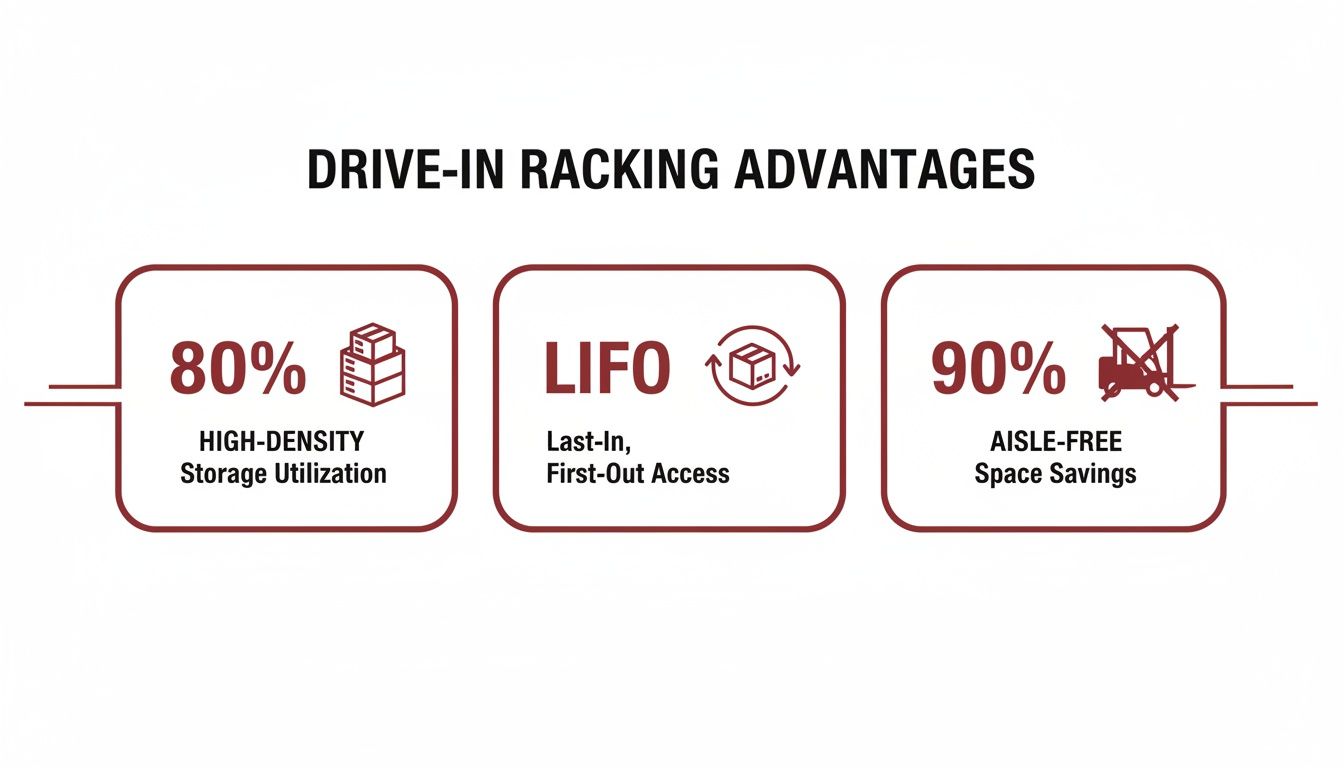
As you can see, the blend of dense packing, LIFO inventory management, and an aisle-free design creates an incredibly effective solution for bulk storage.
A Smart and Cost-Effective Investment
Beyond just saving space, drive-in racking is also one of the most budget-friendly high-density options out there. The design is straightforward and uses fewer components than more complicated systems, which means a lower upfront investment for you.
When you break it down to the cost per pallet position, drive-in racking almost always comes out on top. For businesses handling large volumes of the same product, this means a quicker return on your investment and a lower total cost of ownership over the system's life.
The real value of drive-in pallet racking is its ability to reduce your cost-per-pallet stored. By storing pallets deep within continuous lanes and eliminating aisles, you can dramatically increase your storage capacity, potentially delaying the need for expensive warehouse expansions.
This unmatched cost-effectiveness is a game-changer for budget-conscious warehouse managers all over Australia. In a market where property costs are always climbing, getting the most out of your current footprint is just plain smart business. You can read more about how this system boosts capacity.
Energy Savings in Cold Storage
The benefits of high-density storage become even clearer in cold or freezer environments. In these facilities, every single cubic metre of chilled air costs money to maintain. The compact nature of a drive-in racking system shrinks the total volume of refrigerated space that needs to be cooled.
This leads to significant cuts in energy consumption and lower power bills, month after month. For businesses in the food, beverage, or pharmaceutical industries, these ongoing operational savings can be massive, making drive-in racking an exceptionally smart choice for any temperature-controlled warehouse.
At Super Rack, we make sure our systems are engineered from superior quality steel, giving you the structural integrity needed to operate safely and reliably in any environment. With our competitive pricing, nationwide service, and expert advice, we can help you unlock these powerful operational and financial advantages in your warehouse.
Ideal Applications for Drive In Pallet Racking Systems
So, when does drive in pallet racking actually make sense for an Aussie warehouse? It's one thing to talk about high-density theory, but it's another to see where this system truly earns its keep. The truth is, it’s not a one-size-fits-all solution; it’s a specialist tool that excels in very specific situations.
Knowing these sweet spots is key to understanding if it’s right for you. Let's dig into the industries and scenarios where drive in racking really delivers, solving real-world storage headaches for businesses across the country.
Cold and Freezer Storage
If there’s one place drive in racking is king, it's in cold and freezer storage. We're talking about food processing plants, dairy distributors, and frozen food warehouses. In these places, every single cubic metre of chilled air costs a fortune to build, maintain, and run.
By getting rid of most of the aisles, a drive in system shrinks the refrigerated footprint you need to store the same volume of goods. That means less air to keep cold, which translates directly to lower energy bills. For any business where power is a major overhead, that efficiency is a massive financial win.
The big advantage in cold storage is squeezing every bit of value out of your space. Products are often uniform—like cartons of frozen pies or tubs of ice cream—and stored in huge batches, making the LIFO (Last-In, First-Out) inventory method a perfect fit.
This is exactly why you'll see drive in racking up and down the cold chain, from Perth to Brisbane. It’s a smart investment that pays for itself in ongoing energy savings.
Bulk Storage for Manufacturers
Manufacturing is another perfect match for drive in racking. If you're producing massive, uniform batches of a single product, this system offers incredible storage density. The Last-In, First-Out principle simply doesn't matter when every pallet is identical.
Picture these scenarios:
- Beverage Companies: Stacking thousands of pallets of the same soft drink, beer, or bottled water before it ships out.
- Canned Goods Producers: Warehousing huge quantities of canned veggies, fruit, or soup.
- Building Material Suppliers: Holding bulk pallets of identical items like tiles, bricks, or bags of cement.
In every case, the aim is to cram as much of one product as possible into the space you have. Because the goods aren't perishable and are sent out in large, identical orders, the LIFO system is no problem at all. It’s just pure, unadulterated storage volume.
For warehouse managers, this system can boost storage density by 60-75% compared to standard selective racking by cutting out aisles. That’s a game-changer when industrial land costs in cities like Sydney are sky-high.
Warehousing for Seasonal Goods
Businesses dealing with seasonal stock can also get huge value from drive in pallet racking. Think of a company selling Christmas decorations, winter gear, or outdoor summer furniture. These items usually arrive in massive shipments and sit in storage for months before flying out the door all at once.
During the off-season, the main goal is to store these goods as tightly and cheaply as possible. Drive in racking lets you pack these seasonal items away, freeing up prime floor space for faster-moving products the rest of the year.
When the season kicks off, the entire stock of one item can be cleared from a lane quickly and easily. This makes drive in racking a seriously practical and budget-friendly way to handle the peaks and valleys of seasonal demand.
At Super Rack, our team can look at your specific inventory and workflow to see if drive in racking is the right fit. We offer top-quality racking at competitive prices, with fast delivery and nationwide service to help you solve your biggest storage challenges.
Essential Design and Layout Considerations
Putting a drive in pallet racking system in place is about much more than just buying some steel and bolting it together. A truly successful, safe, and efficient layout comes from careful planning and a solid grasp of a few key factors. Nailing these details from the get-go is the only way to make sure your system delivers maximum value and doesn't cause costly headaches down the line.
The whole design process is a bit of a balancing act between cramming in as much stock as possible and keeping things running smoothly. You have to think about how your team, your forklifts, and your products will all interact with the racking every single day. Miss just one detail, and you could be looking at bottlenecks, wasted space, or even serious safety hazards.
Forklift Specifications and Lane Width
The type of forklift you use is probably the single biggest factor that shapes your drive-in racking design. The size and turning circle of your machine directly sets the minimum width for each storage lane. A standard counterbalance forklift, for instance, is going to need a lot more room to move than a nimble reach truck.
This decision has a massive knock-on effect on your total storage density.
- Wider Lanes: These make life easier for your operators. They can get in and out faster, and there's less risk of bumping into the uprights. The downside? You'll fit fewer lanes across your warehouse floor.
- Narrower Lanes: Using more specialised forklifts lets you squeeze the lanes closer together, maximising every square metre. The trade-off here is that it takes a more skilled operator to navigate those tight spaces safely.
It’s the classic dilemma: speed and ease of use versus pure storage numbers. You absolutely have to design the racking to suit the forklift, not the other way around.
Pallet and Product Dimensions
The data on your pallets is the bedrock of the entire design. You need to know the exact length, width, height, and weight of your typical loaded pallet. These numbers dictate everything, from the vertical gap between support rails to the overall depth and height of each bay.
Getting an accurate read on your pallet loads is critical for both safety and simple functionality. Overload the system or get the size wrong, and you could compromise the whole structure. Underestimate the height, and you'll either waste vertical space or end up with pallets that just won't fit.
When planning your system, always design for the biggest and heaviest pallets you'll ever handle. This ensures all the structural parts, like the support rails and upright frames, are up to the job. The strength of the horizontal supports is paramount, which is why understanding the specs of key components like our pallet racking beams is so important for building a system that lasts.
Structural and Facility Limitations
Before you even think about ordering steel, you need to take a good, hard look at your building. A number of physical constraints will shape the final design of your drive-in racking layout.
Here are the big ones to watch out for:
- Floor Quality: That concrete slab has to be strong enough to take the massive point loads from the racking uprights, especially when they're full. You'll often need a professional structural assessment to confirm it can handle the weight.
- Ceiling Height: The clear internal height of your building—after you account for sprinklers, lights, and ducting—sets the absolute maximum height for your racking.
- Building Columns: The location of your building's support columns will dictate where racking lanes can and can't go, forcing you to design around them.
At Super Rack, our experts are here to help you navigate these challenges. We’ll work with you to create an optimised and compliant layout that fits your building’s unique quirks, ensuring a safe and efficient installation with our fast, nationwide service.
Navigating Australian Safety and Compliance Standards
In any Aussie warehouse, safety comes first. No exceptions. When you bring a drive-in pallet racking system into your facility, you're not just adding storage space—you're taking on a serious responsibility to keep your team safe and your stock secure.
This means you've got to play by the rules, and the most important rulebook is the Australian Standard AS 4084:2023 for steel storage racking. Think of this standard as the non-negotiable benchmark for safe racking in Australia. It's not just a guideline; it covers everything from the quality of the steel to how the system is installed and maintained, ensuring your workplace is both compliant and safe.
Understanding AS 4084 in Simple Terms
So, what does AS 4084 actually mean for your day-to-day operations? It really boils down to a few key things every warehouse manager needs to have locked down.
First up is certified load capacity. Every single part of your racking must have clear, easy-to-read signs showing its Safe Working Load (SWL). This isn't a ballpark figure; it’s an engineered rating that tells your forklift operators the absolute maximum weight a bay can hold. Overloading is one of the fastest ways to invite a catastrophic collapse.
Next, the standard is strict about correct installation procedures. Your drive-in racking has to be put together by qualified professionals who follow the manufacturer’s instructions to the letter. This guarantees the structure is plumb, level, and securely anchored to the floor, giving it the stability it needs to stand up to the daily grind.
Mandatory Inspections and Common Risks
A major part of AS 4084 is the requirement for regular checks. You are legally required to have your racking inspected by a competent professional at least once every 12 months. This formal audit looks for damage, confirms everything is still compliant, and flags potential hazards before they turn into serious incidents.
Don't underestimate the power of daily checks by your own crew. Encourage your forklift drivers to report any knock, scrape, or dent straight away, no matter how minor it seems. A small bump today can weaken the structure and lead to a major failure down the track.
Because forklifts drive right into the racking, the risk of accidental impact is naturally higher with drive-in systems. The most common trouble spots include:
- Upright Damage: The front columns are the most exposed part of the rack. A solid hit here can compromise the entire bay’s strength.
- Rail Damage: Any impact on the pallet support rails can reduce their load-bearing capacity.
- Bracing Damage: If the horizontal or diagonal braces get damaged, the whole system can lose its stability.
To counter these risks, fitting protective gear is a must. Upright protectors act like a bumper bar for your racking, absorbing the force from low-level bumps and scrapes. On top of that, guide rails on the floor can help steer forklifts safely down the middle of the lane, drastically cutting the chances of contact with the frame. For an extra layer of protection for your team and walkways, exploring options like safety control barriers is a smart move.
At Super Rack, we don't just sell racking—we deliver peace of mind. All our systems are engineered to meet and exceed Australian Standards, using high-quality materials. Our expert team is here to offer professional advice and service nationwide, making sure your drive-in pallet racking is safe, compliant, and built to last.
Partnering with Super Rack for Your Storage Solution
Choosing the right racking system is a huge decision, but it’s not one you have to make on your own. Now that you've seen the benefits, applications, and safety standards of drive in pallet racking, the next step is finding a partner who gets your operational needs and can deliver a solution that actually works. This system is a powerful tool for maximising storage density, but only when it’s designed and installed correctly for your specific inventory.
At Super Rack, we keep the process simple and straightforward. It all starts with a chat.
Our Collaborative Process
We believe in a hands-on approach, working with you from the initial idea right through to the final sign-off. Our goal is to provide a complete solution that’s safe, efficient, and gives you real value for money.
Our simple, four-step process gets it done right:
- Initial Consultation: We start with a free, no-obligation chat to understand your goals, your inventory, and your warehouse layout. This is where we listen to your challenges and start mapping out a practical solution.
- Expert Design: Our experienced team designs a custom drive in pallet racking layout that gets the most out of your space while meeting all Australian safety standards. We consider everything from your forklift type to your product flow.
- Clear Quoting: You’ll get a detailed quote with competitive AUD pricing. We’re committed to providing superior quality materials and exceptional value, with no hidden surprises.
- Nationwide Installation: Our professional installation teams operate across Australia, making sure your system is assembled correctly, safely, and with minimal disruption to your business.
The Super Rack Advantage
What sets us apart is our commitment to being more than just a supplier; we’re your storage solution partner. We combine top-tier products with genuine expertise to ensure you get the best possible outcome for your investment.
Choosing a partner for a major capital expense like pallet racking comes down to trust. You need to know the advice is sound, the product is high-quality, and the service will be there when you need it. That's the foundation of our business.
With Super Rack, you get superior quality steel racking, fast delivery to keep your project on track, and practical advice from a team that truly knows storage.
Ready to see how drive in pallet racking could transform your warehouse? The next step is easy. Contact our friendly team today for a free assessment and quote. Let’s work together to unlock your warehouse’s true potential.
Frequently Asked Questions
We get a lot of questions about drive-in pallet racking, so we've put together some straight answers to the most common ones. This should clear up a few things and help you figure out if it's the right fit for your warehouse.
How Do I Know If Drive-In Racking Is Right for My Business?
Drive-in racking is a game-changer if you store huge volumes of only a handful of different products. It’s built from the ground up for businesses using a Last-In, First-Out (LIFO) inventory system.
Think non-perishable goods, seasonal stock, or bulk materials where the order you pick them in doesn't matter. If that sounds like your operation, you’re on the right track. However, if you need to get to every single pallet at a moment's notice, you’ll be better off with a standard selective racking system.
What Kind of Forklift Do I Need for a Drive-In System?
You can use a standard counterbalance forklift, but they’re bulky and need wider lanes, which eats into your storage space a little.
To really get the most out of your floor space, a reach truck or a narrow aisle forklift is the way to go. It's absolutely critical that the racking is designed to match your specific forklift to keep things safe and running smoothly. Always double-check with your racking supplier that your equipment is compatible.
How Much Does Drive-In Pallet Racking Cost in Australia?
The final price tag really depends on a few things: how high the system is, how deep the storage lanes are, how much weight it needs to hold, and the overall complexity of the layout.
Even with those variables, drive-in pallet racking almost always offers one of the lowest storage costs per pallet when you compare it to other high-density options. The best way to get a firm price in AUD is to ask our team at Super Rack for a detailed, no-obligation quote based on your warehouse specs.
How Often Should My Drive-In Racking Be Inspected?
This one is non-negotiable. Under Australian Standard AS 4084:2023, you are legally required to have your racking inspected by a certified professional at least once every 12 months. It’s a key part of maintaining a safe and compliant workplace.
On top of the official annual audit, we can't stress this enough: get your own team to do regular visual checks. A quick walk-through to spot dents, scrapes, or any other forklift damage should be part of your routine. Reporting these small issues immediately is the best way to prevent a major failure down the line.
Ready to see how drive-in pallet racking could transform your storage capacity? The team at Super Rack is here to offer expert advice and a free, no-obligation quote that’s built around your business. With top-quality products, competitive pricing, and fast service across Australia, we're your partner for smarter storage solutions. Visit us at https://www.superrack.com.au to find out more.