
Looking for "pallet racking 2nd hand" often starts with one goal: saving money. For any Aussie business keeping an eye on the budget, a lower price tag is tempting. But that initial saving can be misleading, with the real cost appearing later through safety issues, compliance headaches, and unexpected bills.
The True Reality of Second Hand Pallet Racking
Buying used pallet racking is a big gamble. While the upfront cost is lower, you are buying a system with a completely unknown and often untraceable history.
It’s like buying a used car without a service book or a roadworthy certificate. It might look okay on the outside, but hidden problems could lead to a catastrophic failure when you need it most.
In a warehouse, a failure could mean a full structural collapse, putting your staff in danger and destroying thousands of dollars in stock. The appeal of saving a few dollars fades quickly when you’re facing potential workplace accidents, big fines for not meeting Australian safety standards, and costly downtime for your business.
What Are the Immediate Risks?
Choosing a second-hand system brings a host of risks into your business from day one. Unlike new pallet racking, which comes with guaranteed quality and compliance certificates, a used system gives you a long list of uncertainties that you, the buyer, now have to solve.
These risks include:
- Unknown Load History: You have no idea if the racking was constantly overloaded in its past life. This can cause invisible metal fatigue, seriously weakening its structural integrity.
- Hidden Structural Damage: Small dents from forklift bumps, patches of rust, or poor repairs can be easy to miss, but they can dramatically reduce the rack's safe load capacity.
- No Manufacturer Warranty: If a beam or frame fails, you're on your own. You'll have to cover the full cost of replacement parts and any damage it causes. There’s no manufacturer to back the product.
- Compliance Uncertainty: The racking might not meet the current, strict Australian Standard AS 4084 for steel storage racking. This puts your business in a risky position, both legally and financially.
The Problem with an Unknown Past
Imagine a logistics company in Sydney buys a large set of used racking, saving $15,000 AUD on the purchase. On the surface, it looks solid. But then, a routine safety audit reveals that several uprights are dangerously weak from old forklift impacts at its previous location.
To make the system compliant, the business now faces thousands in engineering assessment fees, the high cost of replacement parts, and lost productivity while sections of the warehouse are closed off. That initial saving is gone, replaced by unexpected stress and expense.
A storage system is more than just shelving; it is the operational backbone of your business. Its reliability directly impacts your team's safety, your inventory's security, and your overall efficiency.
This guide will walk you through these hidden realities. Our goal is to give you the practical knowledge to see why investing in a new, certified pallet racking system from a trusted supplier like Super Rack isn't just a safer choice—it's a much smarter long-term business decision. With nationwide service and expert advice, we provide the certainty that second-hand options simply can't match.
Weighing the True Cost of New vs Used Racking
When you shop for pallet racking, the first thing you notice is the price difference. A "pallet racking 2nd hand" deal looks tempting, especially when the upfront cost is a fraction of buying new. But that sticker price is just the beginning.
To really understand the cost, you need to look at the Total Cost of Ownership (TCO). This isn’t just about the initial price; it’s about every single cost that will come up over the life of your racking. With used systems, these surprises can quickly turn a bargain into a major financial headache.
Think of it like buying a car. A new system is like driving a brand-new ute off the lot with a full warranty, capped-price servicing, and modern safety features. Buying used is more like getting a cheap deal from a private seller with no logbook—you might save cash today, but you're also buying every potential problem that comes with it.
The Hidden Costs You Can't Ignore
That initial saving on a used system often gets wiped out by later costs. These aren't optional extras; they're essential for keeping your warehouse safe and compliant with Australian workplace safety laws.
Let's break down where the money really goes:
- Engineering Certifications: You can't just install used racking and start using it. Australian standards require any relocated or reconfigured racking to be certified by a qualified engineer. They need to inspect every component and verify the system's safe load capacity. This assessment alone can cost thousands of dollars.
- Unexpected Repairs: Used racking has a history. You might only discover bent uprights, damaged beams, or missing safety pins after you've paid for it. Replacing these parts adds up, and finding exact matches for old models can be a frustrating and expensive task.
- Costly Downtime: If your racking fails an inspection or needs urgent repairs, you have to shut down that part of your warehouse. Every hour your team can't access stock is an hour of lost productivity and revenue. This is a huge business cost that is never part of the initial "saving".
- No Warranty Protection: New pallet racking from a reputable supplier like Super Rack comes with a manufacturer's warranty. If a part is faulty, it gets replaced. With used racking, you get zero warranty. Every failure and every replacement comes straight out of your budget.
A Real-World Cost Comparison
Let’s imagine a small business in Melbourne setting up its first warehouse. They find a second-hand racking system and save an initial $10,000 AUD compared to the quote for a new setup. Sounds good, right?
But then the real work starts. They have to pay $4,000 AUD for an engineer to inspect and certify the system. The engineer finds several damaged beams that need replacing, which costs another $3,000 AUD. Suddenly, their $10,000 AUD saving has shrunk to just $3,000 AUD—and that’s before considering the hassle and delays.
The demand for second-hand pallet racking in Australia is understandable as businesses manage rising costs. As some reports show new racking prices have climbed, many are drawn to pre-owned systems, sometimes seeing prices under $100 AUD per pallet position compared to over $250 AUD for new. You can read the full research on Australia's warehousing market trends.
When you choose new pallet racking, you are buying certainty. You get guaranteed compliance with Australian standards, predictable performance, and a clear, upfront cost with no nasty surprises.
Super Rack closes this value gap by offering competitively priced, superior quality new racking. Our systems come with fast, nationwide delivery and the expert advice you need to get it right the first time, making new racking the smarter, more reliable choice for your business's future.
Understanding Australian Pallet Racking Safety Standards
When setting up a warehouse, understanding Australian safety standards is not just a box-ticking exercise. It's your core responsibility for keeping your workplace safe. The main standard is AS 4084:2023 Steel Storage Racking, and it’s critical to understand it before considering a second-hand purchase.
Think of AS 4084 as the official safety blueprint for your storage system. It covers the minimum requirements for everything, from the quality of steel to how the system must be designed, installed, and maintained. Its purpose is simple: prevent catastrophic failures and protect people.
For any business owner, compliance is non-negotiable. It’s a legal duty under Australia’s Work Health and Safety (WHS) laws. Ignoring these standards can lead to huge penalties and, more importantly, put your team in real danger.
Why New Racking Gives You Peace of Mind
One of the huge advantages of buying a new pallet racking system from a trusted supplier like Super Rack is knowing it’s engineered to meet AS 4084 from the factory. Every component, from the smallest safety pin to the largest upright frame, has been designed and tested to these strict standards.
This means you get:
- Certified Load Ratings: Every beam and upright has a guaranteed, tested load capacity. You know exactly how much weight it can safely hold.
- Material Traceability: You get a system made from high-quality, traceable steel, without the hidden damage common in used equipment.
- Guaranteed Compliance: Your new system comes with the paperwork to prove it’s compliant, making safety audits simple and giving you complete confidence.
Buying pallet racking second-hand is like buying a car without a roadworthy certificate. It might look fine, but you have no verified history. You have no idea if it was overloaded, hit by a forklift, or repaired poorly. That uncertainty is a massive liability.
The Serious Risks of Non-Compliant Racking
Using racking that doesn’t meet AS 4084 standards opens the door to trouble. The risks aren't just financial—they're personal and can have devastating consequences for your staff and your business reputation.
A non-compliant system is an immediate hazard. For example, a beam weakened by a past forklift knock could collapse without warning, causing serious injury. The legal fallout from such an incident can be crippling, involving hefty fines and even prosecution.
On top of that, your insurance company might refuse to pay out for damages if they find your racking wasn't compliant. Suddenly, you're left covering the entire cost of lost stock, property damage, and legal fees yourself.
Investing in new, compliant pallet racking isn't an expense—it's an investment in the safety of your people and the stability of your business. The peace of mind from a certified and safe system is invaluable.
The only way to be 100% sure your storage system is safe and legal is to start with new, certified equipment. Super Rack provides top-quality racking systems that are competitively priced and come with the expert advice you need to get your installation fully compliant.
Your Practical Checklist for Inspecting Pallet Racking
While we will always recommend new pallet racking for its guaranteed safety and compliance, warehouse managers need to be skilled in spotting potential dangers. Whether you're checking your existing setup or considering a second-hand purchase, a thorough inspection is essential.
This practical checklist will guide you through the must-check areas, helping you spot risks before they become disasters. Knowing what to look for is the difference between a safe workspace and a catastrophic failure, as even minor-looking issues can seriously weaken the whole structure.
Start with the Foundation and Uprights
Think of the uprights as the backbone of your racking system. They carry the entire load down to the floor, so their condition is critical.
Start your inspection at the base of each frame.
- Check the Footplates and Anchors: Make sure every footplate is securely anchored to the concrete floor. Any missing or loose anchors are a massive red flag. They stop the rack from toppling over. The baseplate itself should be flat and free of damage.
- Inspect for Plumbness: Look down the aisle. Are the uprights perfectly vertical? If a rack is leaning, even slightly, it's under enormous stress. This could be a sign of poor installation, overloading, or an uneven floor.
- Scan for Bumps and Dents: Carefully check the upright posts for any impact damage, especially in the bottom metre where forklifts often hit. Even a small dent can dramatically reduce an upright's load-bearing capacity.
Examine the Beams and Connectors
The beams are the horizontal supports that hold your pallets. If one fails, it's a sudden collapse, so a detailed check is critical.
When looking at beams, focus on their physical condition and how they connect to the uprights. The connection point between the beam and the upright is one of the most vital joints in the system.
Any visible sagging or bowing in a beam—even when unloaded—is an immediate sign it has been overloaded in the past. It is no longer safe and must be replaced immediately.
This simple infographic shows the typical process for ensuring racking meets Australian Standards, from design to ongoing audits.
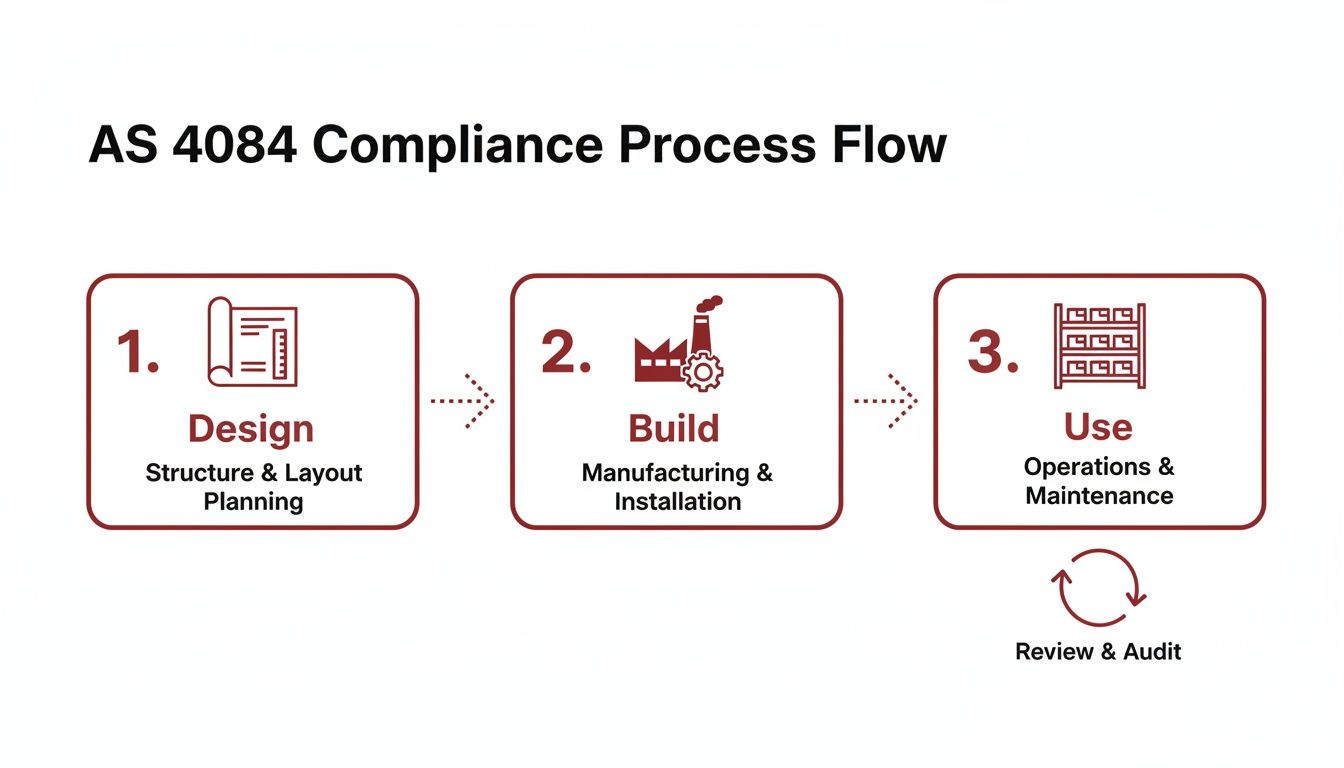
As you can see, compliance is an ongoing job, not a one-off task. It's another reason why starting fresh with a new, certified system is always the most dependable option.
Check for Corrosion and Surface Damage
Rust isn't just ugly; it's steel actively weakening. Corrosion eats away at the metal, reducing its thickness and structural integrity.
- Look for Surface Rust: Scan for orange or brown patches. Pay close attention to welds, connection points, and any spots where paint has been chipped.
- Identify Pitting or Flaking: If the corrosion is advanced, the metal will look pitted or start to flake. This is a serious sign of degradation, and any component with this level of rust must be replaced.
Finally, double-check that every beam has its safety pins or locking clips fitted correctly. These small parts are crucial—they stop a forklift from accidentally lifting a beam out of the upright. Missing pins are a common and dangerous oversight. When inspecting a potential pallet racking 2nd hand system, a lack of these clips often points to a poor maintenance history.
With new equipment, you avoid these worries. You can find a huge range of compliant and reliable pallet racking beams and accessories that guarantee a secure fit. This inspection process highlights the hidden risks of used racking, reinforcing the safety and peace of mind you get with new, certified equipment from Super Rack.
How to Plan Your Warehouse Layout for Maximum Efficiency
Choosing the right pallet racking is a great start, but it's only half the job. An efficient and safe warehouse comes from a smart layout that makes the most of your floor space. This is where you move beyond just buying steel and start designing a high-performance system.
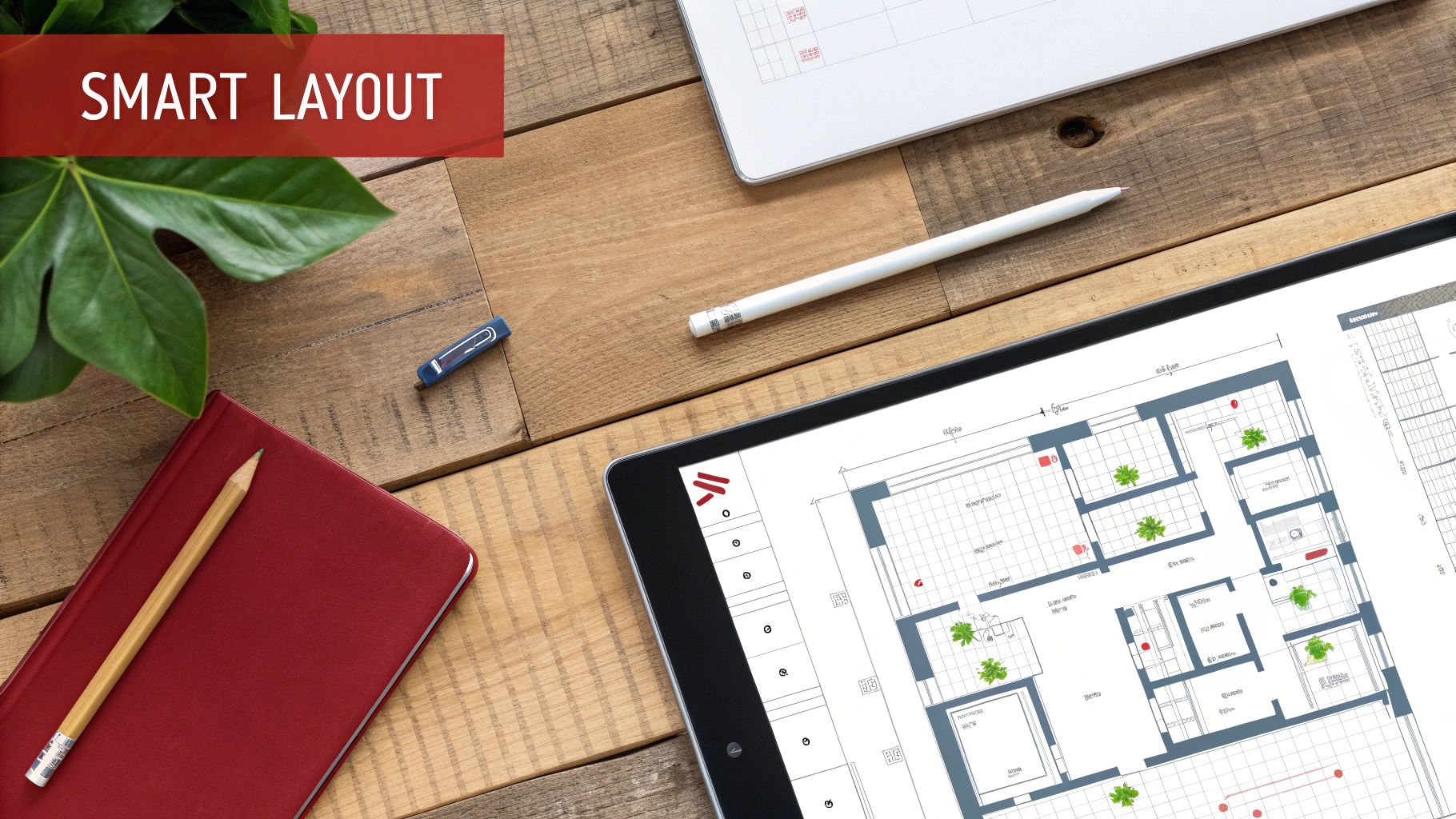
When you buy pallet racking 2nd hand from a private seller, you get the parts—and that's it. What’s missing is the crucial design and layout expertise that turns a pile of beams and frames into a smooth, productive workflow. A well-planned layout isn't a bonus; it's what prevents bottlenecks, improves safety, and allows your business to grow.
Key Planning Considerations for Your Space
Before a single frame is installed, you need a clear plan of your operational flow. It’s all about thinking through how goods will move through your facility, from arrival to dispatch.
Here are the core elements to get right:
- Aisle Width: This depends on the forklifts you use. Standard counterbalance forklifts need a good amount of room to turn, typically 3.5 to 4 metres. But if you're using reach trucks or narrow-aisle equipment, you can shrink those aisles and significantly increase your storage density.
- Workflow Logic: Your layout should follow a logical path. Place your fastest-moving products closest to the packing and dispatch areas. This simple step cuts travel time for your pickers and can make a huge difference to your order fulfilment speed.
- Beam Heights and Levels: The vertical space between your beams should match the height of your typical pallet loads. If you set them too high, you’re wasting valuable space. Too low, and you risk damaging products or making it difficult for forklift drivers to load and unload.
An E-commerce Warehouse Example
Imagine a growing e-commerce business in Brisbane setting up its first warehouse. They could buy a cheap lot of used racking, but then they'd have to figure out the layout themselves. Without experience, it's easy to make mistakes, like creating aisles too narrow for their forklift or putting the receiving area next to dispatch, causing chaos.
Now, consider the alternative. By working with a supplier like Super Rack, they get expert advice as part of the service. Our team would help them design a layout with dedicated zones for receiving, bulk storage, pick-and-pack stations, and dispatch. We’d ensure the workflow is fluid and efficient, preventing operational headaches that can slow growth.
A smart warehouse layout is an investment in productivity. The time saved by eliminating bottlenecks and reducing picker travel time translates directly into faster order fulfilment and lower operational costs.
This kind of expert advice is a huge advantage of investing in a new, professionally supplied system. It’s a service you just don't get when buying second-hand parts online. The right layout, supported by the right pallet racking accessories, ensures your operation runs at peak efficiency.
The Australian warehousing sector is booming, and the pallet racking market is growing with it. As the Australia pallet racking system market expands, businesses are looking for smart ways to scale up. Read more about the growth of the Australian pallet racking market.
Why Investing in a New Racking System Is the Smarter Choice
The choice between new pallet racking and a second-hand system comes down to risk versus reward. While the cheap upfront price of “pallet racking 2nd hand” might look good on paper, it’s a short-term saving that can quickly become a long-term problem.
The real investment isn't just in the steel. It's in the safety of your team, the smooth operation of your warehouse, and the future of your business. A used system comes with a history of unknowns that you inherit the moment it's installed.
The Real Cost of a Bargain
When you buy a used system, you’re gambling on its past. Was it overloaded? Damaged by a forklift? Patched up with a dodgy repair? You have no way of knowing, and that uncertainty creates risks that can appear months or years later.
The potential downsides are serious:
- Uncertain Safety: Hidden damage like metal fatigue or small dents can compromise the entire structure. This puts your staff and your valuable stock in real danger.
- Compliance Gambles: There's no guarantee that a second-hand system meets the current AS 4084 Australian Standard. This can expose you to hefty fines and legal liability if something goes wrong.
- Hidden Costs: The money you save upfront often gets eaten up by mandatory engineering certifications, unexpected repairs, and costly downtime. Suddenly, that initial bargain doesn't look so good.
The Strategic Advantage of Choosing New
Investing in a new system from a trusted partner like Super Rack isn't just a purchase; it's a strategic move for your business. It’s about choosing certainty over chance. With Super Rack, you get more than just new steel—you get a complete storage solution designed to support your business.
Choosing a new, certified pallet racking system isn't just a purchase. It's an investment in a safe, compliant, and efficient operational backbone that gives your business a solid foundation for growth.
By going new, you get tangible benefits that a used system can't match. Our commitment to superior quality means your racking is built with the best materials and backed by a full warranty. You also get transparent, competitive pricing with no hidden surprises, plus nationwide service and fast delivery across Australia.
Most importantly, you get our expert advice on everything from layout design to installation. We'll help you create a solution that works for your specific needs, maximising both efficiency and safety. Explore our complete pallet racking system to see how a certified new solution can transform your workspace.
Ready to build a storage solution you can trust? Contact the Super Rack team today for a no-obligation consultation and let us design a system that works for your business.
Frequently Asked Questions
Here are some straight answers to the most common questions about new vs second-hand pallet racking.
Is It Ever Safe to Buy Pallet Racking 2nd Hand?
Buying pallet racking 2nd hand is always a gamble. You have no idea about its history – has it been overloaded, hit by a forklift, or repaired incorrectly? Crucially, you don't know if it meets the current Australian Standard AS 4084.
Without an engineer's costly assessment, you can't be certain it's safe for your team.
For genuine peace of mind and guaranteed compliance, the only sure way is to invest in new, certified racking from a trusted supplier like Super Rack. Knowing your system is safe and compliant from day one is invaluable.
How Much Do I Really Save With Used Racking?
The initial price of used racking looks attractive, but it rarely tells the whole story. The total cost often ends up much higher once you add mandatory professional inspections, potential repairs for hidden damage, and the engineer certifications needed for sign-off. These extras can easily run into thousands of dollars.
On top of that, there's no warranty. If something fails, your business covers the full cost of repairs and downtime. New racking from Super Rack offers a clear, upfront price and a full warranty, making it a more predictable and often cheaper long-term investment.
While the upfront cost of used racking is tempting, the hidden expenses for certification and repairs often erase the savings. The true cost includes the risk to your team's safety and the potential for expensive operational delays.
What Should I Do If My Current Racking Is Second Hand?
If you're already using second-hand racking, your first step should be to book an inspection with a qualified engineer immediately. They can assess its condition, verify its load capacity, and flag any urgent safety issues.
Under Australian workplace safety laws, regular inspections are mandatory to maintain a safe environment. For long-term stability and to remove any doubt, we strongly recommend planning to upgrade to new, AS 4084-compliant racking. This eliminates any guesswork about its history and structural integrity.
At Super Rack, we don't just sell storage solutions; we deliver certainty and safety. Our team of experts is ready to help you design a brand-new, compliant, and efficient racking system that’s built for your exact needs, backed by our superior quality, competitive pricing, nationwide service and fast delivery.
Contact us today for a no-obligation consultation at Super Rack