

A Guide to Warehouse Racking Inspections for Safe Storage

Warehouse racking inspections are a non-negotiable part of keeping your Aussie workplace safe and running smoothly. Think of them as a regular health check for your storage systems, designed to spot damage, wear, and potential hazards before they turn into a catastrophe. It's the best way to prevent collapses, protect your team, and make sure your operations are fully compliant with Australian safety standards. A formal inspection isn't just paperwork; it's a smart strategy to protect your people and your assets.
Why Racking Inspections Are Critical for Your Warehouse
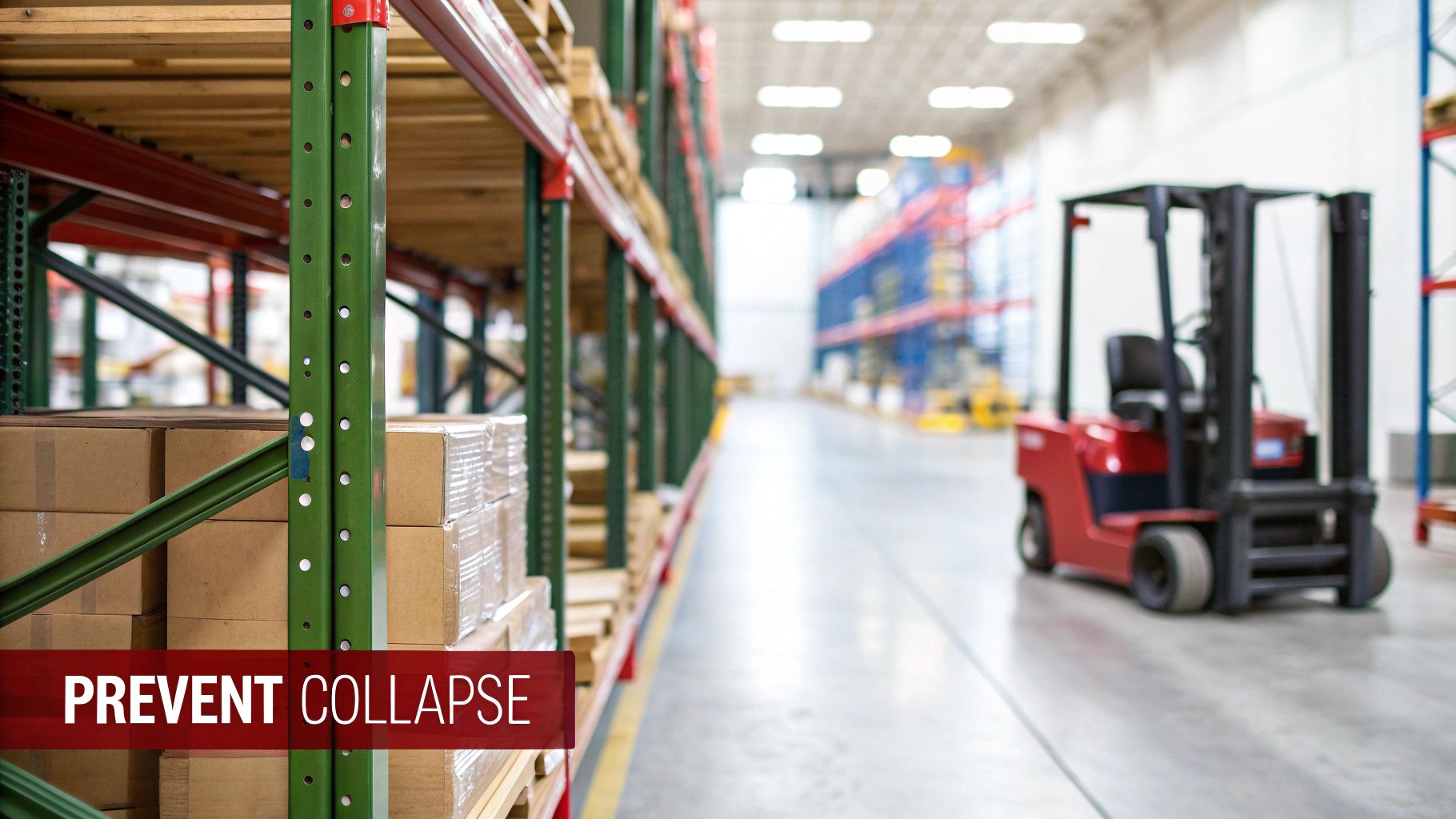
Picture this: a forklift operator nudges an upright frame during a busy shift. It might not look like much, but that small impact could be the start of a devastating racking collapse. This isn't just a worst-case fantasy; it’s a real-world risk that regular warehouse racking inspections are designed to catch.
These inspections are much more than a box-ticking exercise. They are a fundamental part of protecting your staff, your valuable stock, and the very continuity of your business. Being proactive about safety is always the smartest investment you can make in your operations.
Protecting Your Most Valuable Assets
The number one reason for regular inspections is simple: safety. A compromised racking system is a serious threat to everyone working nearby. Beyond the unacceptable human cost, a collapse can trigger a cascade of other problems:
- Significant Inventory Loss: Damaged or completely destroyed stock can easily run into the thousands, or even millions, of dollars.
- Operational Downtime: The clean-up after a collapse, plus replacing the damaged infrastructure, can bring your operations to a grinding halt for days or even weeks.
- Costly Repairs: Emergency, reactive repairs will always cost you far more than planned, preventive maintenance.
- Reputational Damage: A major safety incident can do serious harm to your business's reputation with both customers and partners.
Regular inspections are a hands-on example of effective loss control strategies that drastically reduce these risks and the costs that come with them.
Meeting Your Legal Obligations
Here in Australia, these inspections aren't just good practice—they're a legal requirement. Under Australian Standard AS 4084, which is the rulebook for steel storage racking, warehouse operators are mandated to have a professional inspection of their racking systems at least once every 12 months.
This requirement, reinforced in the latest AS 4084:2023 update, ensures that structures like pallet racking are fit for purpose and can handle the daily stresses of a busy warehouse. You can find more details about this crucial Australian Standard on Super Rack’s guide.
A regular inspection schedule shifts your warehouse culture from reactive to preventive. It ensures your storage systems, including robust pallet racking systems, remain a reliable asset, not a hidden liability waiting to cause problems.
This is exactly where the team at Super Rack comes in. We offer expert advice to help you understand your obligations. Our superior quality racking is engineered to meet and exceed these stringent standards, giving you complete peace of mind. With our competitive pricing and fast, nationwide delivery, keeping your warehouse safe and compliant has never been easier.
Decoding Your Legal Duties Under AS 4084
Trying to get your head around the legal side of racking safety can feel like a headache, but it doesn't have to be. Let's cut through the jargon and look at what Australian Standard AS 4084 actually requires of you as a warehouse operator. This isn’t about becoming a lawyer; it’s about knowing your core responsibilities to keep your people safe and your operation above board.
Basically, AS 4084 is the official rulebook for steel storage racking in Australia. It’s there to set a minimum safety benchmark, prevent catastrophic collapses, and protect everyone working in and around the racking. Cutting corners here isn't just a bad idea—it can open you up to hefty fines and serious legal trouble if something goes wrong.
The Annual Inspection: A Non-Negotiable
Here’s the biggest takeaway from AS 4084: you must have a professional warehouse racking inspection at least once every 12 months. This isn't a friendly suggestion; it's a mandatory health check to verify your racking is still structurally sound after a year of wear and tear.
Now, if your warehouse is a hive of activity with constant forklift traffic or round-the-clock shifts, waiting a full year is probably too long. For these high-traffic environments, getting a professional in every six months is a much smarter and safer way to go. You’ll catch problems before they have a chance to become dangerous.
Who Exactly Is a ‘Competent Person’?
The standard is very specific that the annual inspection must be done by a ‘competent person’. This isn’t just a buzzword. It means someone who has the right training, knowledge, and hands-on experience to spot faults and properly assess the structural integrity of your racking system.
So, while your in-house maintenance crew is brilliant for day-to-day visual checks, they can't sign off on that official annual inspection. For that, you need a qualified, independent expert who understands the engineering, knows the latest standard inside out, and can give you a completely unbiased report.
Your legal responsibility boils down to this: have an impartial expert verify your racking's safety every single year. This third-party sign-off is your proof of compliance and shows you're taking every reasonable step to maintain a safe workplace.
Displaying Safe Working Loads Loud and Clear
Another major responsibility is making sure Safe Working Load (SWL) signs are permanently fixed and clearly visible on your racking. These signs aren't just for show. They are critical pieces of safety information that tell your forklift operators the absolute maximum weight a beam or bay can handle.
Without clear SWL signs, your team is left to guess, which is a recipe for overloading and potential collapse. If your signs have gone missing, faded beyond recognition, or are wrong because you’ve changed the layout, you are legally required to get them replaced. It’s one of the simplest things you can do to prevent a serious incident.
Why Meticulous Records Are Your Best Friend
Picture this: a safety inspector walks into your warehouse and asks for your racking records. Are you ready? AS 4084 demands that you keep a detailed logbook for all your racking systems.
This logbook needs to contain:
- The original installation documents from the supplier, including load capacity data.
- A full history of all professional inspection reports.
- Records of any damage reported—date, location, and what the issue was.
- Proof of all repairs and modifications, showing who did the work and when.
This isn’t just paperwork. It’s your official record that proves you’re on top of your safety management. To get the full picture, it's worth reviewing a guide to Australian workplace safety standards, as AS 4084 fits within that broader legal framework.
Working with an expert like Super Rack means you're not just buying a product; you're getting the ongoing support you need to stay compliant. We provide practical advice on meeting your AS 4084 duties, and our racking systems, like our incredibly durable cantilever racking, are engineered to exceed these standards for long-term safety and peace of mind.
How to Conduct Effective In-House Safety Checks
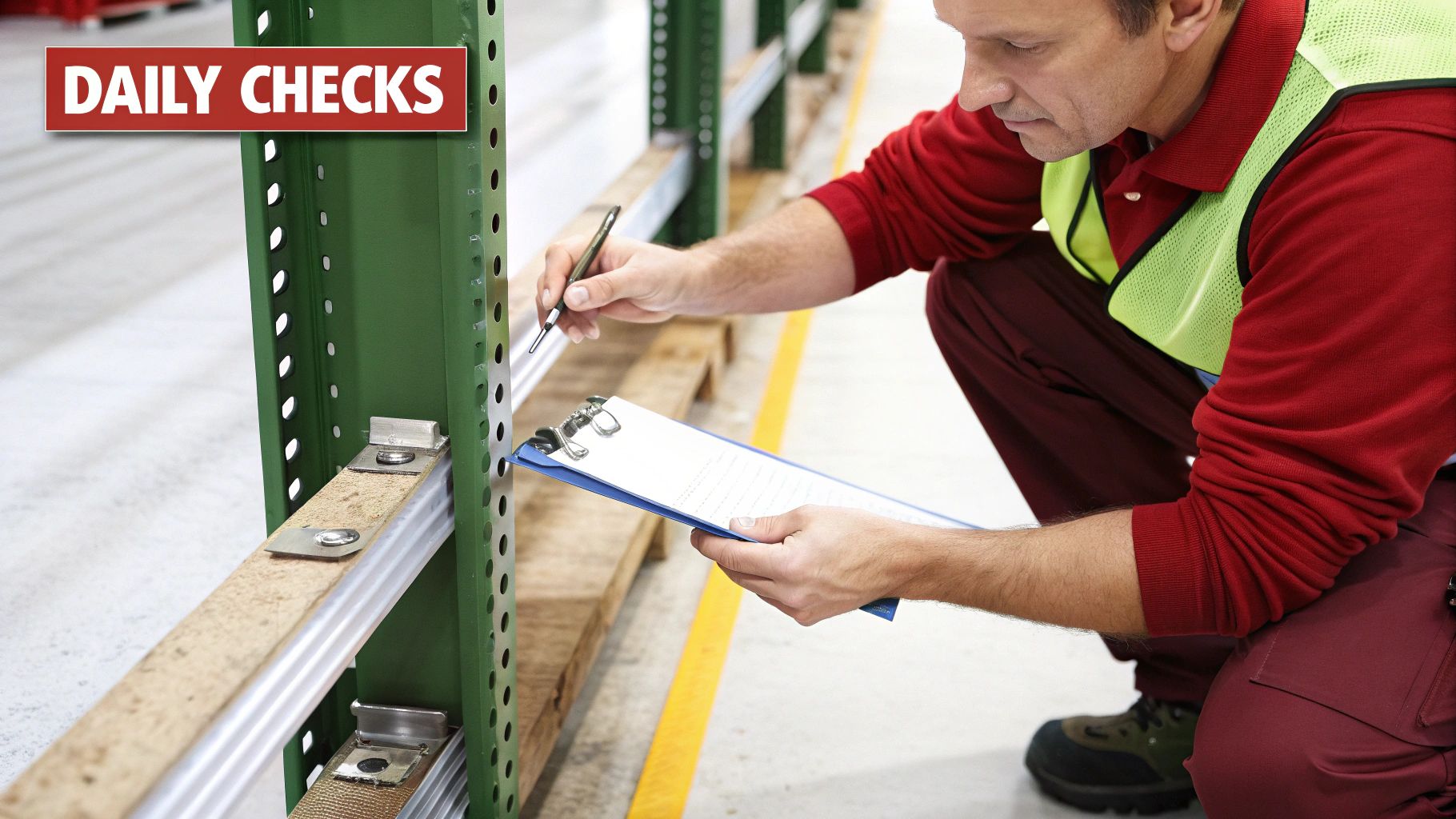
While the annual professional audit is a non-negotiable, the real safety of your warehouse is determined by what happens in the 364 days in between. Your team on the floor is your first line of defence against racking failure. Empowering them to spot trouble early is one of the smartest safety measures you can take.
This isn't about handing over a complicated checklist and expecting miracles. It's about building a culture of proactive observation, where everyone feels confident identifying and reporting potential issues before they become major incidents. Think of these regular in-house checks as the vital supplement to formal warehouse racking inspections.
Starting from the Ground Up
The foundation of your racking system is, quite literally, its foundation. Every good in-house check should start from the bottom and work its way up. Get your team to pay close attention to the base plates and anchoring points of every single upright.
So, what should they be looking for?
- Solid Anchoring: Every base plate needs to be bolted securely to the concrete floor with all of its specified anchor bolts. Even one missing or loose anchor is a massive red flag that can compromise the stability of the entire rack.
- No Visible Damage: Scan for signs of twisting or heavy scrapes on the base plates. These are tell-tale signs of a significant impact from a forklift or other machinery.
- Column Plumbness: Look straight up the column from its base. Does it appear vertical? Any noticeable lean or twist right at the bottom is a serious structural problem that needs immediate expert attention.
Remember, a seemingly small issue at ground level can have a huge domino effect on the load-bearing capacity of the whole bay.
Inspecting Uprights and Bracing
The upright frames and their diagonal or horizontal bracing are the skeleton of your system. This is where damage is most common, especially in busy aisles where forklift encounters are inevitable.
When your staff are walking the aisles, train them to spot these key issues:
- Dents and Dings: Any dent, buckle, or crease in an upright column reduces its strength. A good rule of thumb is that if you can easily feel the damage with your hand, it’s serious enough to report for a closer look.
- Bent or Missing Braces: The bracing that connects the two columns of an upright frame is crucial for lateral stability. If a brace is bent, broken, or completely missing, the frame's ability to resist sideways forces is shot, making it far more vulnerable to collapse.
- Surface Condition: A bit of surface rust might just be cosmetic, but deep corrosion can seriously weaken the steel. This is especially important to monitor in cold storage facilities or humid environments.
A classic scenario is a forklift operator accidentally clipping an upright, causing a small dent. It might seem like nothing, but that one impact can reduce the column's load capacity by a surprising amount. Training your team to report every single impact, no matter how minor it seems, is absolutely vital.
Checking Beams and Connectors
The horizontal load beams are where the real work happens, holding thousands of kilograms of product. Their connection points are critical, and failures here are often sudden and catastrophic.
A quick visual check can tell you a lot about the health of your beams. Instruct your team to look for signs of beam deflection—a slight sag or bow in the middle of the beam. A tiny bit of flex under load is perfectly normal, but excessive sagging is a clear warning sign of overloading or a failing beam.
For instance, if a team member notices a beam is bowing more than usual right after a new pallet is loaded, they need to report it immediately. That simple observation could prevent a total beam failure.
Also, get them to zoom in on the connectors:
- Safety Pins: Every single beam connector must have its safety pin or clip securely in place. These little pieces of metal are what stop a beam from being accidentally knocked upwards and dislodged by a forklift. A missing safety pin is a high-priority hazard that needs fixing now.
- Connector Damage: Look for any cracks, twists, or warping in the beam-end connectors themselves. This can indicate extreme stress, a manufacturing defect, or an overloaded beam.
Giving your team this practical knowledge transforms them from passive workers into active guardians of your warehouse safety. And when it's time for repairs or replacements, having a partner like Super Rack ensures you get quality parts delivered fast, anywhere in Australia. Our expert advice helps you not only fix the immediate issue but strengthen your warehouse safety for the long run.
What Professional Racking Inspectors Look For
Ever wondered what a professional inspector really sees when they walk through your warehouse? It’s a lot more than just spotting a few obvious dents. They're trained to hunt for the subtle, often invisible signs of structural stress that can warn of a future collapse.
Understanding what’s on their checklist gives you a powerful insight into the true health of your storage systems. This isn’t about ticking boxes; it’s a detailed structural assessment from a fresh, expert perspective.
An inspector’s trained eye can catch issues your own team might walk past every day. For example, they can spot the barely perceptible twisting of a column after a minor forklift knock. It might look fine, but that tiny defect can slash the upright's load capacity and put the whole bay at risk.
Moving Beyond the Obvious Damage
While your in-house team is great at spotting the day-to-day scrapes and dings, a professional inspection digs much, much deeper. Inspectors are looking for patterns of damage, signs of metal fatigue, and clues pointing to systemic problems like an improper installation or chronic overloading. They bring a forensic level of detail to the job.
For instance, they'll meticulously check for:
- Column Twisting: A column that's even slightly twisted can no longer distribute weight the way it was engineered to. This puts enormous stress on the bracing and connections.
- Hairline Cracks: These tiny fractures in welds or around beam connectors are often invisible to the untrained eye. But to an inspector, they’re a massive red flag for metal fatigue and potential failure.
- Component Straightness: Inspectors use specialised tools to check the vertical and horizontal alignment of uprights and beams, ensuring everything is perfectly plumb and true.
You can discover more insights about common racking mistakes on rackking.com.au that can lead to these kinds of issues.
The Critical Role of Beam Deflection
One of the most important checks involves the health of your beams. A professional inspector will carefully assess beam deflection—the technical term for how much a beam sags under a full load. While a little bit of flex is perfectly normal, excessive sagging is a serious warning sign.
As a benchmark, inspectors often use the ‘L/200 rule’. It's a simple calculation: a beam's deflection shouldn't exceed its length (L) divided by 200.
So, for a standard 2.6-metre (2600mm) beam, this means a maximum allowable sag of just 13mm. Anything more than this is a clear indicator that the beam is either overloaded, damaged, or simply not right for the job. When this happens, replacing compromised components with high-quality, correctly rated Super Rack pallet racking beams is non-negotiable to restore safety.
Demystifying the Damage Classification System
After the inspection, you’ll get a report that categorises any damage found. This is usually a colour-coded system designed to help you prioritise action immediately. Understanding this system is crucial for a fast, appropriate response.
The traffic light system—red, amber, and green—isn't just a suggestion. It’s a clear, legally defensible directive on risk. Ignoring a 'Red Risk' item is a serious safety breach.
Here’s a simple breakdown of what those colours mean for you:
- Red Risk (High Risk): This is as serious as it gets. It means critical damage that poses an immediate danger of collapse. Any component flagged as red must be offloaded and cordoned off right away. It cannot be used again until it has been professionally replaced.
- Amber Risk (Medium Risk): This flags significant damage that needs attention soon, but isn't an immediate collapse hazard. The racking should be offloaded if possible, and a repair or replacement must be scheduled within a clear timeframe, usually a few weeks.
- Green Risk (Low Risk): This covers minor damage or wear that doesn't currently compromise the racking’s structural integrity. These items must be recorded, monitored closely during your regular in-house checks, and looked at again during the next professional inspection.
This system really highlights why investing in superior quality, durable racking from a trusted supplier like Super Rack from day one is the smartest, most cost-effective strategy. Our systems are built to handle the realities of a busy warehouse, minimising the chance of you facing costly red-risk repairs and keeping your operations running safely and smoothly.
Taking Action After Your Racking Inspection
An inspection report is just a piece of paper until you act on it. This is where the real work begins—turning the findings from your warehouse racking inspections into a solid action plan. It's not just about ticking a compliance box; it's about actively maintaining a safe workplace for your team.
Most professional reports will classify damage using a simple, traffic-light-style priority system. This is designed to give you an immediate, at-a-glance understanding of the risks so you can decide what to tackle first.
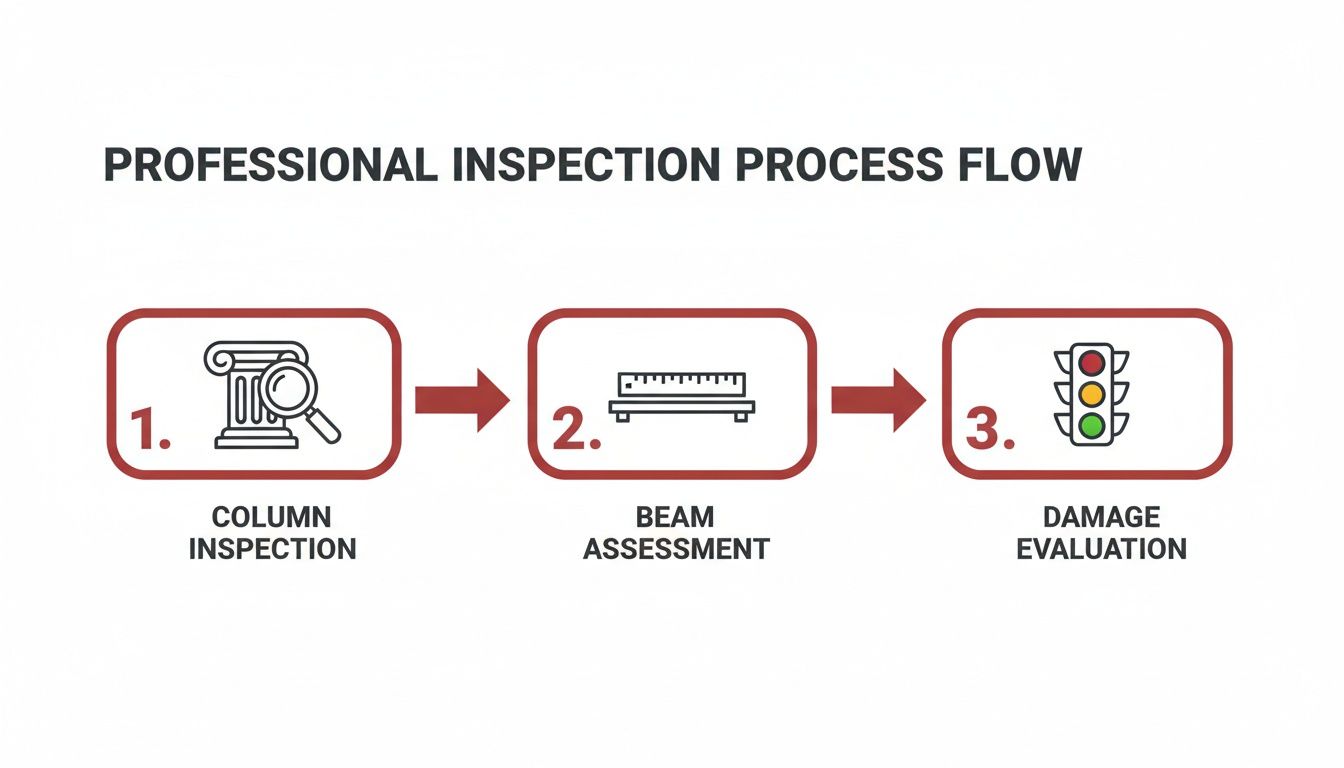
This visual shows the systematic approach inspectors take, moving from individual components like columns and beams to an overall damage evaluation. Following this process ensures nothing critical gets missed.
Responding to Red Risk Items
A ‘Red Risk’ is as serious as it sounds. It means severe damage that poses an immediate threat of collapse, and you need to act on it now. There is absolutely no room for hesitation.
Your response should be automatic and non-negotiable:
- Offload Immediately: Every single item needs to be carefully removed from the affected bays.
- Isolate the Area: Cordon off the entire bay to stop staff or machinery from getting anywhere near it. Using proper control barriers to clearly define the no-go zone is a smart move.
- Do Not Use: Under no circumstances should the racking be used again until it has been professionally repaired or completely replaced.
- Book Repairs Straight Away: Get a qualified racking technician on the phone to schedule the replacement of the damaged components.
Ignoring a red-risk item isn't just risky; it's a major breach of your safety duties. Quick, decisive action is the only way to protect your people and prevent a catastrophe.
Managing Amber and Green Risks
‘Amber Risk’ items are your next priority. This damage isn't an immediate collapse risk, but it definitely needs attention before it gets worse. Think of a moderately dented upright that's still holding but is clearly weakened. The best practice is to offload the area if you can and schedule the repair within the timeframe suggested in the report, which is usually around four weeks.
‘Green Risk’ items are the minor bumps and scrapes. While they don't compromise the structure’s integrity right now, they're worth keeping an eye on. Add these points to your internal checklists for your team to monitor during their regular walk-throughs.
The Importance of Meticulous Record-Keeping
As laid out in Australian Standard AS 4084, you are required to keep a detailed log of all inspections, damage reports, and the corrective actions you’ve taken. This logbook is your proof of compliance and your record of maintaining a safe system of work.
Your records must include:
- The full, original inspection report.
- The date the damage was first spotted.
- Photos of the damage for clear reference.
- A log of what you did and when (e.g., "Bay C-4 offloaded and cordoned off on 15/10").
- Documentation of the final repair, including who did the work and the date it was completed.
With the latest AS 4084:2023 standard, the focus on proper warehouse maintenance has never been stronger. Penalties for non-compliance can be severe, so keeping detailed records isn't just good practice—it's essential protection for your business.
When downtime is costing you money, having a partner you can rely on is everything. Super Rack offers fast, nationwide delivery of high-quality, compliant replacement parts to get you back up and running safely with minimal fuss.
Answering Your Top Racking Inspection Questions
When it comes to warehouse safety, there’s no room for guesswork. Let's tackle some of the most common questions we hear from managers and business owners about warehouse racking inspections, giving you clear, straightforward answers to keep your operation safe and fully compliant.
How Often Do I Really Need a Professional Racking Inspection?
Legally, you need a professional inspection by a competent person at least once every 12 months. This is the bare minimum required under the Australian Standard AS 4084, and it’s non-negotiable.
But is once a year truly enough? If you’re running a high-traffic warehouse with forklifts constantly on the move and rapid stock turnover, waiting a full year is a risky game. For busy operations, a six-monthly professional check is a much smarter, proactive approach to catching issues before they become serious hazards.
Of course, these official inspections don't replace your own regular internal checks. Your team should be doing quick visual walkthroughs weekly or monthly, and always immediately after any collision or impact, no matter how minor it seems.
What Happens if an Inspector Finds Significant Damage?
If an inspector spots damage, they won’t just point it out—they’ll classify it by risk level so you have a clear plan of action. The most critical category is a ‘Red Risk’, and it means you need to act immediately.
If a component gets slapped with a Red Risk tag, you must:
- Immediately and safely unload the entire affected bay.
- Isolate the area to ensure no one can access or use it.
- Keep it out of commission until it has been professionally repaired or the damaged parts replaced.
An ‘Amber Risk’ means there’s damage that needs attention soon, but it isn’t an immediate collapse threat. You’ll be given a timeframe to get it fixed. A ‘Green Risk’ covers minor issues to log and keep an eye on during your internal checks. Your inspector’s report will detail everything, and it’s your responsibility to follow through and document all the repairs.
Can My Own Staff Do the Official Annual Inspection?
In a word, no. While your team is your first line of defence for spotting daily wear and tear, they can't conduct the official annual inspection required by Australian Standard AS 4084.
This formal audit has to be done by an independent and ‘competent person’. The standard requires this to guarantee an unbiased, expert assessment of your racking’s structural integrity. An external specialist has the training to spot subtle signs of stress, metal fatigue, or incorrect installation that an untrained eye would easily miss.
Your team’s role in daily safety is crucial for prevention, but the annual compliance certification must come from a qualified and impartial third party to be valid.
This separation of duties is a fundamental safety principle baked into the standard to ensure maximum accountability.
What Records Should I Keep for My Racking Inspections?
Good record-keeping isn't just about being organised—it’s a legal requirement. You need to keep a dedicated logbook or a tidy digital folder for everything related to your racking systems. Think of it as the complete service history of your warehouse’s most critical assets.
Your file must contain:
- Original supplier documents, especially the safe working load (SWL) charts.
- Every professional inspection report you've received.
- Records of your internal visual checks, with dates and any findings.
- A detailed log of all reported damage incidents, ideally with photos.
- Proof of every repair, replacement, or modification ever made.
This documentation is your evidence that you're proactively managing your safety obligations. If a workplace safety auditor ever walks through your door, this file will be one of the first things they ask for. It shows you take your responsibilities seriously and are committed to maintaining a safe environment for your team.
For expert advice on setting up a compliant and safe storage system, or for help sourcing high-quality replacement parts, trust the team at Super Rack. Our superior quality racking, competitive pricing, and fast nationwide delivery ensure your warehouse stays safe, compliant, and productive. Visit us at https://www.superrack.com.au to learn more.