Choosing the right equipment in a warehouse is more than just about storage; it’s the foundation of your entire operation’s success. For any Aussie business, from a local workshop to a huge national distribution centre, the right tools transform a simple storage space into a high-performance logistics machine.
Think of your warehouse like a busy restaurant kitchen. To get meals out to hungry customers quickly, you need separate stations for prep, cooking, and plating, each with its own specialised tools. In the same way, warehouse equipment falls into key categories that must work together seamlessly to get orders out the door.
This guide will walk you through how smart equipment choices, from heavy-duty pallet racking to a trusty pallet jack, directly lead to better efficiency, a safer workplace, and a healthier bottom line. We’ll break down each category with practical, real-world examples to help you build a warehouse that’s not just organised, but truly set up for growth.
Picking the right gear is one of the most important decisions a warehouse manager can make. Get it right, and you create a smooth, efficient workflow. Get it wrong, and you’re looking at constant bottlenecks, safety hazards, and money down the drain.
Imagine a small e-commerce business in Melbourne, swamped with orders. Their stock is currently piled on the floor, making it a nightmare to find anything quickly. By simply investing in a longspan shelving system, they can instantly organise their inventory, slash their picking times, and get more orders processed every day. That one decision has a direct and immediate impact on their profitability.
Every piece of equipment in a warehouse serves a purpose, and they generally fall into one of three main categories. Understanding these pillars helps you see how the whole puzzle fits together.
A well-equipped warehouse operates like a finely tuned machine. Every component, from the tallest pallet rack down to the humble packing tape dispenser, plays a vital role in keeping your operations moving smoothly and profitably.
At Super Rack, we give you the expert advice needed to select the ideal equipment for your space. With our superior quality products, competitive pricing, and fast nationwide delivery, we help Australian businesses build a solid foundation for success. Making the right investment from the start prevents costly mistakes down the track and ensures your operation is ready for anything.
Every square metre of your warehouse is prime real estate. Using it well isn’t just about being tidy; it’s about laying the groundwork for a truly efficient operation. The right storage solutions turn your floor space from a simple holding area into a dynamic, vertical asset, directly impacting how quickly you can find, pick, and ship your products.
This is a big deal for Australian businesses, where getting the most out of your premises is crucial for managing costs. Having versatile and effective storage is vital for companies nationwide, handling everything from electronics in Sydney to building materials in Perth.
When you picture a warehouse, you probably imagine rows of tall steel frames stacked high with pallets. That’s pallet racking, and it’s the undisputed workhorse for any business handling goods on standardised pallets. Its genius is in its simplicity and raw strength, letting you build upwards and multiply your storage capacity without needing a bigger building.
Think of a beverage distributor in Brisbane. They receive huge shipments of drinks, all neatly stacked on pallets. A robust pallet racking system lets them store hundreds of these pallets in a surprisingly small footprint. Forklifts can easily get to any specific pallet, making sure that stock with the nearest expiry date gets shipped first—a system called First-In, First-Out (FIFO). It’s a simple setup that prevents waste and keeps the entire inventory organised. Super Rack offers superior quality steel pallet racking solutions built for exactly this kind of high-density, heavy-duty storage, giving you safety and reliability you can count on.
This flowchart shows how your business goals connect directly to the equipment choices you make.
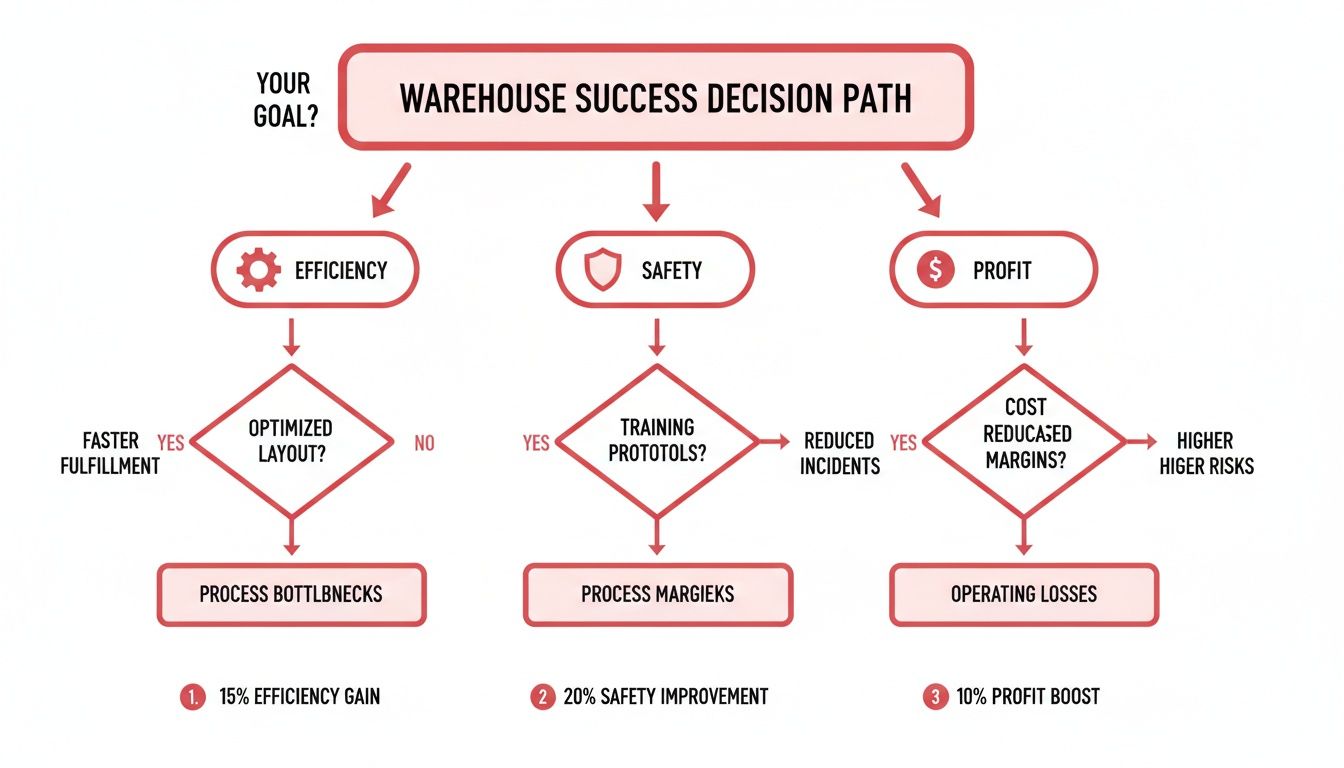
As you can see, whether your priority is boosting efficiency, improving safety, or increasing profit, the path always leads back to choosing the right foundational equipment.
Of course, not everything fits neatly on a pallet. What do you do with long lengths of timber, steel pipes, PVC tubing, or even bulky furniture? This is where cantilever racking really shines. Unlike pallet racking, it has no front vertical beams getting in the way, which creates long, uninterrupted shelves perfect for those awkward items.
Imagine a hardware supplier in Adelaide trying to store 6-metre lengths of steel beams and large sheets of plywood. Squeezing them onto a standard pallet rack would be impossible and incredibly unsafe. With cantilever racking, they can lay these items flat across strong horizontal arms, making them easy and safe to access with a forklift. This doesn’t just keep the products secure and undamaged; it makes the whole storage area safer for staff.
When choosing a cantilever system, you need to consider a few key things:
For all those items that are too small for pallet racking but too heavy for standard office shelves, longspan shelving is the perfect middle ground. Think of it as a heavy-duty version of the shelving in your garage, offering wide, open bays that can be easily adjusted for different product sizes. It’s ideal for manual picking operations where staff access inventory by hand.
A perfect example is an online auto parts retailer in Perth. They stock thousands of different parts, from tiny boxes of spark plugs to heavy brake discs. Longspan shelving lets them organise this diverse inventory in a logical way. Lighter, fast-moving items go at eye level for quick picking, while heavier parts are stored safely on lower shelves. This adaptability makes it a cornerstone for e-commerce fulfilment centres, workshops, and retail stockrooms everywhere. At Super Rack, our longspan solutions deliver this flexibility with the toughness to handle demanding commercial environments, all at great prices with fast, nationwide delivery.
If storage solutions are the skeleton of your warehouse, then material handling equipment is the muscle that brings it all to life. A warehouse is all about movement. The right tools are what keep your products flowing seamlessly from the receiving dock to the dispatch bay, day in and day out. This gear does the heavy lifting, letting your team work smarter, not harder.
Putting your money into solid, reliable tools for moving goods isn’t just about making life easier; it’s fundamental to running a productive and profitable operation. Material handling equipment is a powerhouse segment in Australia’s industrial machinery market, driving efficiency in warehouses nationwide.
When you’re dealing with heavy pallets and high racking, the forklift is the undisputed king. These powerful machines are non-negotiable for any business that needs to lift and shift serious weight, especially upwards. They work hand-in-glove with a well-designed pallet racking system, allowing operators to place and pull stock from heights that are otherwise completely out of reach.
Picture a major distribution centre in Sydney handling bulk groceries. Their entire workflow hinges on forklifts—unloading trucks, moving pallets into storage bays metres high, and retrieving them for order fulfilment. Take away the forklifts, and the whole operation grinds to a halt.
Picking the right forklift comes down to a few key questions:
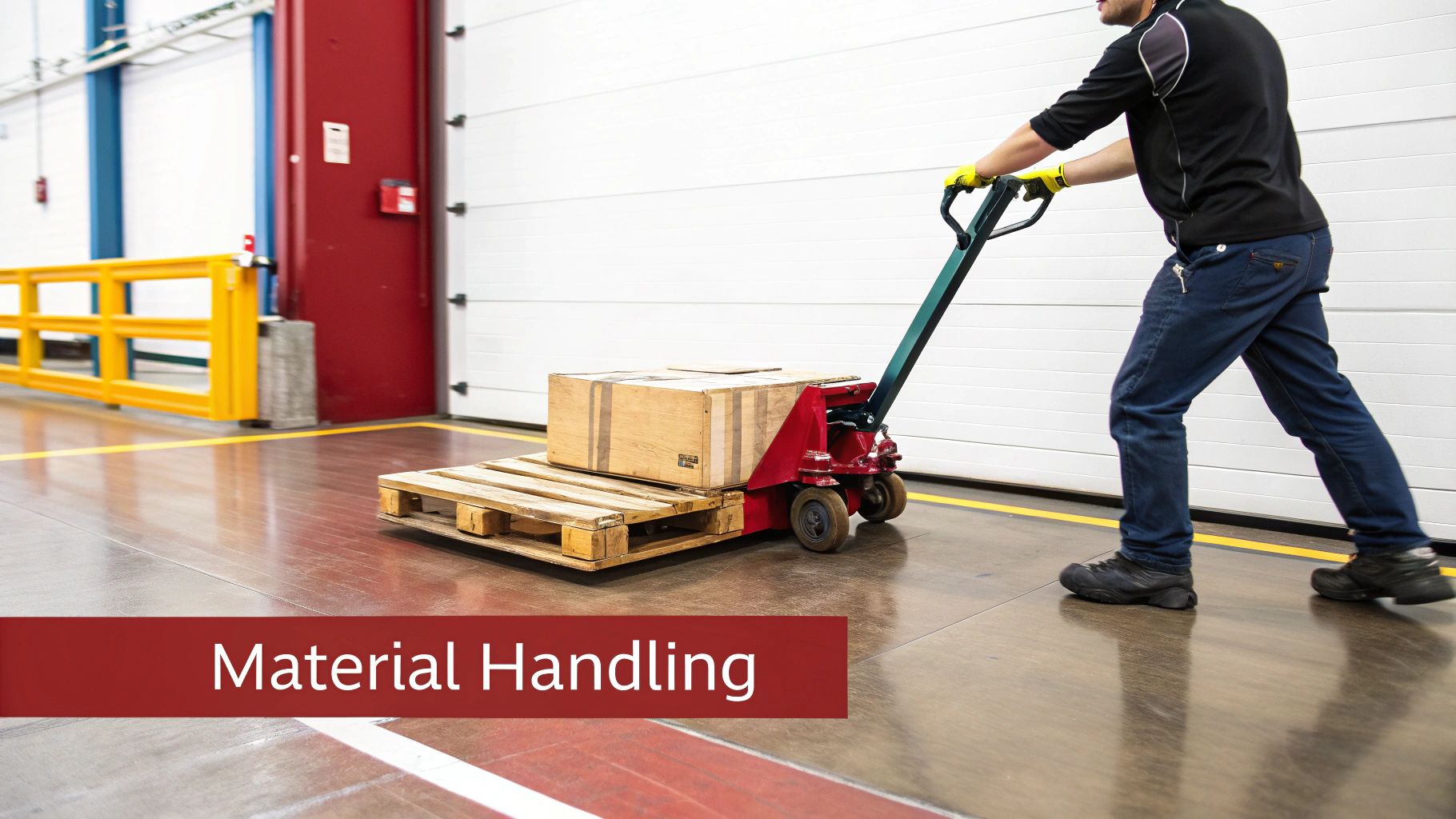
Not every job needs the muscle of a forklift. For zipping pallets across the warehouse floor, the humble pallet jack (or pallet truck) is an incredibly efficient and budget-friendly workhorse. Whether they’re manual or electric, these are perfect for unloading trucks at the dock, shifting stock from bulk storage to a packing bench, or just general repositioning.
Think of a small e-commerce business in Melbourne. They might not have the space or the need for a full-sized forklift. A simple hand pallet jack lets them quickly move a new shipment from the loading zone to their longspan shelving. It saves a huge amount of time and prevents back strain on the team, all for a tiny upfront cost.
The right piece of material handling equipment doesn’t just move products; it moves your business forward. By matching the tool to the task, you reduce manual handling, minimise product damage, and create a faster, safer workflow for your team.
When you’re moving smaller, individual items instead of whole pallets, trolleys and carts are your best friends. They are essential for order picking, where staff need to grab multiple items from different spots to build a customer’s order. They come in all shapes and sizes, from simple flatbed trolleys to multi-tiered picking carts designed for efficiency.
One of the most useful options is the roll cage trolley. These wheeled, enclosed cages are brilliant for transporting a mix of goods securely without anything falling off. To see how they can streamline order picking or moving stock from the back room to the shop floor, you can check out Super Rack’s durable roll cage trolley solutions. They’re a simple but incredibly effective tool for almost any operation.
At Super Rack, we get that efficient movement is the key to warehouse success. Our range of quality material handling equipment is built tough, designed for reliability, and priced competitively. With fast, nationwide delivery and expert advice just a call away, we can help you get the right tools to keep your goods—and your business—on the move.
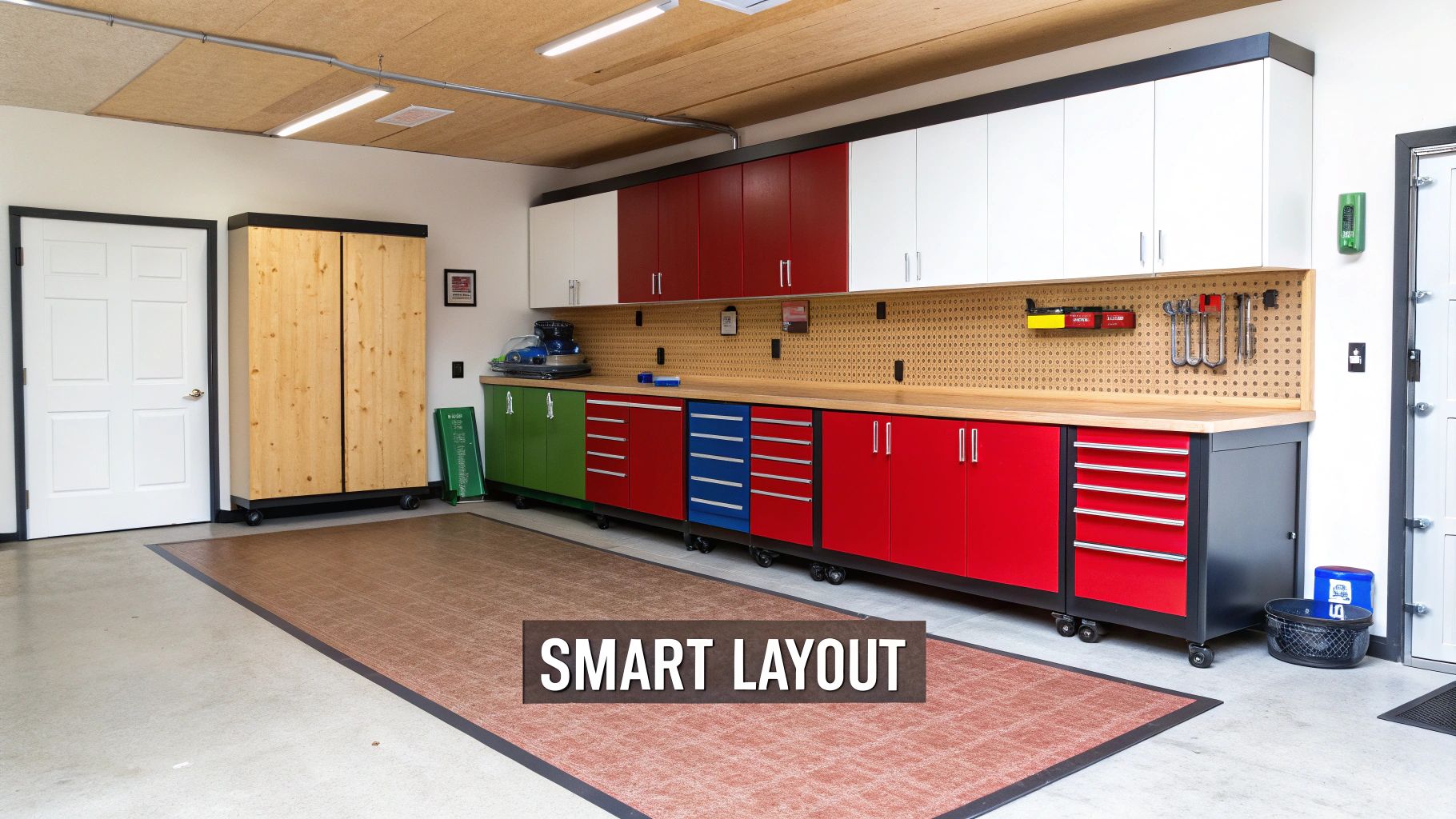
Having the best equipment in a warehouse is one thing, but how you arrange it is what really unlocks its potential. A smart layout is the difference between a chaotic, inefficient space and a high-performing operation. The goal is simple: design a floor plan that makes your team more productive while putting safety first.
This is about more than just finding a spot for your racks. It’s about creating a logical, seamless flow for your goods from the moment they arrive until they’re dispatched. A great layout cuts down travel time for staff and machinery, minimises handling errors, and builds a safer working environment for everyone.
The first rule of a solid warehouse layout is to establish clear, unobstructed pathways. This is absolutely critical for preventing accidents and keeping the workflow moving. Forklifts, pallet jacks, and order pickers all need wide, well-marked aisles to move freely without risking collisions.
A key strategy here is to create separate zones for different activities. Wherever you can, keep pedestrian walkways distinct from vehicle traffic. This one step can dramatically reduce the chances of accidents between your staff and machinery.
A thoughtfully planned warehouse layout doesn’t just organise your stock; it organises your entire workflow. By creating a clear path for goods and people, you reduce wasted movement, speed up order fulfilment, and build a foundation for a safer, more productive operation.
Think about designating specific areas for each core function: receiving, bulk storage, order picking, packing, and dispatch. This separation stops bottlenecks from forming and ensures each stage of the process can run smoothly without tripping over the others.
One of the most powerful layout principles is organising your stock based on how often it moves. Your most frequently picked items—your ‘fast-movers’—should be in the most accessible spots, usually closest to your packing and dispatch areas. It’s a simple change that can shave hours off your pickers’ travel time.
For instance, a manufacturing business could place its raw materials on Super Rack’s heavy-duty pallet racking right next to the production line. This creates a direct, seamless workflow, making sure the assembly team has what they need without trekking across the warehouse. It’s a small tweak that delivers huge gains in efficiency.
Here’s how to put this into practice:
While efficiency is a huge win, safety has to be your number one priority. The design of your layout plays a massive role in creating a safe workplace. Beyond clear pathways, this means making sure your storage equipment itself is structurally sound and properly maintained.
Regular inspections of your pallet racking are non-negotiable. You need to spot any signs of damage from accidental impacts, as even a small dent can compromise the integrity of the whole structure. It’s also vital to give your staff thorough training on how to operate equipment safely within the layout you’ve designed.
At Super Rack, we see ourselves as your partner in building an operation that’s both successful and safe. We offer expert advice not just on our products, but on how to integrate them into your space the right way. With our commitment to superior quality and nationwide service, we help you build a warehouse that truly works for your business and protects your team.
The final moments an order spends in your warehouse are absolutely critical. This is where your accuracy and speed directly hit the customer, making or breaking their experience. Getting your packing and dispatch stations kitted out with the right gear ensures the whole fulfilment process finishes strong.
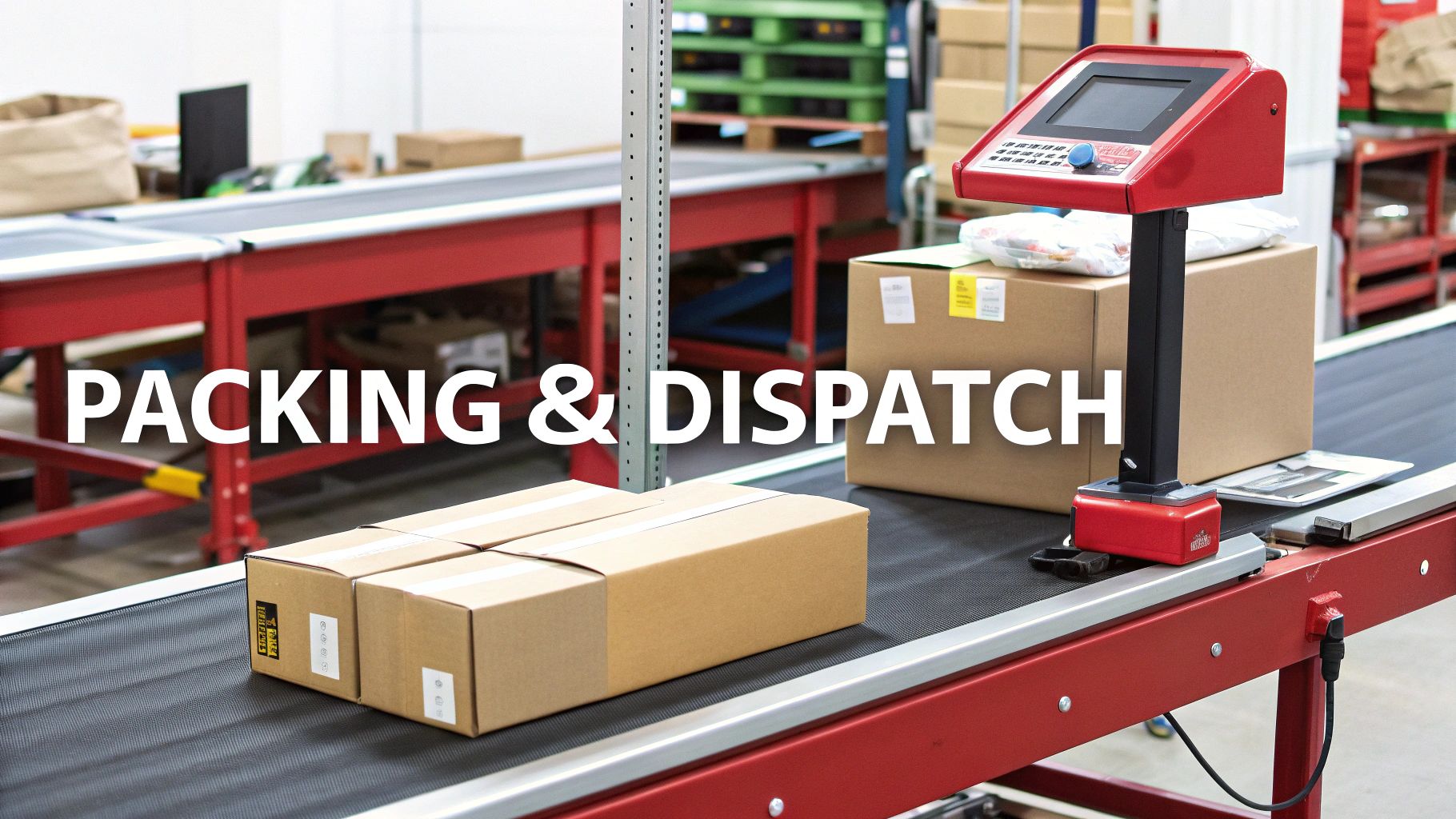
It’s all about creating a seamless handover from your internal workflow to the outside world. The right equipment in warehouse packing areas prevents costly errors, protects your products in transit, and ultimately gets shipments out the door much faster.
A well-designed packing station is the heart of your dispatch operation. It’s not just a table; it’s a dedicated, organised workspace built for maximum output with minimal strain on your team.
Think about an online retailer in Sydney. They can completely transform their fulfilment by setting up ergonomic workbenches. Benches at the correct height reduce physical fatigue, allowing staff to work more comfortably and for longer. Combine this with easy-to-reach storage for boxes, tape, and void-fill, and you’ve created a slick workflow that slashes mistakes and speeds up dispatch times.
A great packing station isn’t an expense; it’s a tool for productivity. By bringing everything the packer needs within arm’s reach, you eliminate wasted steps and create a faster, more accurate fulfilment cycle.
Key gear for an effective packing area includes:
Once an order is packed and labelled, the final hurdle is getting it onto the truck safely and efficiently. This is where loading and unloading equipment becomes vital, especially for businesses dealing with higher volumes or heavier goods.
Imagine a wholesale distributor in Melbourne. Their team is loading dozens of pallets onto delivery trucks every single day. Using something like a dock leveller creates a safe, level bridge between the warehouse floor and the truck bed. This lets forklifts drive straight in and out without navigating dangerous gaps or inclines.
Conveyor systems are another game-changer. They can automatically shuttle packed boxes from the packing station right to the loading bay, dramatically cutting down on manual handling. This not only makes the whole process faster but also minimises the risk of staff injury and product damage from accidental drops.
At Super Rack, we get that every single stage of your warehouse operation needs to be firing on all cylinders. We offer expert advice and high-quality, competitively priced equipment to help Australian businesses perfect their workflow from start to finish. With fast, nationwide delivery, we’re here to help you get your orders out the door and into your customers’ hands.
Choosing the right equipment in warehouse operations is a massive financial decision. It’s easy to get fixated on the upfront price tag, but the smartest operators think about the long-term return on investment (ROI). The real key to a profitable, sustainable business is seeing your equipment as a strategic asset, not just another expense.
Sure, high-quality, durable new equipment might cost more initially. But it consistently pays for itself over and over again through better efficiency, improved safety, and a much longer service life compared to cheaper options.
Investing in top-tier gear, like a well-designed pallet racking system from Super Rack, brings real, tangible returns. For instance, just by making better use of your vertical space, you can store more stock in the same footprint. That simple move could be the difference between staying put and having to fund a costly move to a bigger facility.
Better organisation also has a direct impact on your labour costs. When your team can find and pick items quicker, you get more orders out the door without needing to hire more people. On top of that, quality equipment dramatically cuts the risk of product damage from collapses or poor storage, protecting your inventory and your bottom line.
Going for a cheaper, inferior option often turns out to be a false economy. The initial saving feels good, but it almost always leads to bigger costs down the road. Poorly made equipment breaks down more often, causing operational downtime, expensive repair bills, and forcing you to replace it much sooner than planned.
Even more critically, subpar gear can create serious safety hazards for your team, leading to accidents and injuries. The financial and human cost of a single workplace incident can instantly wipe out any money you thought you saved.
You have to see your equipment purchase as a long-term investment in your business’s future. Durable, reliable solutions give you peace of mind and deliver consistent value, while cheaper options often create more problems than they solve.
The push for greater efficiency is being felt across the industry. Automation is shaking things up in Australian warehouses, with some operators slashing labour costs by up to AUD 60,000 per full-time employee while hitting an incredible 99.8% order accuracy. Investing in quality gear now puts you in a prime position to adapt and thrive as technology becomes more accessible.
At Super Rack, we’re all about providing superior quality equipment at competitive prices. With fast, nationwide delivery and genuine expert advice, we help you make a sound investment that supports your business’s growth, stability, and long-term success.
When you’re fitting out a new warehouse or upgrading an old one, you’re bound to have questions. Getting the right answers is key to building an efficient and safe operation. Here are some of the most common queries we hear from Australian business owners and warehouse managers, with practical, no-nonsense advice.
There’s no one-size-fits-all answer here, but it boils down to four things: what you’re storing, your warehouse height, your forklifts, and how you move stock.
Think about your pallets first—their size, and more importantly, their maximum weight. You need racking with a load capacity that comfortably exceeds your heaviest pallet. From there, look at your building. The racking height should maximise your vertical space without interfering with lighting or sprinklers. Finally, your forklifts dictate aisle width. A standard counterbalance needs more room to turn than a narrow aisle machine.
If you’re dealing with standard-sized pallets and need easy access to every single one, selective pallet racking is often the go-to choice for its versatility. If you’re unsure, the Super Rack team is here to help you nail down the perfect system for your workflow.
It’s all about moving horizontally versus lifting vertically.
A pallet jack is your ground-level workhorse. It’s perfect for shifting pallets across the floor—think unloading a truck and moving stock to a staging area. They’re small, nimble, and a must-have for any fast-paced receiving or dispatch area.
A forklift, on the other hand, is built to lift. It’s the essential tool for getting heavy pallets up onto high racking systems. While it’s a bigger investment, you simply can’t run a warehouse that uses vertical storage without one. In reality, most efficient warehouses need both to keep goods flowing smoothly.
Regular checks are non-negotiable for keeping your team safe and your operation compliant.
For pallet racking, get your staff to do a quick visual check every week. They should be looking for obvious damage like dings, dents, or bent beams from forklift bumps. Anything they spot needs to be reported straight away. Beyond that, you need a thorough inspection by a qualified professional at least once every 12 months.
For machinery like forklifts and pallet jacks, a daily pre-start check by the operator is crucial. This simple habit catches small issues before they become dangerous problems.
At Super Rack, we don’t just sell high-quality equipment; we provide the expert advice you need to build a safer, more productive warehouse. From pallet racking to material handling tools, we deliver superior solutions with fast, nationwide service.
Explore our full range of warehouse solutions at Super Rack today.
The lower upfront cost of used pallet racks can look like a bargain, but the hidden risks often far outweigh any initial savings. You have to understand that any damage, visible or not, can compromise the entire structure, putting your inventory and staff in serious danger. Without a certified history, you're buying a complete unknown.
While saving a few hundred dollars on pallet racks used for a fit-out is tempting, this approach overlooks the serious dangers and long-term costs that come with second-hand equipment. The biggest problem is the total lack of history. You have no idea what that rack has been through.
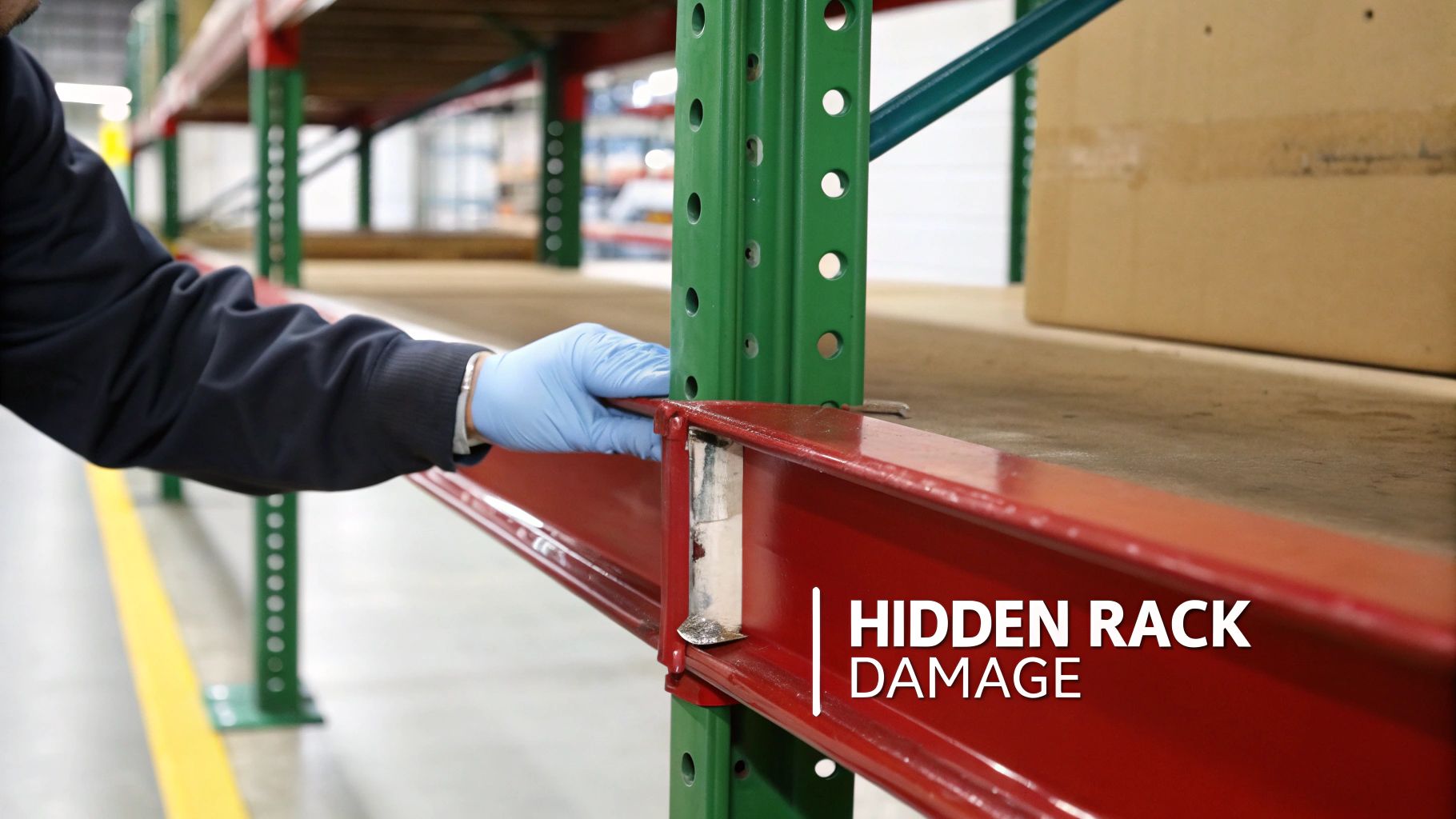
Every pallet rack is engineered for a specific Safe Working Load (SWL). But a used rack might have been repeatedly overloaded by its previous owner, causing stress and metal fatigue you just can't see. This leads to invisible micro-fractures that weaken the steel's integrity.
Imagine buying a used system that came out of a busy distribution centre. A forklift could have bumped an upright just enough to weaken it, but not enough to leave a major dent. The next time you load a heavy pallet onto that bay, the weakened steel could give way, triggering a catastrophic collapse.
The true cost of a rack collapse—including lost stock, operational downtime, potential injuries, and WorkSafe investigations—dwarfs any initial savings from buying used.
Without the original manufacturer's load plates and engineering documents, it's impossible to know a used rack's true capacity. Stickers can be peeled off, and sellers might make honest mistakes or incorrect claims. This creates a massive compliance and safety blind spot.
For instance, you might buy beams that look identical to a high-capacity model but are actually a lighter-duty version. Loading them based on appearance alone is a recipe for disaster.
In contrast, investing in new, certified pallet racking from Super Rack gets rid of the guesswork. You receive:
Choosing new racking isn't just about buying a product; it’s about ensuring the safety and stability of your entire operation. At Super Rack, our experts can provide a competitively priced, fully compliant solution delivered nationwide, removing all the risks that come with second-hand guesswork.
Ready to build a safe and efficient warehouse? Contact the Super Rack team today for expert advice and a fast, no-obligation quote on our certified new pallet racking systems.
When you're fitting out a warehouse or workshop, it’s tempting to focus on the initial price tag. The lower cost of used pallet racks can look pretty good on paper, but it pays to look beyond that first number and think about the total cost of ownership.
New pallet racking isn’t just an expense. It's a strategic asset that delivers long-term value, safety, and operational peace of mind. Choosing new is really about investing in certainty—from the moment it arrives, you have a complete, transparent history of every single component, getting rid of the dangerous guesswork that always comes with second-hand systems.
One of the biggest advantages of buying new is the full manufacturer's warranty. This is your guarantee that every beam, upright, and brace is free from defects and built to do its job properly. If a component fails because of a manufacturing fault, you’re covered. Simple as that.
With used racking, you inherit all the risk. There’s no warranty, no support, and no one to call if you discover a hidden crack or a bent beam after you've already installed it. Any repairs or replacements come straight out of your pocket, which can quickly wipe out any money you thought you saved upfront.
A full warranty isn't just a piece of paper. It's a safety net for your investment and a guarantee of quality, providing a level of security that used racking just can't match.
Meeting safety standards isn’t a choice—it’s a legal requirement. New pallet racking from a reputable supplier like Super Rack is properly engineered and certified to comply with Australian Standard AS 4084:2023 Steel Storage Racking. This standard governs the design, fabrication, and installation of racking to make sure it's safe for the loads it’s designed to hold.
When you buy new, you get the documentation and load plates to prove compliance. This is absolutely critical for WorkSafe inspections and your insurance obligations. With used racks, proving they meet the current standard is nearly impossible, putting your business at serious legal and financial risk.
As Australia's e-commerce and logistics sectors keep growing, the demand for reliable storage is only getting stronger. Businesses are realising that safe and efficient warehousing is key to success, which is why investing in new, compliant systems is becoming the standard. You can read more about the drivers behind this growth in the Australian pallet racking market.
At Super Rack, we make this choice even easier. Our new systems are competitively priced, and when you factor in the value of a warranty, guaranteed safety, and zero hidden repair costs, the financial gap with used options often disappears. With fast, nationwide delivery and expert advice, we provide a reliable, long-term solution that protects your staff, your stock, and your bottom line.
Don’t compromise on safety just to save a few dollars upfront. Contact Super Rack for a quote on a new, fully compliant pallet racking system that’s built to last.
When you're looking at a row of used pallet racks that have done years of hard work in another warehouse, it's easy to miss the small warning signs that point to big dangers. Without knowing what to look for, you could be buying a system that's already on the verge of collapse. A thorough visual inspection is your first line of defence, but often, it's what you can't see that poses the greatest risk.
The real problem is that even minor-looking flaws can drastically compromise a rack's structural integrity. A seller might try to pass them off as just cosmetic wear and tear, but these imperfections are often red flags signalling a history of misuse or damage.
When inspecting used racking, there are several critical issues that pop up time and time again. These aren't just minor blemishes; each one is a potential failure point that could have devastating consequences for your team and your stock.
You need to get good at spotting these problems quickly:
The process flow below shows the clear advantages you get with new racking, which lets you skip these safety gambles entirely.
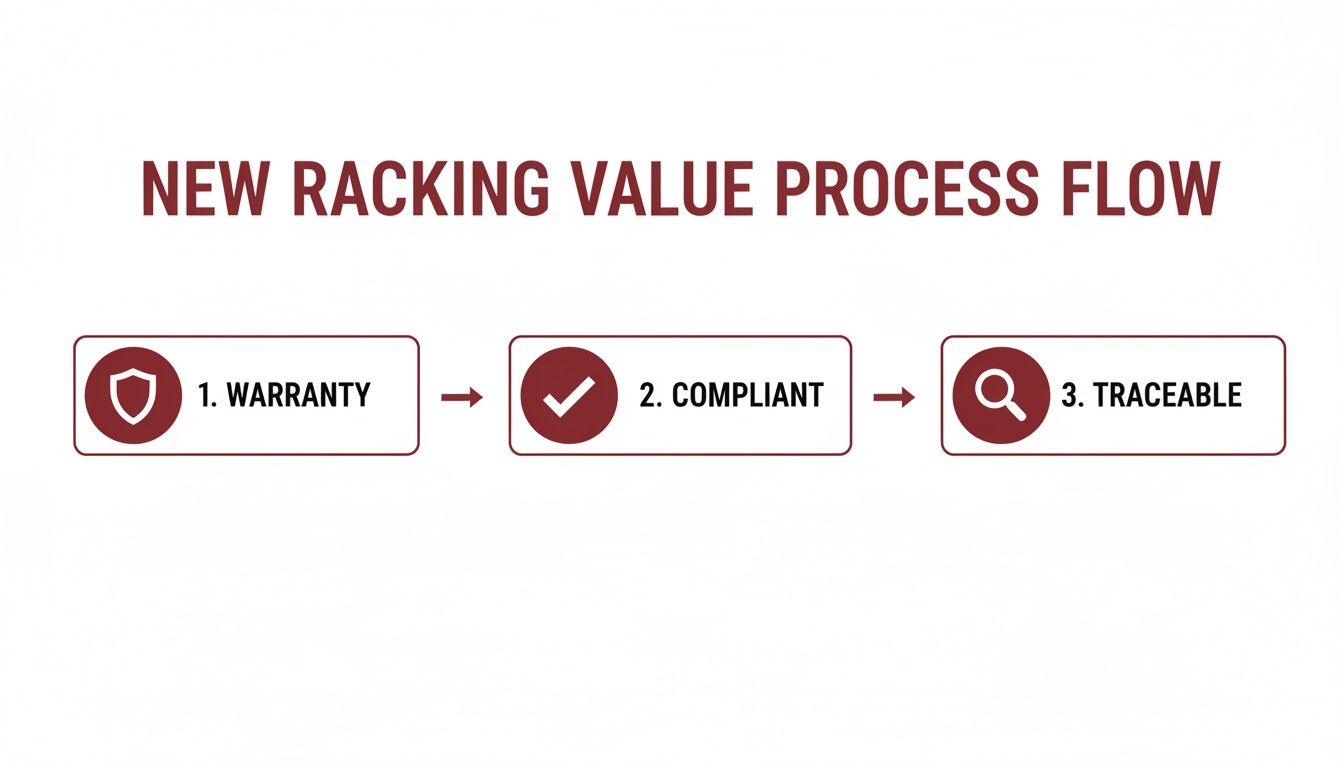
This highlights the core value of buying new: you get a full warranty, a guarantee that it's compliant with Australian Standards, and complete traceability of all materials.
Let’s zero in on one of the most common issues: a bent or dented beam. Picture a beam with a slight downward bow in the middle. This condition, known as deflection, was likely caused by consistent overloading. While it might still hold a pallet, the steel is fatigued and has lost its original strength.
A structural engineer would almost certainly condemn a visibly deflected beam on the spot, as its Safe Working Load is no longer reliable. Without that expert assessment, you’re just guessing—and that’s a dangerous game to play with thousands of kilograms of stock suspended overhead.
This is exactly why the clear, certified specifications of new components are so vital. When you need to know the precise capabilities of your system, you can learn more about Super Rack’s certified pallet racking beams and how they ensure safety from day one.
Ultimately, the biggest problem with used racking is that a typical buyer simply can't assess its true condition. A proper evaluation requires a costly engineering report, and without it, you are accepting all the risk. This is where choosing new from Super Rack becomes the most practical path to a secure warehouse, giving you certified products, expert advice, and nationwide service.
Getting your head around load ratings is easily the most critical part of keeping your warehouse safe and, just as importantly, legal. This isn't just about best practice; it's a non-negotiable legal requirement under WorkSafe regulations. Every single pallet racking system must have a clearly stated Safe Working Load (SWL), which is the absolute maximum weight it can safely handle.
Here’s the biggest problem with pallet racks used in a previous life: they almost never come with their original load plates or engineering documents. Without the manufacturer's certified load plates, it's impossible to legally prove their capacity. And that leaves your business exposed to massive liability.
Picture this: you buy a set of used beams and uprights. The seller casually tells you they’ll hold two tonnes per level, but how can you actually be sure? There’s no official paperwork, no engineer’s certificate, and zero history on how they were used—or abused—before. You're simply taking someone's word for it, which won't stand up for a second in a safety audit.
This gamble isn't just a compliance headache; it's a genuine threat. Overloading a rack because its true capacity is a mystery can lead to catastrophic failure. We're talking about collapsed stock, damaged equipment, and the very real risk of serious injury to your team.
When you buy used racking, you inherit a complete unknown. The absence of a certified load plate makes it legally impossible to prove your system is safe, placing your entire operation and your people at risk.
The need for reliable storage is only getting bigger, with the global pallet racking market tipped to hit USD $13.60 billion in 2026. Here in Australia, that growth is being driven by industries like e-commerce that simply can't afford to take chances on uncertified gear. You can read the full research about the global pallet racking market to see just how serious this is.
This is where the value of buying new becomes blindingly obvious. Every new system from Super Rack arrives with a clear, compliant, and permanently fixed load rating plate. This simple plate gives your team—and any WorkSafe inspector who walks through the door—all the critical information they need at a glance.
This includes:
That little plate removes every bit of guesswork. It’s your concrete proof of compliance with Australian Standard AS 4084 and your guarantee that the system is safe when used correctly. You can even see how individual components, like our certified 1200 series pallet racking uprights, are engineered to contribute to a fully compliant and robust system.
At the end of the day, buying new is the only way to guarantee you're meeting your legal obligations and providing a safe workplace. With Super Rack’s competitive pricing, fast nationwide delivery, and expert advice, it’s the smartest and safest choice for any business.
Don't leave safety to chance. Contact Super Rack today for a quote on a fully certified and compliant racking system.
A smart warehouse layout is the engine room of an efficient business, and your pallet racking is its most important part. A well-designed system doesn't just hold your stock; it dictates how quickly you can move it, how much you can store, and how safely your team can operate.
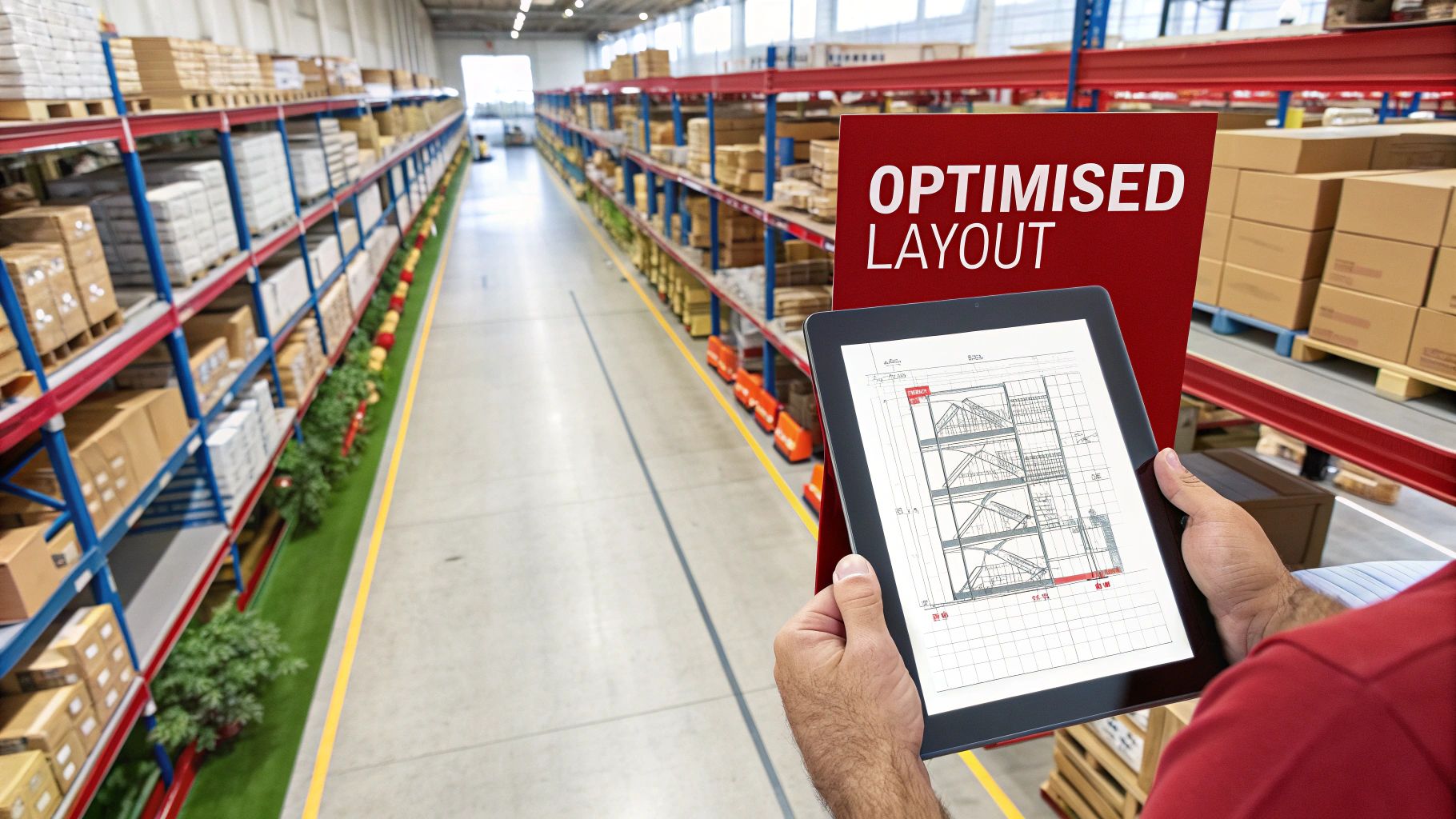
This is where buying pallet racks used from a previous owner becomes a major roadblock. You’re stuck with whatever sizes and configurations they had, which forces you to design your layout around their old equipment. It’s a recipe for wasted space, awkward workflows, and long-term inefficiency.
One of the most critical design decisions you'll make is your aisle width. It needs to be wide enough for your forklifts to manoeuvre safely and efficiently, but not so wide that you sacrifice valuable storage space. A standard forklift might need a 3.5-metre aisle, while a specialised narrow-aisle truck could operate in half that.
When you buy a job lot of used racking, you get a random mix of upright depths and beam lengths. This can force you into a compromised layout with inefficiently wide aisles or awkward rack placements that disrupt the natural flow of goods from your receiving dock to your shipping area.
A layout built around mismatched used racking is a layout built on compromise. It limits your storage density and slows down your pick-and-pack times from day one, costing you money in the long run.
In sharp contrast, new pallet racking gives you a blank canvas. You get to design a system that’s perfectly suited to your specific inventory, equipment, and workflow, not someone else's.
Starting with new racking allows you to create a layout that maximises every square metre of your facility. It’s about more than just fitting in racks; it’s about creating a cohesive, high-performance operation.
With a new system, you can:
Designing a warehouse from scratch can feel daunting, but you don't have to go it alone. The expert team at Super Rack can help you design a tailored pallet racking system that meets your exact needs. We offer fast, nationwide delivery, ensuring your investment pays off in safety and efficiency from the moment it’s installed.
Don’t let second-hand limitations dictate your business's potential. Contact Super Rack today for a free consultation and quote on a new, purpose-built racking solution.
Even with all the facts, pulling the trigger on a new storage system is a big decision. Let's run through some of the final questions that might be on your mind, especially when you're weighing up a brand-new system against the potential risks of pallet racks used in a previous life.
This is easily the most common question, and the answer often catches people by surprise. While the sticker price for a new rack is usually higher than second-hand, the total cost of ownership is often much lower.
Think of it this way: a used system can be a Pandora's box of hidden costs. You might find yourself paying for unexpected repairs, hunting down replacement parts for an obsolete model, or hiring a structural engineer to certify that it's even safe to use. These costs can add up to thousands of dollars very quickly.
With new racking from Super Rack, you get a fixed, all-in price. No nasty surprises. Our pricing is so competitive that the gap is smaller than you'd expect. For a small bump in the initial spend, you're buying total peace of mind, a full warranty, and guaranteed safety compliance. In the long run, that’s just a smarter financial move.
Here’s the thing: whether it’s new or used, pallet racking must be installed correctly to be safe. The huge advantage with a new system is consistency. Every single component is engineered to fit together perfectly, right out of the box. It also comes with proper instructions and engineering specs, making the whole assembly process quicker and far less stressful.
Used racking, on the other hand, is often a mixed bag of components from different brands, batches, or previous layouts. This can easily lead to connection problems, wobbly frames, and a build that’s both frustrating and potentially unstable.
When you buy new racking, you’re not just buying steel; you’re buying a complete, engineered solution. The simple, predictable installation saves you a heap on time and labour costs, getting your system up and running faster and safer.
All racking needs regular inspections, but a new system gives you a massive head start. You’re starting from a perfect, damage-free baseline. This makes future inspections dead simple—you know exactly what a "good" rack looks like, so spotting a fresh dent or scrape is easy.
With used racks, you inherit all the existing wear and tear. It becomes almost impossible to tell if that bent brace is an old issue or a new hazard about to fail. Because new racking from Super Rack is built from high-quality steel, it’s also tougher against the daily knocks and bumps of a busy warehouse. That means less maintenance and fewer repair bills over its entire lifespan.
Choosing new is about setting your operation up for success from day one with a safe, reliable, and efficient storage system you can count on for years.
Don't gamble with the safety and efficiency of your warehouse. The expert team at Super Rack is here to kit you out with a brand-new, fully certified pallet racking solution that meets Australian Standards and works with your budget. For a smarter, safer investment that pays dividends for years to come, visit us at https://www.superrack.com.au to get a fast, no-obligation quote today.
Ever looked at a cluttered wall and wished you could turn it into a perfectly organised, functional storage hub? That’s exactly what wall to wall shelving units are designed to do. This approach takes an entire wall and transforms it into a powerhouse of organisation, perfect for anything from garage tools and home office supplies to warehouse inventory.
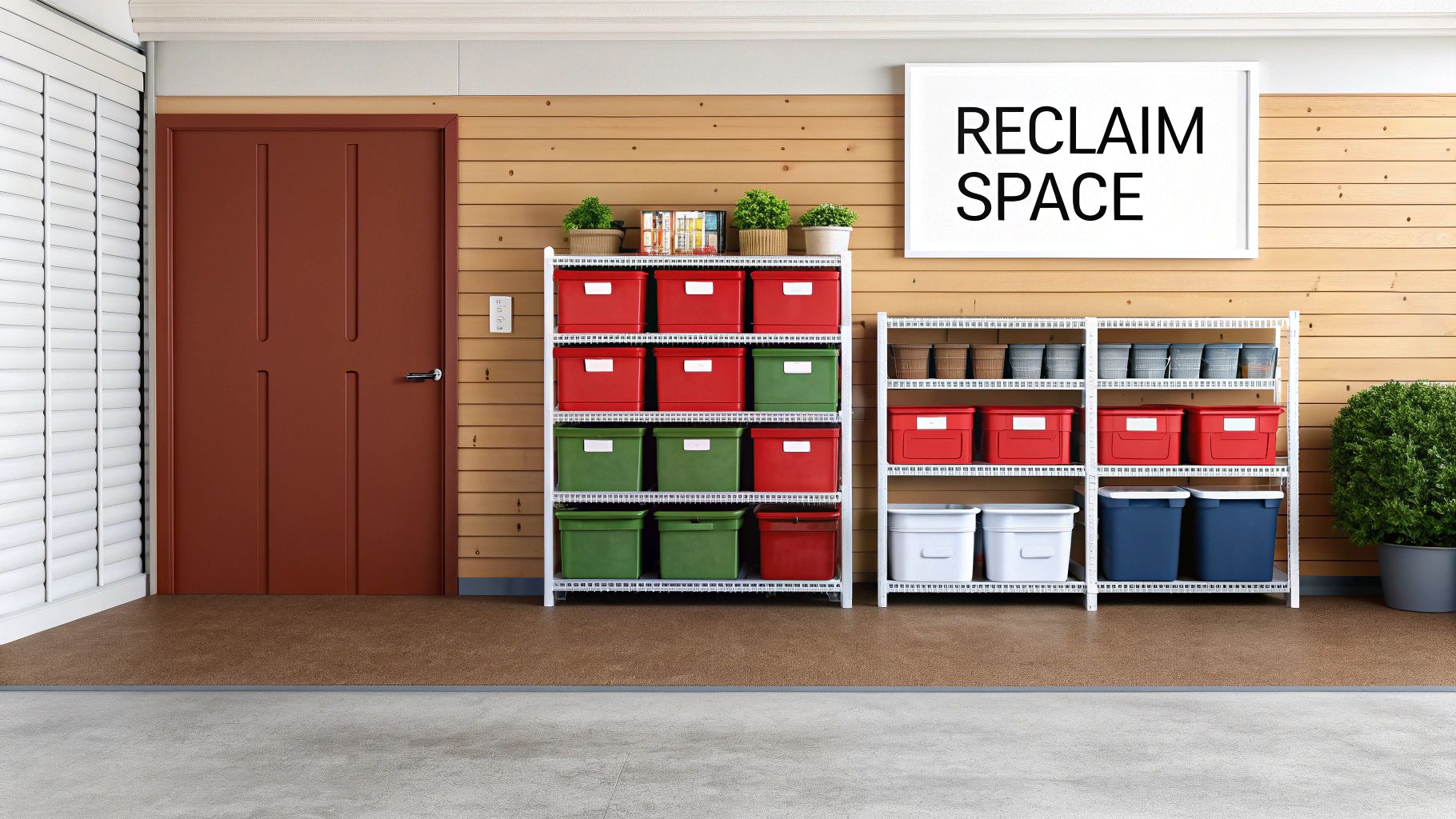
In modern Australian homes and businesses, space is at a premium. Every square metre counts. Wasted space is a missed opportunity, but dedicating an entire wall to storage is an absolute game-changer. It’s about more than just sticking up a few shelves; it’s a smart decision to get the most out of your floor plan without knocking down walls.
Think of it as creating a library for your belongings. Whether it’s tools, excess stock, or household items, everything gets its own designated, easy-to-find home. This method brings a sense of order and clarity to messy areas, turning them into highly functional assets.
The real magic of wall to wall shelving is using height to your advantage. Floorspace is almost always limited, but most rooms have heaps of vertical space that goes completely untouched. By running shelving from one end of a wall to the other, you create a massive amount of new storage capacity out of thin air.
This strategy is especially effective in spaces where efficiency is essential:
Even in smaller living situations like apartments or granny flats, smart storage is essential. Making the most of vertical space is a key trick for maintaining an organised and spacious feel. For some inspiration, check out our ideas for effective tiny home storage solutions to see these principles in action.
Choosing the right system is your first step towards a clutter-free space. At Super Rack, our focus is on delivering solutions that aren't just practical, but are also built tough to last. We know our customers need reliable storage they can depend on, day in and day out.
Our promise is simple: provide top-quality shelving at competitive prices, backed by fast, nationwide delivery. We believe that great storage shouldn't be complicated or break the bank.
With our team's expert advice, you can find the perfect wall to wall shelving units to suit your specific needs, whether you're tackling a small garage project or a large-scale commercial fit-out. We're here to help you plan, select, and install a system that solves your storage problems for good.
Ready to turn your cluttered walls into storage workhorses? Contact the Super Rack team today for some friendly advice and a free, no-obligation quote.
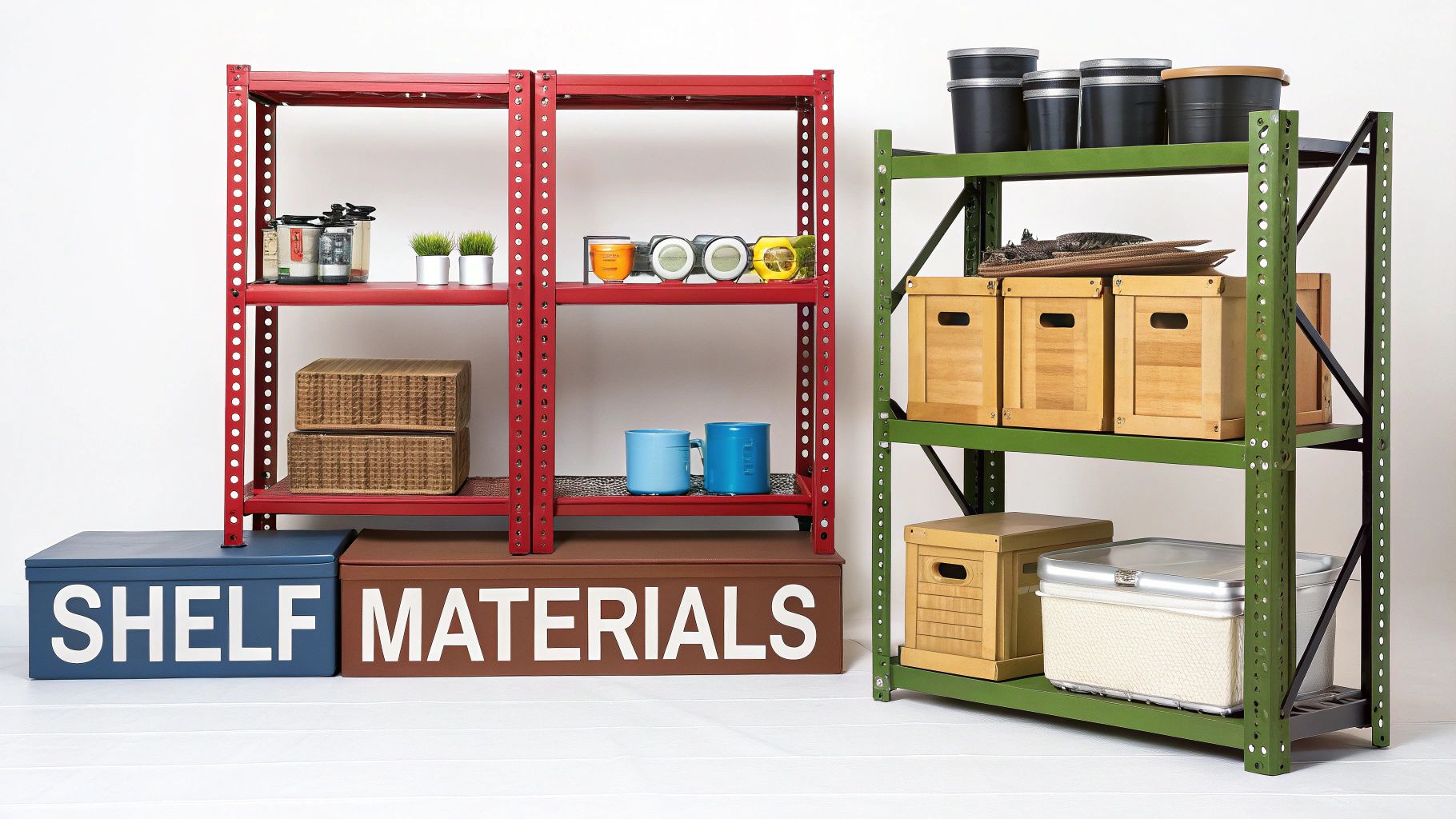
Not all shelves are created equal, and the material you pick is the foundation of a storage system you can rely on. Getting this choice right means your wall to wall shelving units will handle whatever you throw at them, year after year.
Let’s think about this in the real world. Picture a busy mechanic’s workshop. The shelving there needs to take the serious weight of toolboxes, heavy engine parts, and drums of oil without even thinking about buckling. In that scenario, heavy-duty steel isn't just a good idea; it's the only choice that makes sense.
Now, contrast that with a dry goods storeroom in a cafe. It still needs to be sturdy, but the main game might be airflow to keep products fresh. Here, wire shelving is an excellent option, letting air circulate freely around the stock.
When you need pure strength and durability, nothing comes close to steel. There’s a good reason it’s the go-to material for commercial warehouses, packed workshops, and serious garage setups. Steel gives you an incredible strength-to-weight ratio, which means it can hold massive loads without being ridiculously bulky.
At Super Rack, our steel shelving is finished with a tough powder coating. This isn’t just for looks—it creates a hard-wearing barrier that fights off scratches, chipping, and rust. That makes it perfect for tough Aussie conditions where moisture and rough handling are just part of the day.
Think of a panel beater in Adelaide who needs a setup that won't rust from the humidity or get dinged up by heavy equipment. Powder-coated steel delivers that long-term reliability. Its non-porous surface is also a breeze to clean, which is a massive plus in any environment where spills are bound to happen.
The real value of quality steel shelving is the longevity and peace of mind it gives you. You invest once and get a solution you can trust to safely hold your valuable gear or inventory for decades, with barely any upkeep.
While steel is usually the best all-rounder, it pays to know about the other options out there so you can make a properly informed decision. As Aussies look for better ways to organise their spaces, different materials are becoming more common, especially wall-mounted solutions that fit our dynamic lifestyles. You can read more about these market trends if you're curious.
Here’s a quick rundown of the alternatives:
When you weigh up durability, load capacity, and long-term value, high-quality steel shelving comes out on top for almost every practical storage job. It simply offers the best balance of performance and cost, especially for wall to wall shelving units built for serious work.
Take a small e-commerce business running from a garage in Brisbane. They need a system that can handle boxes of all shapes and sizes, be easily adjusted as stock levels change, and won't give out under pressure. Our heavy-duty longspan shelving is the perfect fit—it provides industrial-grade strength in a simple, boltless design that can grow right alongside the business.
Choosing the right material is the first critical step to building a storage system that’s both effective and safe. By understanding the pros and cons of each, you can lock in a solution that not only meets your needs today but provides real value for years to come.
If you want some expert advice on the best shelving material for your specific project, don’t hesitate to get in touch with the Super Rack team. We’re here to help you make a choice you’ll be happy with for a very long time.
A great wall to wall shelving installation is no accident—it all starts with a rock-solid plan. Taking the time to properly measure and map out your space is the single most important thing you can do to get it right the first time, saving yourself a world of headaches and extra costs down the track.
Think of this planning phase as your blueprint for success. It’s where your idea goes from a rough concept to a practical, working project, ensuring the final result is exactly what you pictured.
Before you even think about clicking "add to cart," get your tape measure out. Precision is your best friend here. A small miscalculation can throw off the entire project, so the goal is to get a crystal-clear picture of the dimensions you’re working with.
Start with the basics:
Very few walls are perfect, empty canvases. Most have little quirks and obstacles you need to plan around. Ignoring them now is a recipe for frustration later, so spot them early and build them into your layout.
Keep an eye out for common hurdles like:
Once you know where everything is, you can position your wall to wall shelving units to leave clear access. You don't want your new setup to block a window or make it impossible to plug in a power tool. For awkward corners or interruptions, specialised units like our corner gondola shelving can help you squeeze the most out of every last centimetre.
With your measurements sorted, it's time to bring the plan to life. You don’t need any fancy software for this—a roll of painter's tape is one of the best tools for the job.
Use the tape to mark the outlines of your proposed shelving uprights and shelf levels directly onto the wall. This simple trick lets you step back and get a real feel for how the system will look and function in the space before you commit.
This quick visualisation check helps confirm if your shelf heights are practical for what you’re storing and if the overall layout feels balanced and easy to use. It’s also the perfect time to think ahead. Will your storage needs change? Planning for a flexible system with adjustable shelves now means you can easily adapt as your requirements evolve.
A thorough plan takes all the guesswork out of the project. You’ll know exactly how many uprights, beams, and shelves you need, letting you order from Super Rack with total confidence. And if you need a hand finalising your layout, our expert team is always ready to offer practical advice to help you design the perfect storage solution.
Choosing the right wall to wall shelving units is about more than just making them fit your space—it's about knowing what they can safely hold. Get this wrong, and you're not just looking at a messy collapse; you're dealing with a serious safety hazard. That's why understanding shelf load capacity is one of the most critical parts of your decision.
Think about it. A home office storing a few archive boxes has completely different demands than a mechanic's workshop stacking heavy engine parts and toolboxes. One needs a standard-duty setup, while the other requires a heavy-duty system built to handle some serious punishment.
This is where you'll see the term UDL, which stands for Uniformly Distributed Load. It's a simple but vital concept. It means the maximum weight a shelf can support when that load is spread evenly across its surface, not just piled in the middle. A shelf with a 400kg UDL is designed to handle that weight when it's distributed from end to end.
Before you can pick the right shelving, you need a ballpark idea of how much weight you're planning to store. Don't worry, you don't need to be a mathematician to get it right. A quick estimation will point you in the right direction.
Getting your measurements and calculations right from the start is fundamental to choosing a system that's both safe and effective.
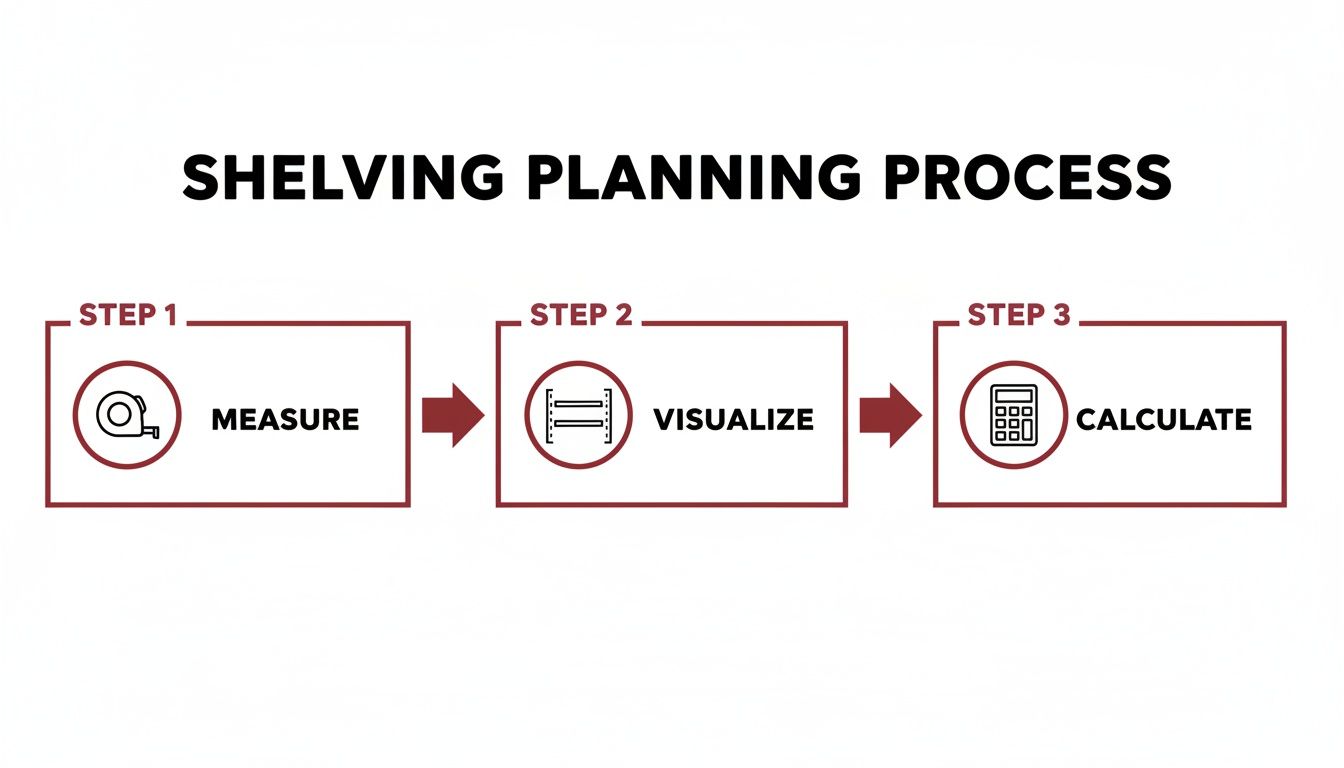
Here’s a practical way to figure out your needs:
This simple foresight makes sure your shelving is not just good enough for today, but ready for whatever you throw at it tomorrow.
With your weight estimate sorted, you can confidently choose a system that’s genuinely up to the task. At Super Rack, we clearly label all our products with their load ratings to take the guesswork out of it.
For instance, a home garage storing sporting gear, gardening tools, and a few toolboxes would likely be fine with a system rated for 200kg UDL per shelf. But for a small business holding heavy stock or equipment, a more robust option is non-negotiable. Our heavy-duty garage shelving with a 1600kg total capacity is specifically engineered for these demanding situations, giving you total peace of mind and lasting durability.
Always choose a load capacity that comfortably exceeds your heaviest estimated shelf load. It's the smartest way to invest in a storage solution that is safe, reliable, and built to last.
By getting a handle on load capacity, you’re making an informed choice that will turn your wall to wall shelving units into a dependable asset for years to come. If you’re ever unsure about your weight needs, our expert team is here to offer practical advice and help you select the perfect system.
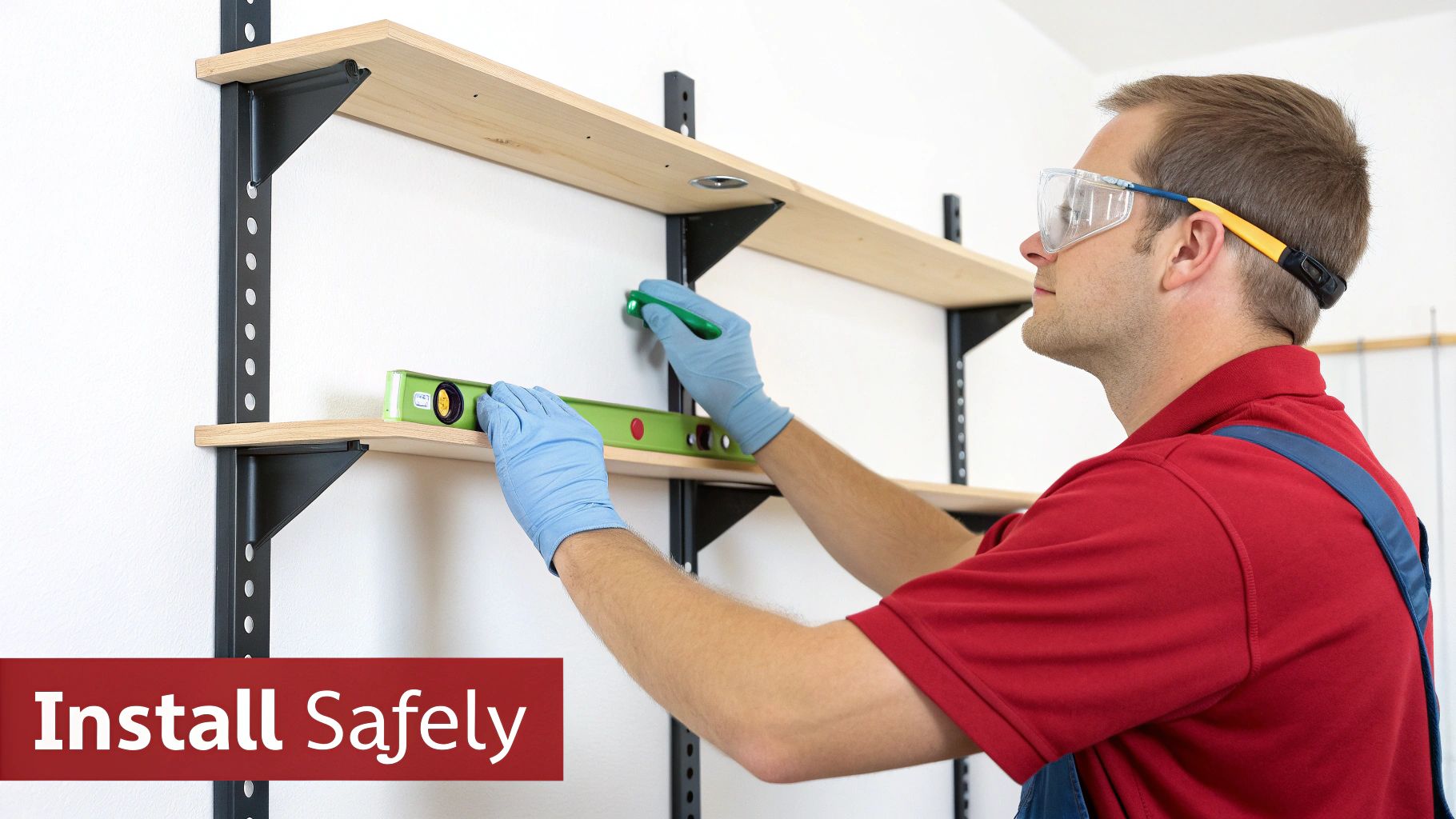
A well-planned storage system is only as good as its installation. Putting your wall to wall shelving units together safely is the top priority, ensuring they remain a stable and reliable asset for years. A secure setup doesn't just protect your stored items—it's absolutely critical for preventing accidents.
This all starts with understanding your walls. While freestanding units are fairly straightforward, securing shelving directly to a wall needs a bit more care. The goal is always to anchor your system to the solid framework behind the plasterboard, not just the plasterboard itself.
Before you even think about assembly, take the time to prepare your space and grab the right tools. A few non-negotiable steps will guarantee your shelving is level, stable, and ready to be loaded up safely.
The single most critical step is finding the wall studs—the vertical timber or steel beams that form your wall’s skeleton. Attaching your brackets or uprights directly to these studs provides the strongest possible anchor point. A simple stud finder is an inexpensive tool that makes this job quick and easy.
Next up, you need the correct fixings for your specific wall type.
Finally, a spirit level is your best friend. Every upright must be perfectly vertical, and every shelf perfectly horizontal. An uneven installation puts uneven stress on the components, which can slowly compromise the entire structure’s integrity.
Once your shelving is installed and loaded, a little ongoing care will go a long way in extending its life and maintaining its safety. Think of it as a quick health check for your storage system. These simple routines take just a few minutes but can prevent major headaches down the track.
A proactive approach to maintenance ensures your wall to wall shelving units stay in top condition, protecting your investment and guaranteeing continued safe operation. At Super Rack, we engineer our products for durability, but regular checks are simply best practice for any storage system.
A quick visual inspection every few months is all it takes. This simple habit helps you spot potential problems early, before they become safety hazards. It’s the easiest way to ensure your shelving continues to perform exactly as it should.
Your routine check-up should include:
Following these simple installation and maintenance tips ensures your storage solution is not just effective, but safe. For friendly, expert advice on installing your system, don’t hesitate to reach out to the Super Rack team—we're here to help.
When you're gearing up for a big storage project, it's normal to have a few questions floating around. We've pulled together some of the most common queries we get about planning and putting in wall to wall shelving units. Our aim is to give you the clear, practical answers you need to get the job done with confidence.
Here's what people usually want to know.
You bet. Most of our shelving is designed for straightforward DIY assembly. We use clever, boltless designs where everything just locks securely into place, and every kit comes with clear instructions to make it as simple as possible.
Of course, if you're tackling a massive setup or just aren't a fan of DIY, bringing in a professional is always a smart move. The most important part, hands down, is making sure the units are properly anchored to the wall—especially with heavy loads—to keep them safe and stable for years to come.
That's the big question, and the answer really depends on the model. Our light-duty units are spot-on for home garages or office storerooms. On the other hand, our heavy-duty longspan shelving is built for tough commercial jobs and can handle much, much more weight per shelf.
It’s crucial to check the specific load rating, often called the UDL (Uniformly Distributed Load), before you buy anything. A good rule of thumb is to always pick a system that can handle more than your heaviest estimated load. Our team is always here to help you pick the right capacity, but if you want to see our toughest options, you can check out our heavy-duty longspan shelving.
Yep, flexibility is built right into our designs. The vast majority of our shelving systems come with fully adjustable shelves, so you can customise the height between each level.
This is incredibly handy because your storage needs are bound to change. It means you can easily reconfigure your setup for taller boxes or smaller items without having to pull the whole thing apart. It's a practical feature that makes our shelving a smart, long-term investment.
Keeping our steel shelving in top shape is incredibly simple. The powder-coated finish is tough as nails, designed to resist rust, scratches, and general wear and tear from the get-go.
For a routine clean, just wipe the surfaces down with a damp cloth to get rid of any dust or grime. Steer clear of harsh or abrasive chemicals, as they can damage the protective coating. We also recommend giving the unit a quick once-over every now and then to make sure all the locking pins and safety clips are still sitting tight. That’s all it takes to keep your Super Rack shelving performing safely for years.
Ready to build the ultimate storage setup with high-quality wall to wall shelving units? The expert team at Super Rack is here to help you design and choose the perfect system for your space and budget.
Visit Super Rack today to explore our full range and get a free, no-obligation quote!
Choosing the right cabinet for your workshop is about more than just cleaning up a messy corner. It's one of the smartest moves you can make to boost your productivity and protect the tools you’ve invested in. A properly organised workshop means less time hunting for things and more time getting the job done.
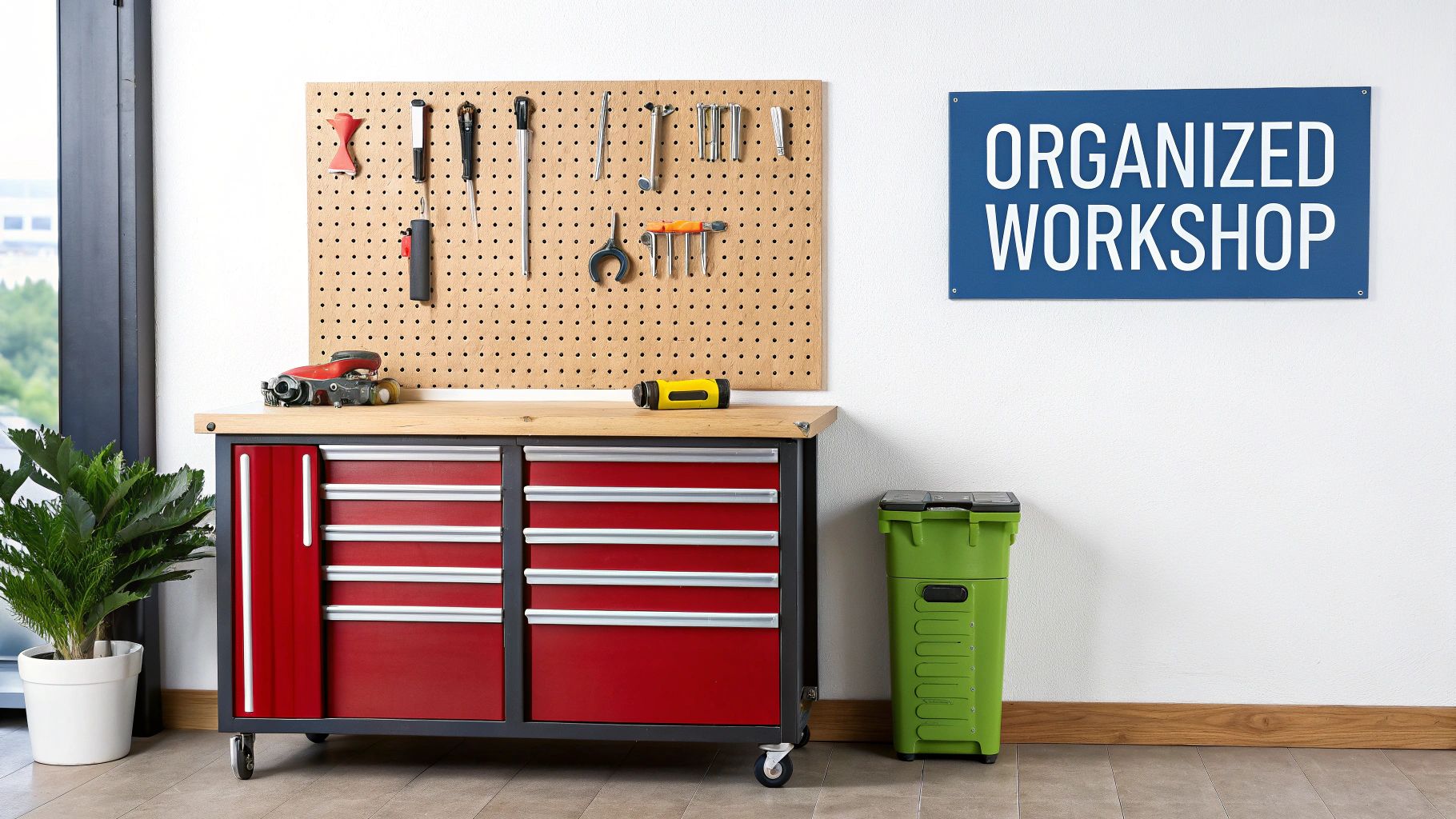
Think of your workshop like a chef’s kitchen. No chef can work well if their knives are missing and their ingredients are all over the place. It just doesn't work. In the same way, a quality cabinet for a workshop acts as your central station—a system where everything has its own spot, ready to go when you are.
Making that shift from chaos to control brings some serious benefits. First off, it completely changes your workflow. You're no longer wasting precious minutes digging through a pile of tools to find that one 10mm socket. You know exactly where it is. That time saved really adds up, whether you're a weekend DIYer or a small business owner where every minute counts.
An organised space isn't just about feeling good; it's about protecting your investment. Good tools can cost a fortune, and leaving them out in the open—exposed to dust, moisture, or getting knocked off a bench—is a recipe for rust, damage, and expensive replacements.
A tough cabinet for your workshop gives your gear a safe home, keeping everything in top nick. This is especially true for heavy-duty steel cabinets, which offer the best protection against common workshop hazards like chemical spills and heavy impacts.
Here's what you really gain:
The trick to choosing the right cabinet is to think about your specific situation. What kind of jobs do you do? How much room do you have? What’s your budget? Answering these questions first will help you pick a system that works for you now and can grow with you later.
Here at Super Rack, we get that every workshop is unique. That’s why we offer practical advice to help you find the perfect storage setup. With our focus on superior quality, competitive pricing, and fast delivery Australia-wide, getting your ideal workshop sorted has never been easier. We’ll help you build a foundation for efficiency and safety that will pay you back for years to come.
When you're fitting out your workshop, one of the biggest calls you'll make is the material for your cabinets. It's a choice that impacts everything from longevity to how well your gear is protected. The two main contenders are steel and timber, and each has its place depending on what you do day in, and day out.
Think of it like choosing between a tough ute and a classic sedan. Both will get you there, but they’re built for completely different demands. Steel is the rugged workhorse built for tough conditions, while timber brings a traditional look that's right at home in certain craft-focused spaces.
For most workshops, steel is the undisputed champion, and for good reason. It’s tough, secure, and built to handle a busy workspace. We're talking mechanic shops, fabrication floors, and any environment where durability isn't just a bonus—it's a necessity.
Here’s where steel really pulls ahead:
Imagine this: you knock over a can of degreaser. On a timber bench, that's soaking in, leaving a permanent stain. On a quality steel cabinet from Super Rack? You just wipe it up. No harm done.
There's no denying the classic charm of timber. It's a popular pick for woodworking studios or home workshops where looks are a priority. A good set of timber cabinets can give a space that proper craftsman's den feel.
But while timber looks the part, it has practical drawbacks in a serious workshop. It’s vulnerable to moisture, which leads to warping and swelling. It also won't stand up to the same level of impact or chemical exposure as its steel counterpart.
When you weigh it all up, steel comes out on top for almost every workshop application. Its resilience, security, and low-maintenance nature make it the smarter long-term investment. This reflects a wider trend across Australian homes and businesses for durable, functional storage. In fact, research shows the Australian kitchen furniture market is projected to grow to $1.97 billion by 2030, showing just how strong the demand for robust storage is. You can learn more about the Australian furniture market trends and projections.
At Super Rack, we back high-grade steel for our workshop cabinets because we know it delivers the performance our customers need. Our cabinets are engineered for strength, with robust construction and premium finishes designed for the long haul. With our competitive pricing and fast, nationwide delivery, we make it simple to get your workshop kitted out with storage that’s truly built to last.
Ready to find the perfect steel cabinet for your workspace? Explore our range of durable garage shelving solutions or get in touch with our experts for practical advice tailored to your needs.
The best cabinet for a workshop is one that fits like a glove—it needs to match your space, your tools, and the way you work. A cabinet that’s perfect for a weekend woodworker in their garage would be completely out of its depth in a busy mechanic’s shop. The key is to think about what you really need it to do.
This decision tree gives you a simple starting point for figuring out your main priorities.
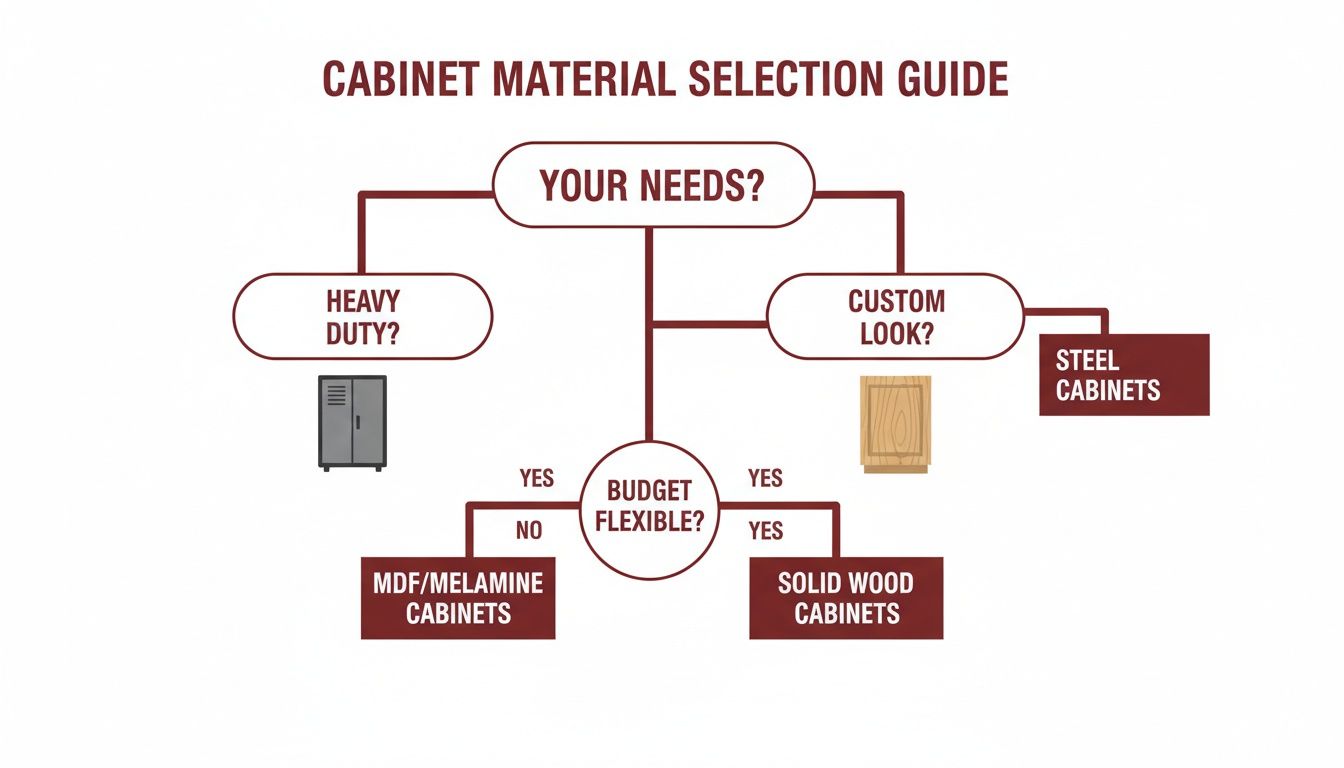
As the chart shows, if heavy-duty performance and security are your top priorities, steel is almost always the right answer for your workshop.
If your workshop shares space with the family car in the garage, versatility is key. You need storage that keeps your tools organised and secure but can also be moved out of the way. This is where mobile cabinets on castors are brilliant.
Imagine finishing a project on a Sunday arvo. You can simply wheel your tool cabinet back against the wall, leaving the floor clear. Look for a mix of shallow drawers for hand tools and deeper drawers for power tools. A sturdy top surface can also double as a small, mobile workbench.
A typical home setup might include:
For a professional mechanic, fabricator, or tradie, the workshop is your livelihood. Your tools represent a massive investment, sometimes adding up to tens of thousands of dollars. Here, the focus shifts to heavy-duty capacity, security, and durability.
You need a robust system of large, lockable steel cabinets that can handle serious weight and withstand the daily grind. Think about a full wall of interconnected cabinets and drawers, creating a complete, integrated workstation.
For instance, a busy auto shop might have a row of Super Rack cabinets with a solid steel workbench top. The deep drawers hold heavy socket sets and air tools, while upper cabinets store supplies. Everything is lockable, ensuring thousands of dollars in gear is secure overnight. You might find our heavy duty garage shelving solutions are ideal for storing bulkier items alongside your cabinets.
Farm sheds and rural workshops face their own set of challenges. Dust, moisture, and pests are constant battles, and the equipment stored is often heavy and greasy. The ideal cabinet for this kind of workshop needs to be tough, sealed, and incredibly robust.
Fully enclosed, powder-coated steel cabinets are your best defence. They keep dust and moisture out, protecting everything from expensive harvester parts to sensitive testing gear. Strong, adjustable shelves are also a must to accommodate everything from tubs of grease to spare filters.
Picture a farm shed in rural NSW. A series of tall, lockable steel cabinets line one wall. One securely stores agricultural chemicals, safely away from people and animals. Another holds spare parts for machinery—all organised and protected, ready to go during a critical harvest period. This can save hours of downtime when a repair is urgently needed.
At Super Rack, our experts understand these different needs. We offer superior quality storage solutions with fast, nationwide delivery, helping you find the perfect cabinet for a workshop that truly works for you.
Having the best cabinet for your workshop is only half the battle. If it’s in the wrong spot, it can actually slow you down. A smart workshop layout is the secret to unlocking true efficiency, turning a cluttered space into a productive powerhouse.
This isn't just about making things look tidy. It's about designing a space that flows with your work, saving you precious time and energy on every project. The goal is to cut down on wasted steps so your work becomes smoother and safer.
You've probably heard of the 'work triangle' in kitchen design, which links the sink, stove, and fridge. We can use the same idea for the workshop, creating a triangle between your main workbench, your key tool storage, and your most-used large equipment.
By arranging your layout this way, your essential tools and surfaces are always just a step or two away. For instance, the cabinet for workshop tools you use constantly should be within arm's reach of the bench. This simple concept dramatically reduces wasted movement.
An efficient workshop is an organised one, and setting up dedicated 'zones' for different tasks is a game-changer. Think of it as giving every activity its own home base.
When you group related tools and supplies together, you create a logical flow. A versatile Super Rack work bench can be the perfect anchor for any of these zones.
Making smart use of space is critical, especially in smaller garages and sheds. Wall-mounted cabinets are fantastic for getting things off the floor, freeing up valuable room and getting rid of trip hazards.
When planning your layout, always leave enough clearance. Make sure cabinet doors and drawers can open fully without hitting machinery. A good rule of thumb is to allow at least 90cm of clear space in front of any cabinet.
Safety has to be your number one priority. Tall cabinets, particularly those loaded with heavy tools, must be securely anchored to a wall stud to prevent them from tipping over. It’s a simple step that brings crucial peace of mind.
Modular cabinet systems, like those from Super Rack, are perfect for creating a layout tailored to you. You can mix and match different units to fit your specific space and workflow. With our expert advice and fast nationwide delivery, designing your ideal workshop layout is easier than you think.
A quality workshop cabinet is a serious investment. Like any good tool, it’s built to last—but only if you look after it. A bit of simple, regular maintenance doesn't just keep your setup looking sharp; it ensures everything works smoothly and safely for the long haul.
This small amount of upkeep protects your gear and your investment. Think of it like checking the oil in your ute; it’s a quick job that stops a massive headache from developing down the track.
You don’t need to spend hours keeping your cabinets in top condition. A basic clean and a quick inspection every few months is usually all it takes.
For steel cabinets, a wipe-down with a damp cloth and a mild detergent is perfect for getting rid of dust and grime. If you've got timber cabinets, stick to a wood-friendly cleaner and don't use too much water, as it can cause warping.
After a clean, give the moving parts some attention. A quick spray of lubricant on drawer runners and door hinges will keep them sliding smoothly. While you're there, check the handles and locks to make sure they’re all tight and secure.
Beyond a good clean, safety should be your top priority. Following these simple rules will make sure your workshop stays a safe and productive space.
Your top safety priorities should be:
At Super Rack, we build our cabinets for durability and safety, but proper use is what guarantees their long life. Our team can give you expert advice on setting up your storage correctly. With our commitment to superior quality and nationwide service, we’re here to help you build a workshop that’s not just organised, but safe.
Let's talk dollars and sense. Buying a quality cabinet for a workshop isn't just another expense—it's a direct investment in your efficiency, safety, and the life of your tools. When you see it that way, the focus shifts from the upfront cost to the long-term value.
The initial outlay for workshop cabinets in Australia can vary. A basic unit might set you back a few hundred dollars, while a complete, heavy-duty system could run into the thousands. For example, a sturdy mobile tool chest might cost around $500 to $900 AUD, whereas a full wall of premium steel cabinets could be $2,000 AUD or more.
While it's easy to get hung up on the price tag, the real story is the return on investment (ROI). A well-organised workshop doesn't just feel better; it genuinely performs better.
The ROI from a good cabinet system comes from three key places: time saved, money saved on tool replacement, and a boost in productivity.
Think about it like this:
Imagine a small fabrication business. The owner invests $3,000 AUD in a Super Rack steel cabinet and workbench system. By getting their tools sorted, they shave 20 minutes of setup time off every job. This allows them to take on one extra small job per week, generating an additional $200 in revenue.
In this scenario, the cabinet system pays for itself in just 15 weeks. Everything after that is pure profit. This tracks with industry data on how crucial efficiency is. For example, some industry benchmarks show that as turnover increases, expenses can claim a large percentage of revenue, squeezing profit margins. Driving efficiency through smart investments isn't just a nice idea—it's essential for growth. You can discover more insights at IBISWorld's carpentry services industry report.
At Super Rack, our focus is on delivering this long-term value. Our superior quality ensures your investment lasts, while our competitive pricing makes it accessible. Combined with our fast, nationwide delivery and expert advice, we help you build a workshop that pays you back for years to come. For businesses looking to truly max out their floor space, exploring options like installing a mezzanine floor can further boost this return.
Picking the right cabinet for a workshop can feel like a big decision. We've pulled together some straightforward answers to the questions we get asked most often.
For almost any Aussie workshop, steel is the best material. It's tougher, handles knocks and spills way better, and can hold more weight than timber.
While a wooden cabinet might look nice in a hobbyist's studio, steel gives you far better value and security in a proper working environment.
This boils down to your workflow. Mobile cabinets on castors give you incredible flexibility—you can roll your entire tool kit right up to the job. They're brilliant for smaller or shared spaces.
Stationary cabinets, on the other hand, are the foundation of a permanent workshop layout. The most organised workshops often use a mix of both, giving them a fixed base with the flexibility to move tools where they're needed.
The weight capacity varies massively, so you have to check the manufacturer's specs. A cheap, flimsy cabinet might only take a few kilos per shelf.
Heavy-duty steel cabinets, like the ones from Super Rack, are properly engineered to handle serious weight. It's common for our shelves to be rated for 50kg or more, making them a safe bet for storing heavy power tools, parts, and other bulky gear.
One hundred percent. Lockable cabinets are non-negotiable for two reasons: security and safety. First, they stop your expensive tools from being stolen.
Just as importantly, they keep dangerous equipment and hazardous materials like chemicals away from kids and pets. That peace of mind alone is worth its weight in gold.
At Super Rack, we're here to offer expert advice and top-quality storage to help you build the perfect workshop. With our competitive pricing and fast, nationwide delivery, getting organised has never been easier.
Ready to find the perfect cabinet for your setup? Check out our full range of workshop storage solutions online at Super Rack.
Looking for "pallet racking 2nd hand" often starts with one goal: saving money. For any Aussie business keeping an eye on the budget, a lower price tag is tempting. But that initial saving can be misleading, with the real cost appearing later through safety issues, compliance headaches, and unexpected bills.
Buying used pallet racking is a big gamble. While the upfront cost is lower, you are buying a system with a completely unknown and often untraceable history.
It’s like buying a used car without a service book or a roadworthy certificate. It might look okay on the outside, but hidden problems could lead to a catastrophic failure when you need it most.
In a warehouse, a failure could mean a full structural collapse, putting your staff in danger and destroying thousands of dollars in stock. The appeal of saving a few dollars fades quickly when you’re facing potential workplace accidents, big fines for not meeting Australian safety standards, and costly downtime for your business.
Choosing a second-hand system brings a host of risks into your business from day one. Unlike new pallet racking, which comes with guaranteed quality and compliance certificates, a used system gives you a long list of uncertainties that you, the buyer, now have to solve.
These risks include:
Imagine a logistics company in Sydney buys a large set of used racking, saving $15,000 AUD on the purchase. On the surface, it looks solid. But then, a routine safety audit reveals that several uprights are dangerously weak from old forklift impacts at its previous location.
To make the system compliant, the business now faces thousands in engineering assessment fees, the high cost of replacement parts, and lost productivity while sections of the warehouse are closed off. That initial saving is gone, replaced by unexpected stress and expense.
A storage system is more than just shelving; it is the operational backbone of your business. Its reliability directly impacts your team's safety, your inventory's security, and your overall efficiency.
This guide will walk you through these hidden realities. Our goal is to give you the practical knowledge to see why investing in a new, certified pallet racking system from a trusted supplier like Super Rack isn't just a safer choice—it's a much smarter long-term business decision. With nationwide service and expert advice, we provide the certainty that second-hand options simply can't match.
When you shop for pallet racking, the first thing you notice is the price difference. A "pallet racking 2nd hand" deal looks tempting, especially when the upfront cost is a fraction of buying new. But that sticker price is just the beginning.
To really understand the cost, you need to look at the Total Cost of Ownership (TCO). This isn’t just about the initial price; it’s about every single cost that will come up over the life of your racking. With used systems, these surprises can quickly turn a bargain into a major financial headache.
Think of it like buying a car. A new system is like driving a brand-new ute off the lot with a full warranty, capped-price servicing, and modern safety features. Buying used is more like getting a cheap deal from a private seller with no logbook—you might save cash today, but you're also buying every potential problem that comes with it.
That initial saving on a used system often gets wiped out by later costs. These aren't optional extras; they're essential for keeping your warehouse safe and compliant with Australian workplace safety laws.
Let's break down where the money really goes:
Let’s imagine a small business in Melbourne setting up its first warehouse. They find a second-hand racking system and save an initial $10,000 AUD compared to the quote for a new setup. Sounds good, right?
But then the real work starts. They have to pay $4,000 AUD for an engineer to inspect and certify the system. The engineer finds several damaged beams that need replacing, which costs another $3,000 AUD. Suddenly, their $10,000 AUD saving has shrunk to just $3,000 AUD—and that’s before considering the hassle and delays.
The demand for second-hand pallet racking in Australia is understandable as businesses manage rising costs. As some reports show new racking prices have climbed, many are drawn to pre-owned systems, sometimes seeing prices under $100 AUD per pallet position compared to over $250 AUD for new. You can read the full research on Australia's warehousing market trends.
When you choose new pallet racking, you are buying certainty. You get guaranteed compliance with Australian standards, predictable performance, and a clear, upfront cost with no nasty surprises.
Super Rack closes this value gap by offering competitively priced, superior quality new racking. Our systems come with fast, nationwide delivery and the expert advice you need to get it right the first time, making new racking the smarter, more reliable choice for your business's future.
When setting up a warehouse, understanding Australian safety standards is not just a box-ticking exercise. It's your core responsibility for keeping your workplace safe. The main standard is AS 4084:2023 Steel Storage Racking, and it’s critical to understand it before considering a second-hand purchase.
Think of AS 4084 as the official safety blueprint for your storage system. It covers the minimum requirements for everything, from the quality of steel to how the system must be designed, installed, and maintained. Its purpose is simple: prevent catastrophic failures and protect people.
For any business owner, compliance is non-negotiable. It’s a legal duty under Australia’s Work Health and Safety (WHS) laws. Ignoring these standards can lead to huge penalties and, more importantly, put your team in real danger.
One of the huge advantages of buying a new pallet racking system from a trusted supplier like Super Rack is knowing it’s engineered to meet AS 4084 from the factory. Every component, from the smallest safety pin to the largest upright frame, has been designed and tested to these strict standards.
This means you get:
Buying pallet racking second-hand is like buying a car without a roadworthy certificate. It might look fine, but you have no verified history. You have no idea if it was overloaded, hit by a forklift, or repaired poorly. That uncertainty is a massive liability.
Using racking that doesn’t meet AS 4084 standards opens the door to trouble. The risks aren't just financial—they're personal and can have devastating consequences for your staff and your business reputation.
A non-compliant system is an immediate hazard. For example, a beam weakened by a past forklift knock could collapse without warning, causing serious injury. The legal fallout from such an incident can be crippling, involving hefty fines and even prosecution.
On top of that, your insurance company might refuse to pay out for damages if they find your racking wasn't compliant. Suddenly, you're left covering the entire cost of lost stock, property damage, and legal fees yourself.
Investing in new, compliant pallet racking isn't an expense—it's an investment in the safety of your people and the stability of your business. The peace of mind from a certified and safe system is invaluable.
The only way to be 100% sure your storage system is safe and legal is to start with new, certified equipment. Super Rack provides top-quality racking systems that are competitively priced and come with the expert advice you need to get your installation fully compliant.
While we will always recommend new pallet racking for its guaranteed safety and compliance, warehouse managers need to be skilled in spotting potential dangers. Whether you're checking your existing setup or considering a second-hand purchase, a thorough inspection is essential.
This practical checklist will guide you through the must-check areas, helping you spot risks before they become disasters. Knowing what to look for is the difference between a safe workspace and a catastrophic failure, as even minor-looking issues can seriously weaken the whole structure.
Think of the uprights as the backbone of your racking system. They carry the entire load down to the floor, so their condition is critical.
Start your inspection at the base of each frame.
The beams are the horizontal supports that hold your pallets. If one fails, it's a sudden collapse, so a detailed check is critical.
When looking at beams, focus on their physical condition and how they connect to the uprights. The connection point between the beam and the upright is one of the most vital joints in the system.
Any visible sagging or bowing in a beam—even when unloaded—is an immediate sign it has been overloaded in the past. It is no longer safe and must be replaced immediately.
This simple infographic shows the typical process for ensuring racking meets Australian Standards, from design to ongoing audits.
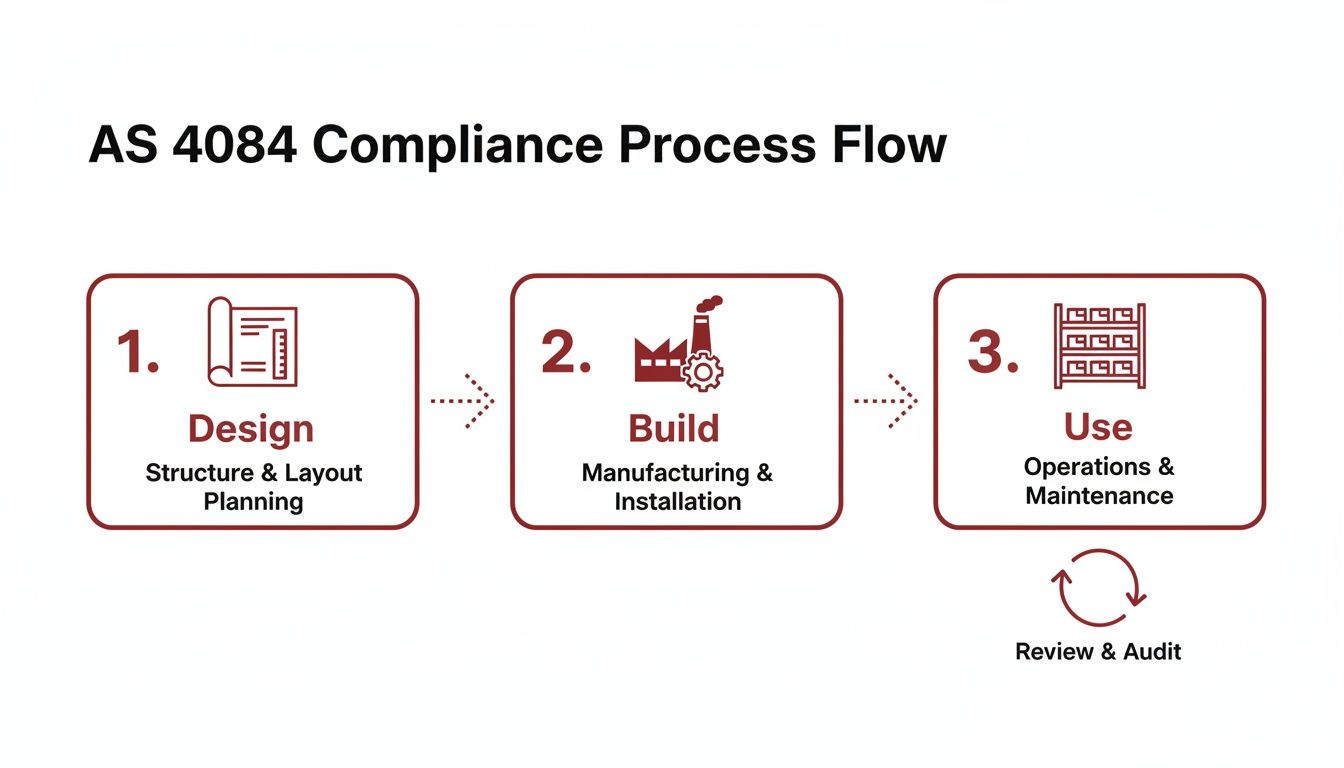
As you can see, compliance is an ongoing job, not a one-off task. It's another reason why starting fresh with a new, certified system is always the most dependable option.
Rust isn't just ugly; it's steel actively weakening. Corrosion eats away at the metal, reducing its thickness and structural integrity.
Finally, double-check that every beam has its safety pins or locking clips fitted correctly. These small parts are crucial—they stop a forklift from accidentally lifting a beam out of the upright. Missing pins are a common and dangerous oversight. When inspecting a potential pallet racking 2nd hand system, a lack of these clips often points to a poor maintenance history.
With new equipment, you avoid these worries. You can find a huge range of compliant and reliable pallet racking beams and accessories that guarantee a secure fit. This inspection process highlights the hidden risks of used racking, reinforcing the safety and peace of mind you get with new, certified equipment from Super Rack.
Choosing the right pallet racking is a great start, but it's only half the job. An efficient and safe warehouse comes from a smart layout that makes the most of your floor space. This is where you move beyond just buying steel and start designing a high-performance system.
When you buy pallet racking 2nd hand from a private seller, you get the parts—and that's it. What’s missing is the crucial design and layout expertise that turns a pile of beams and frames into a smooth, productive workflow. A well-planned layout isn't a bonus; it's what prevents bottlenecks, improves safety, and allows your business to grow.
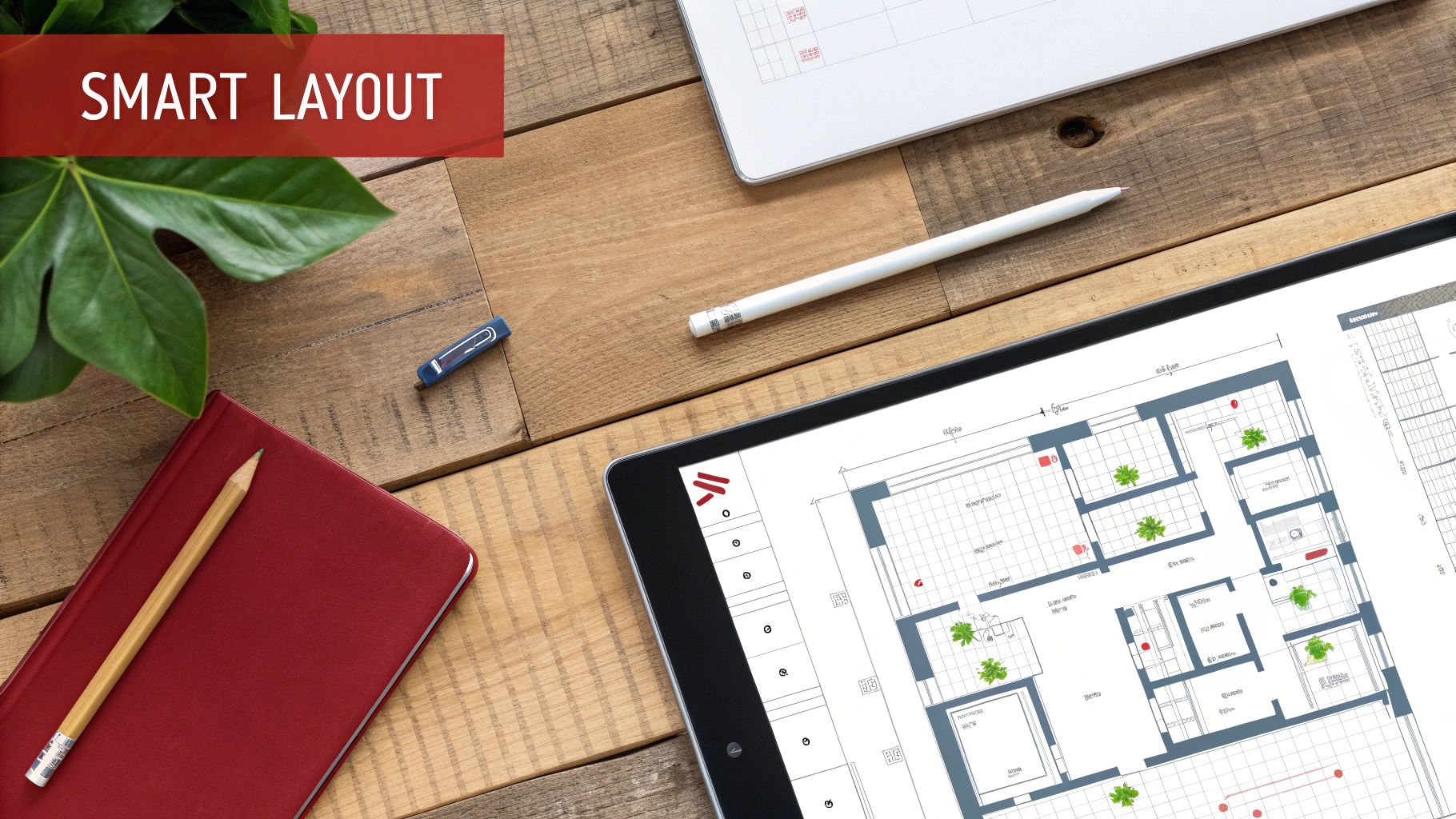
Before a single frame is installed, you need a clear plan of your operational flow. It’s all about thinking through how goods will move through your facility, from arrival to dispatch.
Here are the core elements to get right:
Imagine a growing e-commerce business in Brisbane setting up its first warehouse. They could buy a cheap lot of used racking, but then they'd have to figure out the layout themselves. Without experience, it's easy to make mistakes, like creating aisles too narrow for their forklift or putting the receiving area next to dispatch, causing chaos.
Now, consider the alternative. By working with a supplier like Super Rack, they get expert advice as part of the service. Our team would help them design a layout with dedicated zones for receiving, bulk storage, pick-and-pack stations, and dispatch. We’d ensure the workflow is fluid and efficient, preventing operational headaches that can slow growth.
A smart warehouse layout is an investment in productivity. The time saved by eliminating bottlenecks and reducing picker travel time translates directly into faster order fulfilment and lower operational costs.
This kind of expert advice is a huge advantage of investing in a new, professionally supplied system. It’s a service you just don't get when buying second-hand parts online. The right layout, supported by the right pallet racking accessories, ensures your operation runs at peak efficiency.
The Australian warehousing sector is booming, and the pallet racking market is growing with it. As the Australia pallet racking system market expands, businesses are looking for smart ways to scale up. Read more about the growth of the Australian pallet racking market.
The choice between new pallet racking and a second-hand system comes down to risk versus reward. While the cheap upfront price of “pallet racking 2nd hand” might look good on paper, it’s a short-term saving that can quickly become a long-term problem.
The real investment isn't just in the steel. It's in the safety of your team, the smooth operation of your warehouse, and the future of your business. A used system comes with a history of unknowns that you inherit the moment it's installed.
When you buy a used system, you’re gambling on its past. Was it overloaded? Damaged by a forklift? Patched up with a dodgy repair? You have no way of knowing, and that uncertainty creates risks that can appear months or years later.
The potential downsides are serious:
Investing in a new system from a trusted partner like Super Rack isn't just a purchase; it's a strategic move for your business. It’s about choosing certainty over chance. With Super Rack, you get more than just new steel—you get a complete storage solution designed to support your business.
Choosing a new, certified pallet racking system isn't just a purchase. It's an investment in a safe, compliant, and efficient operational backbone that gives your business a solid foundation for growth.
By going new, you get tangible benefits that a used system can't match. Our commitment to superior quality means your racking is built with the best materials and backed by a full warranty. You also get transparent, competitive pricing with no hidden surprises, plus nationwide service and fast delivery across Australia.
Most importantly, you get our expert advice on everything from layout design to installation. We'll help you create a solution that works for your specific needs, maximising both efficiency and safety. Explore our complete pallet racking system to see how a certified new solution can transform your workspace.
Ready to build a storage solution you can trust? Contact the Super Rack team today for a no-obligation consultation and let us design a system that works for your business.
Here are some straight answers to the most common questions about new vs second-hand pallet racking.
Buying pallet racking 2nd hand is always a gamble. You have no idea about its history – has it been overloaded, hit by a forklift, or repaired incorrectly? Crucially, you don't know if it meets the current Australian Standard AS 4084.
Without an engineer's costly assessment, you can't be certain it's safe for your team.
For genuine peace of mind and guaranteed compliance, the only sure way is to invest in new, certified racking from a trusted supplier like Super Rack. Knowing your system is safe and compliant from day one is invaluable.
The initial price of used racking looks attractive, but it rarely tells the whole story. The total cost often ends up much higher once you add mandatory professional inspections, potential repairs for hidden damage, and the engineer certifications needed for sign-off. These extras can easily run into thousands of dollars.
On top of that, there's no warranty. If something fails, your business covers the full cost of repairs and downtime. New racking from Super Rack offers a clear, upfront price and a full warranty, making it a more predictable and often cheaper long-term investment.
While the upfront cost of used racking is tempting, the hidden expenses for certification and repairs often erase the savings. The true cost includes the risk to your team's safety and the potential for expensive operational delays.
If you're already using second-hand racking, your first step should be to book an inspection with a qualified engineer immediately. They can assess its condition, verify its load capacity, and flag any urgent safety issues.
Under Australian workplace safety laws, regular inspections are mandatory to maintain a safe environment. For long-term stability and to remove any doubt, we strongly recommend planning to upgrade to new, AS 4084-compliant racking. This eliminates any guesswork about its history and structural integrity.
At Super Rack, we don't just sell storage solutions; we deliver certainty and safety. Our team of experts is ready to help you design a brand-new, compliant, and efficient racking system that’s built for your exact needs, backed by our superior quality, competitive pricing, nationwide service and fast delivery.
Contact us today for a no-obligation consultation at Super Rack